
Access Control Tenders in India 2026: Market Opportunities, Key Buyers & How to Win
India's access control market reached ₹8,180 crores in 2024 and is on course to cross ₹24,000 crores by 2033, according to IMARC Group (2024 data). Government procurement is a major engine of this growth, with defence establishments, public sector undertakings, hospitals, and smart-city agencies issuing hundreds of tenders annually for biometric systems, card readers, network access control, and integrated security solutions. There are currently 38 active access control tenders across India listed on TenderDekho, with a combined declared opportunity value of over ₹2.3 crore — and new requirements are published every week.
This guide covers who issues these tenders, what types of systems are procured, which states offer the highest volume of opportunities, and the exact steps to register, bid, and win your first government contract in 2026.
Market Snapshot
| Indicator | Data | Source |
|---|---|---|
| India Market Size | ₹8,180 crores (2024) | IMARC Group (2024 data) |
| Growth Rate | 12.24% CAGR (2025–2033) | IMARC Group (2024 data) |
| Active Tenders | 38+ (as of May 2026) | TenderDekho |
| Avg. Tender Value | ₹7.5 lakhs – ₹2.5 crores | TenderDekho live data |
| Top Issuing Depts. | Indian Air Force, Indian Army, NPCIL | TenderDekho live data |
This guide walks you through every step — from market context to your first submitted bid. Browse active access control tenders to see all live listings updated daily.
Market Overview & Growth Potential
Current Landscape
India's access control systems market is one of the fastest-growing security segments in the country. Grand View Research estimated the market at USD 588.8 million (~₹4,900 crores) in 2024, projecting it will nearly double to USD 1,222.4 million by 2030 at a 13.1% CAGR (2025 data). IMARC Group places the India market at ₹8,180 crores using a broader product definition that includes software and services, with a projected ₹24,360 crores by 2033 at 12.24% CAGR. Both figures point to the same direction: strong, sustained double-digit growth driven by government mandates and rising security awareness.
Key Growth Drivers
1. Smart Cities Mission & Urban Infrastructure
- What it means: The Government of India's Smart Cities Mission and related urban development programmes require integrated security infrastructure, including biometric access control, in all newly built government facilities.
- Data point: The Government of India approved 12 new industrial smart city projects worth ₹28,602 crores in August 2024, each mandating advanced security and access management systems (Polaris Market Research, 2025 data).
2. Defence & Strategic Sector Modernisation
- What it means: The Ministry of Defence, Indian Air Force, Indian Army, and defence PSUs are systematically replacing legacy physical-security setups with biometric and RFID-based access systems.
- Data point: On TenderDekho's live listings, the Indian Air Force alone accounts for four active access control tenders (May 2026), making it the single largest buyer in this category.
3. Digital Public Procurement via GeM
- What it means: GeM's rapid expansion has made access control hardware and services a standard procurement category, lowering barriers for both buyers and sellers.
- Data point: GeM surpassed ₹5 lakh crore in procurement in FY 2025–26, with state-level procurement growing 38.3% year-on-year, according to DD News (May 2026). Access control devices and biometric systems are among the most actively procured electronics categories on the platform.
4. India's Digital Personal Data Protection Act (DPDP)
- What it means: The DPDP Act 2023 mandates that organisations handling sensitive biometric data adopt systems with audit trails and controlled access — creating mandatory upgrade cycles across government departments.
- Data point: India expanded face-based Aadhaar authentication to private entities in 2025, pushing public-sector demand for UIDAI-compatible biometric access hardware upward (Mordor Intelligence, 2025 data).
Year-on-Year Market Projection
| Year | India Market Size (₹ Crores) | YoY Growth |
|---|---|---|
| 2023 | 7,250 | — |
| 2024 | 8,180 | 12.8% |
| 2025 (Est.) | 9,180 | 12.2% |
| 2027 (Proj.) | 11,570 | 12.2% |
| 2030 (Proj.) | 16,350 | ~12.2% |
| 2033 (Proj.) | 24,360 | ~12.2% |
Source: IMARC Group India Access Control Market Report (2024 data); Grand View Research India Access Control Outlook (2025 data)
For businesses supplying biometric readers, card-based systems, boom barriers, or network access control software, the government procurement pipeline represents a reliable, high-volume revenue stream that is growing faster than the private sector.
Major Tender-Issuing Organizations
Access control tenders in India are issued across a wide range of central and state government bodies, public sector undertakings, and autonomous institutions. Understanding who the top buyers are allows vendors to focus their sales and compliance efforts where they will have the greatest impact.
Top Departments & Organizations
| Rank | Organization | Sector | Est. Annual Tenders | Avg. Value |
|---|---|---|---|---|
| 1 | Indian Air Force | Defence | 10–20 | ₹5–50 lakhs |
| 2 | Indian Army | Defence | 10–15 | ₹5–30 lakhs |
| 3 | Nuclear Power Corporation of India (NPCIL) | Energy/PSU | 5–10 | ₹50 lakhs – ₹5 crores |
| 4 | Employees' State Insurance Corporation (ESIC) | Health/Insurance | 5–8 | ₹10 lakhs – ₹2 crores |
| 5 | National Buildings Construction Corp. (NBCC) | Construction/PSU | 4–8 | ₹25 lakhs – ₹3 crores |
| 6 | Medical & Health Departments (state) | Healthcare | 15–25 | ₹5–25 lakhs |
| 7 | ISRO / Space Dept. | Science/Space | 3–6 | ₹10–75 lakhs |
| 8 | BEML / Defence PSUs | Defence Mfg. | 3–6 | ₹10–50 lakhs |
1. Indian Air Force
- Focus: Biometric fingerprint and card-based access for airbase perimeters, administrative buildings, armament stores, and IT infrastructure rooms
- Recent example: Multiple IAF tenders for biometric access control systems, listed May 2026 across Rajasthan and other bases
- Portal: eprocure.gov.in and GeM portal
2. Nuclear Power Corporation of India (NPCIL)
- Focus: Integrated facility management contracts that include access control systems, CCTV integration, and visitor management for nuclear facilities
- Recent example: NPCIL Facility Management Services tender (GeM), ₹2.5 Cr, EMD ₹4.9 lakhs, Deadline 1 Jun 2026, Surat, Gujarat
- Portal: gem.gov.in and NPCIL's own e-procurement system
3. Employees' State Insurance Corporation (ESIC)
- Focus: Network Access Control (NAC) solutions for ESIC hospitals, insurance offices, and data centres across India
- Recent example: ESIC Network Access Control (Q3) tender, Central Delhi, EMD ₹1.7 Cr, Deadline 1 Jun 2026
- Portal: gem.gov.in
All tenders from these and other major buyers are consolidated in one place. Find access control government tenders to track new listings across all issuing organisations.
Types of Access Control Tenders
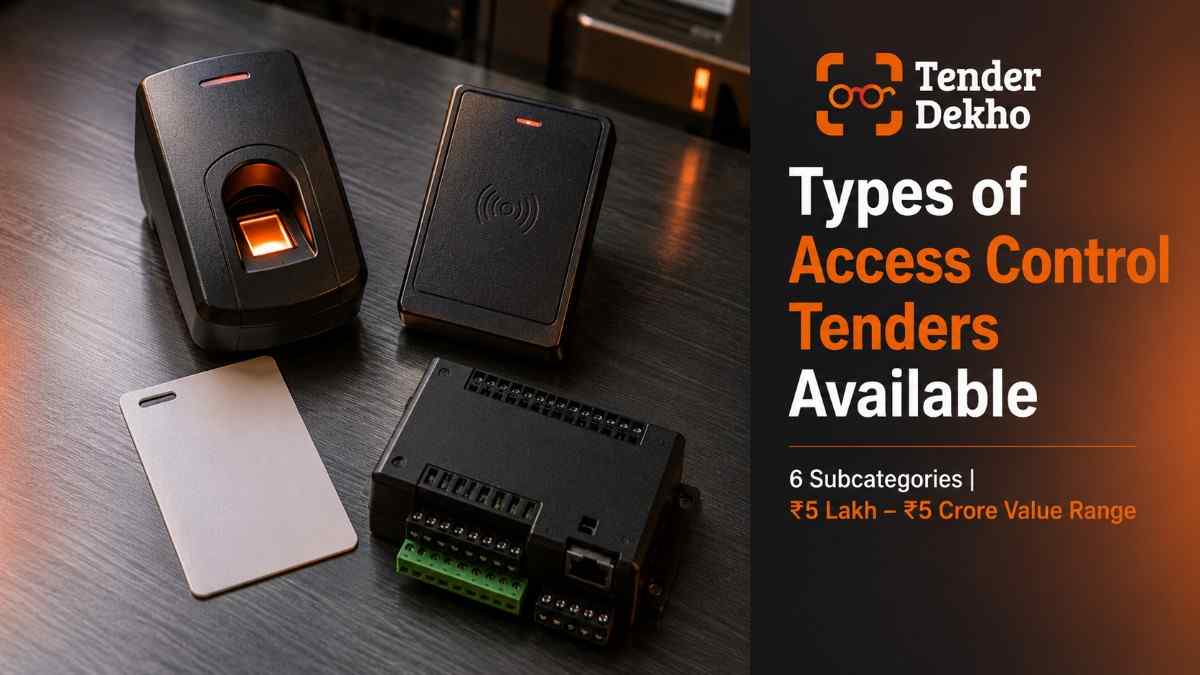
Government access control procurement in India spans several distinct sub-categories. Understanding which type of work your business can deliver is the first step to targeting the right tenders.
Category Comparison
| Type | Est. Market Share | Typical Value | Complexity | Key Buyers |
|---|---|---|---|---|
| Biometric Systems (Fingerprint/Face) | 40% | ₹5–75 lakhs | Medium | Defence, PSUs, Healthcare |
| Card/RFID-Based Systems | 25% | ₹5–50 lakhs | Low–Medium | Govt. Offices, Railways |
| Network Access Control (NAC) | 15% | ₹50 lakhs – ₹5 crores | High | ESIC, IT Depts., UIDAI |
| Integrated Security (CCTV + ACS) | 12% | ₹25 lakhs – ₹3 crores | High | NBCC, Municipalities |
| Boom Barriers & Vehicle ACS | 5% | ₹5–30 lakhs | Medium | Municipalities, PSU plants |
| Maintenance & AMC Contracts | 3% | ₹10–50 lakhs | Low | All sectors |
Biometric Systems — Fingerprint & Face Recognition (40% of Tenders)
Biometric access control is the most commonly procured type across central government and PSU buyers, driven by defence security requirements and smart-building mandates.
What is typically procured:
- Fingerprint scanners with IP/TCP connectivity
- Face recognition terminals with IR anti-spoofing
- Biometric door controllers with relay outputs
- Integration software for HRMS and visitor management
Common specifications:
- Standard: BIS/ISI mark required for electronic components; ISO 27001 for software systems
- Quantity: 3–50 units per tender
- Delivery: 30–90 days after purchase order
Pricing range: ₹8,000–₹1,50,000 per unit depending on technology tier; full turnkey installations ₹5–75 lakhs
Network Access Control (NAC) — Software & IT Infrastructure (15% of Tenders)
NAC tenders are issued by government IT departments, insurance corporations, and centralised agencies to control which devices and users can access sensitive government networks.
What is typically procured:
- NAC appliances for endpoint visibility and policy enforcement
- Software licenses for concurrent users
- Implementation, integration, and 3-year AMC services
Common specifications:
- Standard: ISO 27001 certification mandatory; STQC empanelment preferred
- Quantity: 1 appliance per data centre/office cluster
- Delivery: 45–120 days with phased commissioning
Pricing range: ₹50 lakhs – ₹5 crores for enterprise NAC deployments
Integrated Security Systems — CCTV + Access Control (12% of Tenders)
These are typically construction-linked tenders where the access control system is part of a larger electrical or civil works package — such as fitting out a new government hospital, ministry building, or PSU facility.
What is typically procured:
- Access control panels integrated with IP CCTV
- Flap barriers, turnstiles, and boom barriers at entry points
- UPS for uninterrupted power to security systems
- Fire alarm integration
Pricing range: ₹25 lakhs – ₹3 crores per building or complex
Where the Opportunities Are: State-Wise Distribution
Access control tenders are issued across all Indian states, but procurement volumes are concentrated in a few high-activity regions driven by defence installations, large PSU campuses, and urban health infrastructure.
Top States for Access Control Tenders
| Rank | State | Est. Tender Volume | Key Sectors | Growth Driver |
|---|---|---|---|---|
| 1 | Delhi / NCR | Highest | Defence, PSUs, ESIC, Govt. Offices | Central government headquarters concentration |
| 2 | Rajasthan | High | Indian Air Force, Medical & Health | Defence airbases and district health infrastructure |
| 3 | Maharashtra | High | PSUs, NPCIL, Smart Cities | Mumbai-Pune industrial corridor and Tarapur plant |
| 4 | Karnataka | Medium-High | BEML, ISRO, PSU | Bengaluru's aerospace and IT hub |
| 5 | Andhra Pradesh | Medium | Govt. Offices, Defence | Vizag naval base and Amaravati capital construction |
| 6 | Haryana | Medium | Defence, Industrial | Faridabad PSU belt and Gurgaon government offices |
| 7 | Kerala | Medium | Hospitals, ISRO, Govt. | Thiruvananthapuram space hub and district hospitals |
| 8 | West Bengal | Medium | Defence, Municipalities | North 24 Parganas defence installations |
Regional Highlights
North India (Delhi, Rajasthan, Haryana, UP):
- Delhi dominates with 5 active tenders on TenderDekho (May 2026), including high-value ESIC and NBCC requirements
- Rajasthan accounts for 4 tenders, primarily IAF bases and Medical & Health SITC works in Sawai Madhopur and Jaipur districts
- UP has substantial PSU and railway facilities generating annual access control maintenance contracts
South India (Karnataka, Andhra Pradesh, Kerala, Tamil Nadu):
- Karnataka's BEML (Bengaluru) issued an Integrated Security Surveillance tender worth ₹16,000 EMD in May 2026
- ISRO's Thiruvananthapuram campus regularly procures biometric and card-based systems through GeM
- Andhra Pradesh and Telangana government secretariats are active buyers as part of state modernisation programmes
West India (Maharashtra, Gujarat):
- NPCIL's Surat (Kakrapar) and Tarapur plants drive high-value access control and facility management tenders in Gujarat and Maharashtra respectively
- Mumbai's large central government building stock is managed by NBCC and CPWD, both regular buyers
East India (West Bengal, Odisha):
- Army installations in North 24 Parganas (West Bengal) generate biometric system tenders periodically
- Odisha's rapid industrial expansion through POSCO, NALCO, and state PSUs is increasing security procurement requirements
Access control tenders in Rajasthan — explore the IAF and Health Department opportunities in this high-activity state.
Maharashtra access control tenders — track NPCIL, NBCC, and municipal procurement in the country's largest industrial state.
Delhi access control government tenders — monitor the highest concentration of central government buyers in one location.
How to Participate in Access Control Tenders
Participating in government access control tenders involves a structured process covering business registrations, bid discovery, proposal preparation, and submission. Most tenders in this category are now fully online through GeM or state e-procurement portals.
Phase 1: Registrations & Setup
| Registration | Timeline | Cost | Portal |
|---|---|---|---|
| GST Registration | 7–10 days | Free | gstin.gov.in |
| MSME/Udyam Registration | 1–2 days | Free | udyamregistration.gov.in |
| Digital Signature Certificate (DSC) — Class 3 | 2–3 days | ₹1,000–₹2,000 | Authorised CA |
| GeM Seller Registration | 3–5 days | Free | gem.gov.in |
| CPPP/eProcure Registration | 1–2 days | Free | eprocure.gov.in |
Required certifications for access control tenders:
- ISO 27001 (mandatory for NAC and software-based tenders)
- BIS/ISI mark on electronic hardware (mandatory for some hardware supply tenders)
- OEM Authorization Letter (required when reselling branded biometric or security products)
- STQC empanelment (preferred for cybersecurity-linked systems)
If you are new to government procurement, TenderDekho's GeM seller registration service can guide you through the complete onboarding process, from GSTIN validation to product catalogue listing on GeM.
Phase 2: Finding the Right Tenders
Shortlist checklist:
- Minimum annual turnover requirement met (typically ₹30 lakhs – ₹2 crores depending on tender size)
- Relevant past project experience documented (2–5 similar completed projects)
- Required certifications held (ISO 27001, BIS, OEM authorisation)
- Delivery and installation capacity available within the tender's timeline
- Geography feasible (most tenders require on-site installation and AMC)
Discover matching access control tenders daily: Explore access control tenders on TenderDekho
Key platform features to use:
- Category filter — Narrow to biometric, NAC, or integrated security sub-types
- State filter — Focus on your nearest high-volume regions
- Value filter — Match tenders to your EMD and working capital capacity
- Email alerts — Get notified the moment new access control tenders are published
Phase 3: Bid Preparation
Technical proposal must include:
- Company profile, capability statement, and ISO/BIS certificate copies
- Experience certificates from past 3–5 access control projects (notarised)
- OEM authorisation letter if supplying branded hardware
- Technical specifications compliance sheet mapped to the tender's BOQ
- Team credentials (electronics engineer or security system integrator)
Financial proposal must include:
- Itemised BOQ with unit rates for hardware, installation, cabling, and commissioning
- Bid Security / EMD (typically 2–5% of tender value; MSME bidders may be exempt)
- GST calculation clearly separated
- AMC costs if the tender covers a multi-year maintenance period
Phase 4: Submission Checklist
- Convert all documents to PDF — check portal size limits (usually 5–10 MB per file)
- Apply Class 3 DSC to technical and financial bid files
- Pay the processing fee through the portal's payment gateway (if applicable)
- Submit at least 2–3 hours before the deadline — last-minute uploads regularly fail
- Save the acknowledgment/bid receipt with the portal-generated bid number
- Monitor the portal for pre-bid queries and corrigenda within 24–48 hours of submission
For complex GeM bids requiring reverse auction participation, TenderDekho's GeM bid participation support can help you navigate price negotiation and compliance requirements.
Frequently Asked Questions
Q1. What is the minimum eligibility to participate in access control tenders?
- GST registration and a valid PAN are the baseline requirements for all tenders
- Minimum annual turnover of ₹30 lakhs – ₹1 crore for small-value tenders; ₹1–5 crores for larger system integration tenders
- Past experience in 2–3 similar projects of comparable value (required for tenders above ₹25 lakhs)
- ISO 27001 certification for NAC and network-linked tenders; BIS/ISI mark on supplied hardware where applicable
- OEM authorisation if you are a reseller or integrator rather than a direct manufacturer
Q2. What capital is needed to start bidding?
- EMD/Bid Security: ₹15,000 – ₹1.7 crores (2–5% of tender value; MSME bidders are exempt in many cases)
- Working Capital: ₹5 – 25 lakhs for installation-scale contracts
- Registration Costs: ₹1,000 – ₹5,000 one-time (primarily DSC cost)
Q3. What is the average tender value in this category?
Small SITC tenders for single-building installations range from ₹5–25 lakhs. PSU facility management and enterprise NAC deployments run ₹50 lakhs – ₹5 crores. The live TenderDekho page shows a combined active pipeline of over ₹2.3 crore declared value across 38 current tenders, with many GeM tenders carrying no disclosed value.
Q4. What certifications are mandatory?
- GST registration (all tenders)
- Digital Signature Certificate — Class 3 (all tenders)
- ISO 27001 (NAC, IT security, and network-linked tenders)
- BIS/ISI mark on electronic goods (hardware supply tenders)
- OEM authorisation letter (when supplying branded products)
- MSME/Udyam registration (for EMD exemptions and price preference)
Q5. How do I find tenders specific to my state?
Use TenderDekho's state filter on the category page. For example, Karnataka government tenders covers BEML, ISRO, and municipal requirements in Bengaluru, while the Rajasthan filter captures IAF and Health Department tenders from Jaipur, Sawai Madhopur, and other districts.
Conclusion & 30-Day Action Plan
India's access control tender market is growing at over 12% annually, backed by defence modernisation, PSU security upgrades, and a rapidly expanding GeM procurement platform that surpassed ₹5 lakh crore in FY 2025–26. With 38 active tenders currently listed and new requirements published weekly across defence, healthcare, energy, and smart-city sectors, the opportunity window is open right now. The businesses that invest in registrations and certifications today will be positioned to win contracts within one to two quarters.
Start in 30 Days
Week 1–2: Foundation
- Complete GST, MSME/Udyam, DSC (Class 3), and GeM seller registrations
- Apply for ISO 27001 and obtain OEM authorisation letters for your product lines
- Set up TenderDekho alerts for new listings: access control tenders updated daily
Week 3: Research
- Browse 10–15 active tenders on TenderDekho and download their BOQs
- Study past award patterns — note winning prices, EMD amounts, and qualification criteria
- Identify 3–5 target organisations (IAF, NPCIL, ESIC, state Health Departments) that match your product range
Week 4: First Bid
- Prepare your standard documentation package: company profile, experience certificates, ISO/BIS copies, and a BOQ template
- Submit your first bid on a small-value GeM tender (₹5–25 lakhs) to gain system familiarity
- Track the portal for pre-bid queries and respond within 24 hours
Your next step: View live access control tender listings and identify the right opportunity to enter India's fastest-growing government security procurement market.