
TenderDekho Logo

Tender Insights

122 articles

Infrastructure tenders in India 2026 - top 8 government bids by sector with deadlines
Industry-Specific Opportunities 13 min read

Infrastructure Tenders in India 2026: Top 8 Bids by Sector

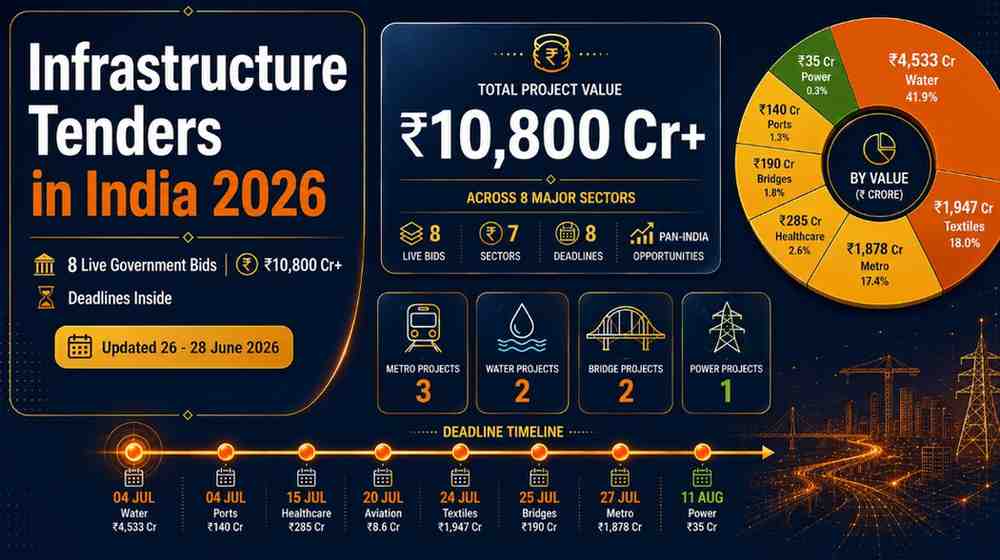
Eight government infrastructure tenders worth over Rs 10,800 crore opened across India in late June 2026, one per major sector, from the Rs 1,947 crore PM MITRA textile park in Lucknow to a Rs 4,533 crore Telangana urban package. India's infrastructure market reached USD 190.51 billion in 2025 (Mordor Intelligence). The key insight: deadlines, not deal size, decide who wins, with the earliest close on 04 July 2026. The actionable takeaway is to shortlist two tenders that match your capability and work backwards from the deadline, using MSME EMD exemption where eligible.

A
Arjun Reddy ·
Read article
More Articles
122 total
Industry-Specific Opportunities 13 min read

Three MoRTH EPC tenders covering the full 168-km Lada–Sarli section of NH-913 (Frontier Highway) completed technical evaluation on 23 June 2026, with financial bids opening 2 July 2026. Combined estimated value is approximately ₹1,126 crore. Of 38 total bid submissions, only 15 qualified technically — with ABCI Infrastructures qualifying in all three stretches. The tenders are part of India's ₹42,000-crore Arunachal Frontier Highway project running 20 km from the China border. This article decodes the results, the qualifying companies, and what to expect next.

Arjun Reddy ·
Read
Industry-Specific Opportunities 11 min read

India's government buyers posted 64,084 new tenders worth ₹1,85,101 crore in the week of June 7–14, 2026 (TenderDekho Weekly Digest), with average value rising to ₹4.40 crore even as volume dipped 1.7%. Civil Works led with 12,847 listings and the lowest competition, while Defence, Power, and Railways drove ministry demand. Uttar Pradesh topped state volume and Maharashtra grew fastest. The ₹12.58–41.35 lakh band offers the best win odds. Complete GST, Udyam, DSC, and GeM registrations, then target low-bidder categories with clean documentation to convert.

TenderDekho ·
Read
Tender Insights 13 min read

GeM reverse auctions accounted for a significant share of the platform's ₹5 lakh crore FY 2025-26 procurement, according to GeM portal data (2025 data). Most sellers lose not on price but on preparation — entering without a floor price, missing decrement rules, or overlooking MSME protections. This guide covers the H1 elimination and 50% RA criteria, how to calculate a profitable floor price, the MSE 15% price band advantage, live auction timing strategy, and a 30-day action plan to improve win rates on India's largest government procurement platform.

Rajesh Kumar ·
Read
Tender Insights 12 min read

GeM recorded ₹5 lakh crore GMV in FY 2025-26 alone, per GeM CEO data (2025-26). For sellers, understanding the difference between Direct Purchase and Custom Bid is essential to winning government contracts. Direct Purchase suits standard catalogue products under ₹5 lakh; Custom Bids open higher-value contracts where buyers define their own specifications. MSMEs with Udyam registration gain EMD exemptions and L1+15% price-matching rights in Custom Bids. This guide explains both routes, compares their rules, and gives sellers a clear action plan.

Rajesh Kumar ·
Read
Tender Insights 12 min read

A comprehensive A-to-Z glossary of government tender terms used in India's procurement process, covering over 45 key terms from NIT and EMD to QCBS and L1 bidder. Based on GFR 2017 (Ministry of Finance) and GeM portal data (2025-26), this guide explains each term in plain language with practical context. Includes MSME-specific benefits terminology, financial deposit timelines, tender type comparisons, and a 4-week action plan for first-time bidders entering India's ₹50-70 lakh crore annual government procurement market.

Rajesh Kumar ·
Read
Tender Insights 12 min read

India operates more than 20 official government procurement portals, spanning national platforms like GeM and CPPP to sector-specific systems for railways, defence, and PSUs, and independent portals for every major state. GeM alone processed ₹5.4 lakh crore in FY 2024–25 according to the Ministry of Commerce (2025 data). This directory maps all 20 portals — their focus, registration requirements, and MSME advantages — so businesses can track the right opportunities without missing tenders across fragmented systems.

Rajesh Kumar ·
Read
Tender Insights 12 min read

Consortium bidding allows two or more businesses to pool their turnover, experience, and technical credentials to qualify for large government tenders that neither could win alone. India's public procurement market is estimated at ₹60–64 lakh crore annually (2025 data), with much of the high-value work in infrastructure, EPC, and IT requiring JV-level credentials. The Supreme Court ruled in December 2025 that JV experience must be considered proportionately in eligibility assessments. This guide covers the legal framework under GFR 2017, step-by-step JV formation, MSME considerations, common disqualification mistakes, and a 30-day action plan.

Rajesh Kumar ·
Read
Tender Insights 12 min read

India's government procurement market exceeds ₹50–70 lakh crore annually, yet thousands of businesses miss contract opportunities simply because they lack a system to track tender deadlines. With GeM crossing ₹5 lakh crore GMV in FY 2025–26 (IBEF, 2026 data), the cost of missing a bid has never been higher. This guide covers how to build a central tracking register, set up multi-channel alerts, monitor corrigendums, and use reverse deadline planning to ensure your team submits bids on time — every time.

Rajesh Kumar ·
Read
Tender Insights 12 min read

GeM OEM panel status gives manufacturers direct access to government procurement across Q1–Q4 product categories. The Vendor Assessment process, now conducted by RITES Ltd. (as of 2025), involves Desktop and Video Assessment and is completed within 15 days of fee payment, with a 3-year certificate validity. With GeM exceeding ₹18.4 lakh crore cumulative GMV per GeM portal data (April 2026), OEM status is a strategic priority for any manufacturer. Udyam-registered MSMEs gain additional advantages including EMD exemption and price preference. This guide covers the complete step-by-step process.

Rajesh Kumar ·
Read
Tender Insights 12 min read

GeM product listing mistakes — wrong category mapping, HSN mismatches, non-compliant images, and unclaimed MSME advantages — are costing thousands of sellers orders on India's largest government procurement platform. With GeM crossing ₹5 lakh crore GMV in FY 2025–26 (IBEF, April 2026) and over 22 lakh sellers competing, a compliant and optimised catalogue is essential. This guide covers eight critical errors and provides a practical 30-day audit plan to fix them.

Rajesh Kumar ·
Read
Best Practice Examples 12 min read

India's two-bid system requires bidders to win two separate evaluations — technical and financial — before a contract is awarded. Around 30% of technical bids are rejected before pricing is even considered, per industry data (2025). This guide explains how technical bid evaluation works under GFR 2017, what QCBS weightage means for service tenders, how L1 pricing strategy should be built, and how MSMEs can use their 15% price preference and EMD exemption to win more bids in 2026.

Sneha Patel ·
Read
Industry-Specific Opportunities 12 min read

Building a government tender track record from scratch is achievable with the right sequence of steps. India's procurement market is worth ₹50–70 lakh crore annually, and GeM alone crossed ₹5 lakh crore in FY 2025–26 with 68% of orders fulfilled by MSMEs (IBEF, 2026 data). New businesses should start with GeM and MSME-reserved tenders where experience conditions are relaxed under GFR 2017, systematically collect completion certificates, and scale bid size as credentials grow. Subcontracting and JV arrangements offer additional entry routes.

Rajesh Kumar ·
Read

Page 1 of 10 · 122 articles

12