
Ambulance Tenders in India 2026: Market Opportunities, Key Buyers & How to Win
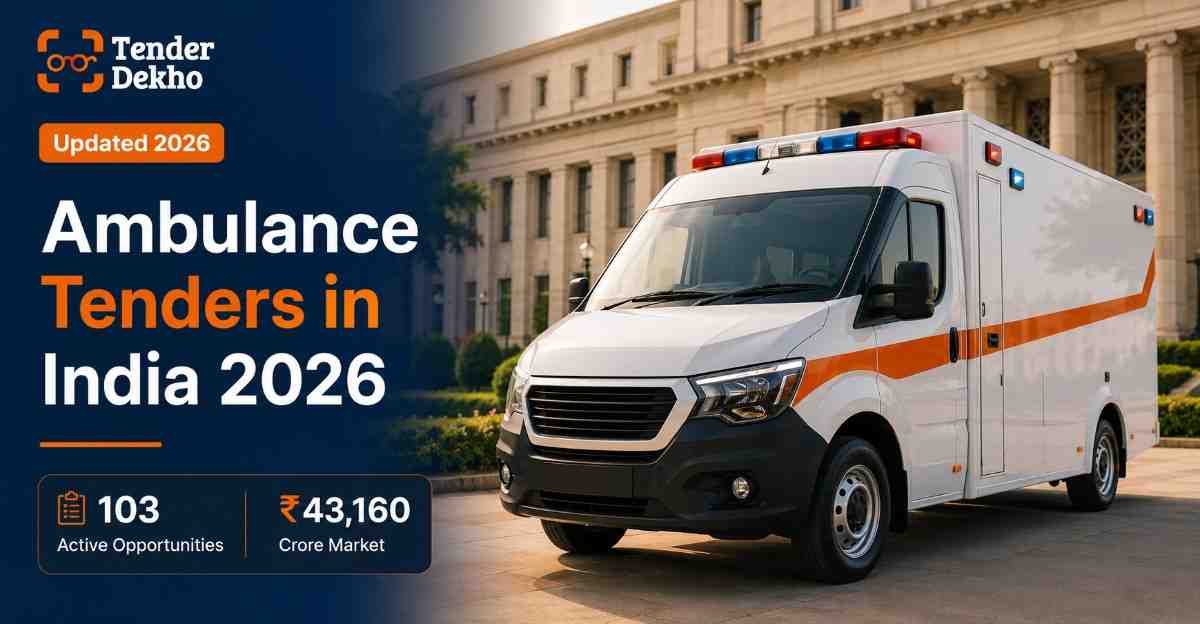
India's ambulance services sector is one of the fastest-expanding segments in government healthcare procurement, with more than 103 active tender opportunities currently listed across the country. Government departments — from the Indian Army to state health ministries and major PSUs — spend hundreds of crores every year on ambulance procurement, hiring, and fleet operations. This guide covers the full landscape: market size, who issues tenders, what types of contracts are available, where the best regional opportunities lie, and exactly how to participate and win.
Market Snapshot
| Indicator | Data | Source |
|---|---|---|
| Market Size (Services) | USD 5.20 Billion ≈ ₹43,160 crores (2024) | IMARC Group (2025 data) |
| Growth Rate | 6.40% CAGR (2025–2033) | IMARC Group (2025 data) |
| Active Tenders | 103+ (as of May 2026) | TenderDekho |
| Combined Tender Value | ₹4.5 crores (current listings) | TenderDekho |
| Top Issuing Buyer | Indian Army | TenderDekho |
| Key Portals | GeM (85%), eProcure (14%) | TenderDekho (2025 data) |
This guide covers everything you need to discover, evaluate, and bid for government ambulance tenders in India.
Browse active ambulance tenders updated daily across all procurement portals.
Market Overview & Growth Potential
Current Landscape
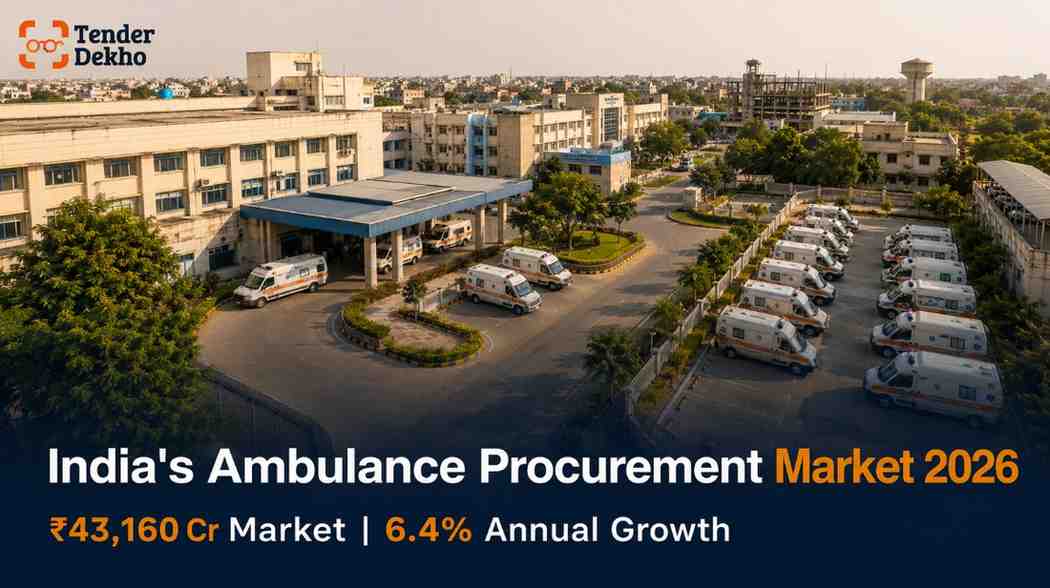
India's ambulance services market reached USD 5.20 billion (approximately ₹43,160 crores) in 2024, according to IMARC Group (2025 data), and is forecast to grow at a 6.40% CAGR through 2033. The market is propelled by rising road accident rates, an ageing population, and the government's sustained push to expand emergency medical services under the National Health Mission. With cardiovascular diseases alone accounting for nearly one-quarter of all deaths in India, the pressure on emergency response infrastructure has never been higher — and procurement tenders are the primary route for private operators and suppliers to enter this ecosystem.
Key Growth Drivers
1. National Health Mission & 108/102 Programmes
- What it means: Union and state governments fund free emergency ambulance services under NHM, creating continuous fleet-replacement and service-hiring demand.
- Data point: Maharashtra alone doubled its 108 ambulance fleet to 1,756 vehicles as part of the MEMS project, with capital expenditure of approximately ₹870 crores for fleet procurement (2024 data, Business Standard).
2. Rising Road Accidents and Chronic Disease Burden
- What it means: India records over 4.6 lakh road accidents annually, each requiring rapid emergency medical response — a direct driver of ambulance service demand.
- Data point: According to IMARC Group (2025 data), increasing rates of cardiovascular disease, diabetes, and respiratory conditions are pushing government agencies to strengthen pre-hospital care through ALS and BLS fleet expansion.
3. PSU and Defence Fleet Modernisation
- What it means: Public sector undertakings — coal companies, railways, defence establishments, and steel plants — are legally required to maintain on-site emergency response capacity, generating recurring annual service contracts.
- Data point: Indian Army currently tops the TenderDekho ambulance category with 12 active tenders, reflecting ongoing fleet and service modernisation across military cantonments (TenderDekho live data, May 2026).
4. Technology Integration in Emergency Services
- What it means: GPS tracking, telemedicine integration, and AI-powered dispatch systems are driving upgrades in ambulance fleets, requiring specialised procurement.
- Data point: Maharashtra's MEMS 108 project integrates real-time GPS-GPRS monitoring and international clinical standards, setting a benchmark that other state programmes are expected to follow (Business Standard, 2024 data).
Year-on-Year Market Projection
| Year | Market Size (USD Billion) | Market Size (₹ Crores est.) | YoY Growth |
|---|---|---|---|
| 2023 | 4.88 | ~40,504 | — |
| 2024 | 5.20 | ~43,160 | 6.6% |
| 2026 (Est.) | 5.89 | ~48,887 | 6.4% |
| 2028 (Proj.) | 6.67 | ~55,361 | 6.4% |
| 2033 (Proj.) | 9.70 | ~80,510 | 6.4% |
Source: IMARC Group, India Ambulance Services Market Report (2025 data). ₹ conversion at ₹83/USD (estimated).
This sustained growth trajectory means government tender volumes are set to increase significantly through the end of the decade, with PSU and defence procurement running in parallel with state health department contracts.
Major Tender-Issuing Organizations
Ambulance tenders in India are issued by a wide range of government buyers — from central ministries to state health bodies, defence establishments, railways, and PSUs. Understanding the buyer landscape helps vendors target the right opportunities efficiently.
Top Departments & Organizations
| Rank | Organization | Sector | Est. Active Tenders | Typical Value |
|---|---|---|---|---|
| 1 | Indian Army | Defence | 12 | ₹50 lakhs–₹1.5 crores |
| 2 | South Eastern Railway | Railways | 7 | ₹10–₹75 lakhs |
| 3 | Mahanadi Coalfields Ltd | PSU / Mining | 3–5 | ₹70–₹90 lakhs |
| 4 | NTPC Limited | PSU / Energy | 3–5 | ₹30–₹60 lakhs |
| 5 | Eastern Coalfields Ltd | PSU / Mining | 2–4 | ₹60 lakhs–₹1.5 crores |
| 6 | Central Railway / Northern Railway | Railways | 2–4 | ₹7–₹20 lakhs |
| 7 | ESIC (Employees' State Insurance) | Healthcare | 2–3 | ₹15–₹40 lakhs |
| 8 | State Health & Family Welfare Depts | Healthcare | Ongoing | ₹25 lakhs–₹10 crores |
1. Indian Army
- Procures short-term event-based and monthly ambulance services across cantonments in Haryana, Assam, Jammu & Kashmir, and other military zones.
- Requires Type B (Patient Transport) and Type C (Basic Life Support) ambulances with trained paramedic staff.
- Recent example: Indian Army, Kamrup, Assam — Type C BLS ambulance service + vehicle hiring, ₹1.0 crore, May 2026 (GEM/2026 series).
2. South Eastern Railway
- Regularly procures monthly all-inclusive ambulance services at railway hospitals and divisional offices.
- Focus on BLS and ALS-type vehicles under GeM service categories.
- Portal: gem.gov.in
3. Mahanadi Coalfields Limited
- Issues recurring monthly ambulance contracts for plant sites in Odisha (Angul, Sundargarh districts).
- Typical specification: Type C BLS Single Stretcher Premium Van, Tata Winger 3200/3400 or Force Traveler.
- Recent examples: Two concurrent tenders at ₹75.4 lakhs and ₹70.1 lakhs, Angul, Odisha, May 2026.
All these buyers and more publish tenders daily. Explore ambulance government tenders on TenderDekho to monitor opportunities from all major procurement portals in one place.
Types of Ambulance Tenders
Ambulance tenders in India span four primary categories — from simple patient transport vehicles to advanced life support units with critical care equipment. Knowing which category fits your fleet and capabilities narrows your bid focus and improves win rates.
Category Comparison
| Type | Approx. Share | Typical Contract Value | Complexity | Key Buyers |
|---|---|---|---|---|
| Type B — Patient Transport Vehicle | ~25% | ₹5–₹20 lakhs/month | Low | Railways, PSUs, hospitals |
| Type C — Basic Life Support (BLS) | ~45% | ₹15–₹90 lakhs | Medium | Defence, Coalfields, NTPC |
| Type D — Advanced Life Support (ALS) | ~20% | ₹30 lakhs–₹1.5 crores | High | State health depts, ESIC |
| Fleet Supply / Ambulance Purchase | ~10% | ₹25 lakhs–₹5 crores | Medium–High | Municipal corps, NHM |
Type B — Patient Transport Vehicle (~25% of Tenders)
What's typically procured:
- Monthly all-inclusive service with driver and assistant
- Multi-stretcher or single-stretcher regular vans (Maruti Suzuki Eeco, Mahindra Maxx, similar)
- Short-distance inter-facility patient transfer
Common specifications:
- Standard: AIS-125 compliant vehicle; basic first-aid kit; foldable stretcher with trolley mechanism
- Staffing: Driver + assistant minimum
- Contract period: 1–2 years, renewable
Pricing range: ₹7 lakhs – ₹20 lakhs per contract (monthly service contracts)
Type C — Basic Life Support (BLS) (~45% of Tenders)
What's typically procured:
- Monthly all-inclusive service (fuel included or excluding fuel reimbursement)
- Premium single-stretcher vans: Tata Winger Ambulance 3200/3400, Force Traveler Ambulance
- Trained paramedic, assistant, and driver
Common specifications:
- Standard: BLS equipment — oxygen cylinder, suction pump, pulse oximeter, AED, emergency medications
- Staffing: Qualified EMT/paramedic with BLS certification mandatory
- Contract period: Typically 1–3 years, with rate contracts common for PSUs
Pricing range: ₹15 lakhs – ₹90 lakhs per contract
Type D — Advanced Life Support (ALS) (~20% of Tenders)
What's typically procured:
- ALS vehicles with ventilators, defibrillators, cardiac monitors, and IV equipment
- Critical care ambulances for hospitals, ESIC centres, and state EMS schemes
- Often Tata Winger Ambulance or Force Traveler with upgraded medical bay
Common specifications:
- Standard: Biphasic defibrillator, transport ventilator, syringe pumps, full drug kit
- Staffing: Qualified medical officer or senior paramedic (Diploma in Pharmacology or equivalent)
- AAA/TRTL compliance required for some coal/PSU tenders
Pricing range: ₹30 lakhs – ₹1.5 crores per contract
Where the Opportunities Are: State-Wise Distribution
Ambulance tender activity is concentrated in states with large industrial workforces, major railway divisions, and active state EMS schemes. Maharashtra leads in sheer procurement scale; Odisha and Assam generate significant PSU-driven volumes.
Top States for Ambulance Tenders
| Rank | State | Active Tenders (TenderDekho) | Key Sectors | Growth Driver |
|---|---|---|---|---|
| 1 | Maharashtra | 14 | State EMS, Municipal Corps, Defence | MEMS 108 project; ₹800 crore annual opex |
| 2 | Gujarat | 7 | PSU, Industrial, Defence | Port & SEZ infrastructure; Ahmedabad ESIC |
| 3 | Odisha | 6 | Coal PSUs, Railways, Health | Mahanadi Coalfields, South Eastern Railway |
| 4 | Tamil Nadu | 6 | State EMS, ESIC, Railways | Expanding urban healthcare; Chennai hospitals |
| 5 | Assam | 5 | Defence, Railways, Health | Indian Army cantonments; NHM rural expansion |
| 6 | Jharkhand | 4 | Coal PSUs | Eastern Coalfields, NTPC Hazaribagh |
| 7 | Andhra Pradesh | 3 | PSU, Port, Health | HPCL Visakhapatnam; ESIC |
| 8 | Haryana | 3 | Defence, ESIC | Indian Army Hisar cantonment |
Regional Highlights
North India:
- Haryana accounts for significant Indian Army ambulance hiring (Hisar, Ambala cantonments).
- Uttar Pradesh state health departments run 108 and 102 ambulance programmes with recurring tenders for BLS and patient transport services.
- Browse UP ambulance tenders to track opportunities from SAMS, NHM, and district hospitals.
South India:
- Tamil Nadu's state government actively procures BLS and ALS ambulances through NHM and ESIC.
- Andhra Pradesh generates demand from the HPCL Visakhapatnam refinery complex and state health mission.
- Karnataka's Health Department is taking over 108 ambulance services management, signalling upcoming fleet contracts and service hiring tenders.
- Find ambulance tenders in Maharashtra and neighbouring states for high-value opportunities.
West India:
- Maharashtra is the dominant market, with the MEMS 108 project (₹870 crores fleet capex, 1,756 ambulances) setting the national benchmark (Business Standard, 2024 data).
- Gujarat PSU and port-area tenders appear regularly on GeM, particularly from Ahmedabad and Surat industrial zones.
East India:
- Odisha leads in PSU-driven ambulance procurement, with Mahanadi Coalfields and South Eastern Railway publishing the highest volumes.
- Jharkhand's Eastern Coalfields Limited issues large annual service contracts (₹1.2 crore+) from Godda and Dhanbad districts.
- Explore Odisha ambulance tender listings for coal sector and railway procurement.
How to Participate in Ambulance Tenders
Government ambulance tenders follow a structured bidding process across GeM, eProcure, and state portals. Over 85% of active ambulance tenders on TenderDekho originate from GeM, making GeM registration the single most important prerequisite.
Phase 1: Registrations & Setup
| Registration | Timeline | Cost | Portal |
|---|---|---|---|
| GST Registration | 7–10 days | Free | gstin.gov.in |
| MSME/Udyam Registration | 1–2 days | Free | udyamregistration.gov.in |
| Digital Signature Certificate (DSC) Class 3 | 2–3 days | ₹1,000–₹2,000 | Authorised CA |
| GeM Seller Registration | 3–5 days | Free | gem.gov.in |
| eProcure/CPPP Registration | 1–2 days | Free | eprocure.gov.in |
| Vehicle RC + Commercial Permit for Ambulance | 15–30 days | Varies by state | RTO |
Required qualifications for this category:
- Minimum 2 years of experience in providing ambulance services to hospitals or government organisations (experience certificates required)
- Valid commercial driving licence for ambulance drivers
- Paramedic staff with BLS/ALS certification as per National Ambulance Code (AIS-125)
- Minimum average annual turnover of ₹5 lakhs or more for the last 3 financial years (varies by tender; larger contracts require proportionally higher turnover)
If you are new to government procurement, TenderDekho's GeM seller registration service can guide you through the full setup process, including service catalogue listing for ambulance hiring categories.
Phase 2: Finding the Right Tenders
Shortlist checklist:
- Minimum turnover requirement met (typically 2.5x the contract value for service tenders)
- Relevant 2-year experience in ambulance services documented with certificates
- BLS/ALS certification held by on-roll paramedic staff
- Ambulance vehicle RC and commercial permit valid and in your firm's name
- Delivery/service geography feasible (check cantonment or plant location)
- EMD (Earnest Money Deposit) amount available in liquid funds
Discover matching ambulance tenders daily: Find ambulance government tenders using state, value, and organisation filters to focus on opportunities that match your capacity.
Key platform features:
- State filter — Focus on high-volume states: Maharashtra, Odisha, Gujarat, Tamil Nadu, Assam
- Value filter — Match to your working capital and EMD capacity
- Organisation filter — Track Indian Army, South Eastern Railway, Coalfields, or specific PSUs
- Email alerts — Get notified the moment new ambulance tenders are published
Phase 3: Bid Preparation
Technical proposal must include:
- Company profile with details of ambulance fleet and capacity
- Experience certificates from hospitals or government organisations (minimum 2 years, notarised)
- Vehicle RC copies and commercial permit documents
- Staff credentials — driver's licence, paramedic BLS/ALS certificates
- Compliance statement against AIS-125 specifications
- GPS tracking system confirmation (mandatory in most contracts)
Financial proposal must include:
- Monthly service rate (inclusive/exclusive of fuel as specified)
- EMD: typically 2–5% of annual contract value (e.g. ₹14,506–₹1,00,000 for contracts from ₹7 lakhs to ₹1.2 crores)
- GST calculations at applicable rate
- Rate for excess kilometres if monthly mileage is exceeded
Phase 4: Submission Checklist
- Convert all documents to PDF — most portals have a 5–10 MB per-file limit
- Apply Class 3 DSC to bid submission on GeM or eProcure portal
- Pay EMD online before the bid deadline — late EMD disqualifies the bid
- Submit 2–3 hours before deadline — last-minute submissions risk portal timeouts
- Save the acknowledgment receipt and bid reference number for tracking
- Monitor portal for queries within 48 hours of submission — buyers often ask for clarifications
For end-to-end support with bid preparation and submission, TenderDekho's GeM bid participation service provides expert assistance through the entire process.
Frequently Asked Questions
Q1. What is the minimum eligibility to participate in ambulance tenders?
- Registered company or proprietorship with valid GST
- Minimum 2 years of experience in providing ambulance services (certificates from hospitals/government organisations)
- Average annual turnover of ₹5 lakhs or more for last 3 years (higher for large contracts)
- Valid ambulance vehicle RC and commercial permit
- BLS/ALS-certified paramedic staff on roll
Q2. What capital is needed to start bidding?
- EMD / Bid Security: ₹14,500 – ₹1,00,000 (2–5% of annual contract value)
- Working Capital: ₹3–₹10 lakhs for monthly service contracts (fuel, staff salaries, vehicle maintenance)
- Registration Costs: ₹2,000–₹5,000 (DSC + minor portal fees)
Q3. What is the average tender value in this category?
Tender values range widely by contract type. Monthly BLS service contracts typically run ₹10–₹90 lakhs per year. Annual ALS contracts range from ₹30 lakhs to ₹1.5 crores. Large fleet procurement or PPP EMS projects (like state 108 schemes) can run ₹100 crores or more. The combined value of the 103 currently active tenders on TenderDekho is approximately ₹4.5 crores for the immediate listings.
Q4. What certifications are mandatory?
- National Ambulance Code (AIS-125) compliance for vehicle type
- GST Registration
- MSME/Udyam (optional but gives EMD exemption benefit)
- BLS/ALS certification for paramedic staff
- AAA/TRTL standards compliance for coal PSU tenders
- ISO 9001 (preferred for large state EMS contracts)
Q5. How do I find tenders specific to my state?
Use the state filter on TenderDekho to narrow results by geography. For Odisha-based operators, ambulance tenders across Odisha are particularly active due to Mahanadi Coalfields and South Eastern Railway volumes. Maharashtra-based operators can track the substantial municipal and state health department pipeline.
Conclusion & 30-Day Action Plan
Ambulance tenders represent one of the most consistent procurement opportunities in India's government market. With 103 active listings today, a combined market growing at 6.40% annually through 2033 (IMARC Group, 2025 data), and demand driven by defence, PSUs, railways, and state health programmes simultaneously, qualified operators have a strong and diversified pipeline to build upon. GeM dominates the portal landscape (85% of active tenders), making digital readiness the single biggest differentiator for new entrants.
Start in 30 Days
Week 1–2: Foundation
- Complete GST, MSME/Udyam, DSC, and GeM registrations
- Ensure ambulance vehicle RC and commercial permit are current
- Verify paramedic staff hold valid BLS/ALS certifications
- Set up TenderDekho alerts: ambulance tenders updated daily
Week 3: Research
- Browse 10–15 active ambulance tenders in your target states
- Study past award patterns — compare winning rates for BLS vs ALS contracts
- Identify 3–5 target organisations (Indian Army, Railways, Coalfields, or State Health)
- Download and review tender documents to understand exact EMD and experience requirements
Week 4: First Bid
- Prepare company profile, experience certificates, and vehicle documentation templates
- Submit your first bid with complete technical and financial proposal
- Track the portal for queries and respond within 24 hours
- Build a document folder with all standard certificates ready for reuse
Your next step: View live ambulance tender listings and identify the opportunities that match your geography, fleet type, and capacity today.