
Infrastructure Work Tenders in India 2026: Market Opportunities, Key Buyers & How to Win
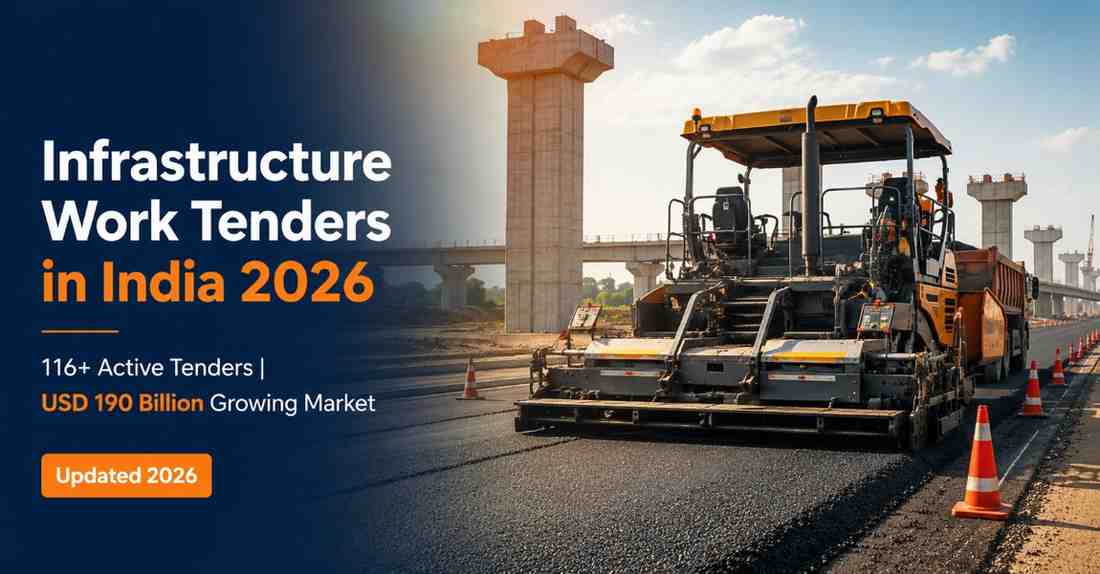
India's infrastructure sector is in the midst of a historic spending boom, and government tenders are at the centre of it. The construction and infrastructure market reached ₹5.31 lakh crore in 2025 — a year-on-year surge of over 11% — and is forecast to sustain a CAGR of 8–8.8% through 2029, according to Construction Week India (2025 data). For civil contractors, infrastructure firms, and MSMEs, this translates into a steady flow of government procurement opportunities spanning roads, culverts, urban structures, drainage systems, and rural connectivity works.
Market Snapshot
| Indicator | Data | Source |
|---|---|---|
| Market Size | ₹5.31 lakh crore (2025) | Construction Week India |
| Growth Rate | 8–8.8% CAGR (2025–2029) | Mordor Intelligence, 2026 |
| Active Tenders | 117+ (as of May 2026) | TenderDekho |
| Avg. EMD Range | ₹1K–₹28.8 lakh | TenderDekho category data |
| Top Issuing Dept. | MP Rural Road Development Authority | TenderDekho, May 2026 |
This guide covers the market landscape, key buyers, tender types, regional distribution, and a step-by-step participation roadmap for infrastructure work tenders in India.
Browse active infrastructure work tenders updated daily from government procurement portals across all states.
Market Overview & Growth Potential

Current Landscape
India's infrastructure and construction sector is being propelled by front-loaded government capital expenditure, with public funding contributing roughly 63% of total outlays (Construction Week India, 2025 data). The Union Budget 2025-26 allocated a record ₹2.65 lakh crore for Indian Railways alone, while NHAI surpassed its FY26 highway construction target — completing 5,313 km — supported by ₹2.44 lakh crore in capital expenditure (IBEF, 2025 data). Concurrently, the PM Gati Shakti portal has cut inter-ministerial clearance times for logistics parks from 18 to 9 months, directly accelerating the pace of tendering, according to Mordor Intelligence (January 2026).
Key Growth Drivers
1. National Infrastructure Pipeline (NIP)
- What it means: The NIP spans 9,142 projects across 34 sub-sectors with an estimated investment of USD 1.9 trillion.
- Data point: Capital investment outlay for infrastructure increased 33% in Budget 2023-24 to ₹10 lakh crore, reflecting a 38.8% cumulative growth in capex over the past five years (IBEF, 2025 data).
2. Highway & Rural Road Expansion
- What it means: India's National Highways network reached 1,46,342 km in FY25, and the government announced ₹11 lakh crore to build 17,000 km of high-speed expressways by 2033.
- Data point: NHAI invited bids for 52 highway projects in a single financial year (FY26), maintaining one of the highest tendering velocities globally (IBEF, November 2025).
3. Urban Infrastructure & Smart Cities
- What it means: AMRUT 2.0, Smart Cities Mission, and metro corridor expansions are generating sustained demand for civil infrastructure works in Tier 1 and Tier 2 cities.
- Data point: 94% of 8,067 Smart Cities Mission projects have been completed with investment exceeding ₹47,652 crore (IBEF, June 2025).
4. Sovereign Green Bonds & Metro Investments
- What it means: Two sovereign green bond tranches totalling USD 4 billion are lowering borrowing costs for clean-transport infrastructure, expanding metro and EV charging projects.
- Data point: The Union Cabinet approved Phase II of the Pune Metro Rail Project at ₹9,857 crore in November 2025 (IBEF, 2025 data).
Year-on-Year Market Projection
| Year | Market Size (₹ Lakh Crore) | YoY Growth |
|---|---|---|
| 2023 | 4.10 (est.) | — |
| 2024 | 4.78 | 8.5% |
| 2025 | 5.31 | 11.1% |
| 2027 (Proj.) | 6.20 | 8.0% |
| 2029 (Proj.) | 7.25+ | 8.8% |
Source: Construction Week India / Mordor Intelligence, 2025–2026 data
The sustained pipeline of capital spending across roads, bridges, culverts, urban drainage, and rural connectivity ensures that infrastructure work tenders will remain among the most active procurement categories through the end of the decade.
Major Tender-Issuing Organizations
Infrastructure work tenders in India are issued by a wide spectrum of central and state agencies, rural authorities, and urban bodies. Understanding who issues these tenders helps contractors focus their business development efforts on the most active buyers.
Top Departments & Organizations
| Rank | Organization | Sector | Est. Annual Tenders | Avg. Value |
|---|---|---|---|---|
| 1 | MP Rural Road Development Authority | Rural Roads | 100–150 | ₹15–50 lakhs |
| 2 | Roads & Buildings Department (State) | State Highways | 80–120 | ₹30–200 lakhs |
| 3 | Narmada Water Resources (Gujarat) | Irrigation/Civil | 60–90 | ₹10–80 lakhs |
| 4 | National Highways Authority of India (NHAI) | National Highways | 50–80 (high value) | ₹5–500 crore |
| 5 | Central Public Works Department (CPWD) | Government Buildings | 40–70 | ₹20–300 lakhs |
| 6 | Municipal Corporations & ULBs | Urban Infrastructure | 200+ | ₹5–50 lakhs |
| 7 | Indian Railways (IREPS) | Rail Infrastructure | 60–100 | ₹50 lakhs–10 crore |
1. Madhya Pradesh Rural Road Development Authority (MPRRDA)
- Focus: Construction and maintenance of rural roads, culverts, bridges, and drainage structures under PMGSY and state rural schemes
- Active example: Construction of infrastructure works at Ksipra Vihar and Triveni Vihar, Ujjain — ₹21.1 crore (EPROCURE-MP, April 2026)
- Portal: eprocure.gov.in / MP state eProcurement
2. Roads & Buildings Department (State Governments)
- Focus: State highway widening, bridge repairs, box culverts, retaining walls, and flood protection structures
- Active example: Package of box culverts on Karjan-Amod Road, Vadodara — ₹4.2 crore (NPROCURE-Gujarat, May 2026)
- Portal: nprocure.com / state R&B portals
3. Narmada Water Resources, Water Supply & Kalpsar Department (Gujarat)
- Focus: Canal infrastructure, RCC box culverts, sluice gates, and irrigation civil works
- Active example: RCC Box Culvert, Navsari Division — ₹7.8 lakh (NPROCURE, May 2026)
- Portal: nprocure.com
TenderDekho consolidates active listings from all these buyers on a single platform, saving contractors hours of portal monitoring.
Explore infrastructure work tenders on TenderDekho to discover opportunities from all major buyers in one place.
Types of Infrastructure Work Tenders
Infrastructure work tenders in India span a broad range of civil engineering activities. Understanding the sub-categories helps bidders focus on work that matches their equipment, experience, and financial capacity.
Category Comparison
| Type | Market Share (Est.) | Typical Value | Complexity | Key Buyers |
|---|---|---|---|---|
| Road Construction & Widening | 35% | ₹50 lakhs–50 crore | High | NHAI, PWD, MPRRDA |
| Bridges, Culverts & Cross-Drainage | 25% | ₹5–500 lakhs | Medium-High | R&B, MPRRDA, NHAI |
| Urban Civil & Storm-water Drainage | 15% | ₹5–100 lakhs | Medium | Municipal Corps, CPWD |
| Irrigation & Water Resource Structures | 15% | ₹10–200 lakhs | Medium | Narmada Dept, Irrigation Depts |
| Rural Connectivity (PMGSY/MMGSY) | 10% | ₹10–100 lakhs | Low-Medium | Rural Development Dept |
Road Construction & Widening (35% of Tenders)
What's typically procured:
- Four-laning and strengthening of state highways
- Expressway package civil works (earthwork, sub-base, pavement)
- Overlay and pavement rehabilitation on district roads
Common specifications:
- Standard: IRC:37 (flexible pavements), IRC:58 (rigid pavements)
- Quantity: 5–100 km packages
- Delivery: 12–36 months
Pricing range: ₹1 crore – ₹100 crore per package
Bridges, Culverts & Cross-Drainage (25% of Tenders)
What's typically procured:
- RCC box culverts on rural roads and state highways
- Minor bridge construction at river crossings
- Gabion walls and protection works
Common specifications:
- Standard: IRC:21 (concrete bridges), IS:456 for RCC work
- Quantity: Single structure to multi-package lots
- Delivery: 4–12 months
Pricing range: ₹5 lakhs – ₹5 crore per structure
Urban Civil & Drainage Works (15% of Tenders)
What's typically procured:
- Storm-water drains and nala improvements
- Road-side drain construction in municipal limits
- Urban road repairs and footpath development
Common specifications:
- Standard: Local ULB/CPWD schedules of rates
- Quantity: 50 metres – 5 km packages
- Delivery: 3–12 months
Pricing range: ₹5 lakhs – ₹2 crore per package
For a complete view of active opportunities across all sub-types, find infrastructure work government tenders filtered by state, value, and deadline.
Where the Opportunities Are: State-Wise Distribution
Infrastructure work tenders are concentrated in states with the highest capital expenditure on rural road programmes, irrigation infrastructure, and urban development. Based on live TenderDekho data (May 2026), Madhya Pradesh dominates with 50 active tenders in this category, followed by Gujarat at 25.
Top States for Infrastructure Work Tenders
| Rank | State | Est. Tender Volume | Key Sectors | Growth Driver |
|---|---|---|---|---|
| 1 | Madhya Pradesh | 50 tenders (active) | Rural roads, culverts, urban infra | PMGSY, CM Rise Schools, Smart Cities |
| 2 | Gujarat | 25 tenders (active) | Irrigation civil works, culverts | MMGSY, Narmada canal works |
| 3 | Karnataka | 10 tenders (active) | State highways, culverts | KRDCL, EPROCURE-Karnataka |
| 4 | Uttar Pradesh | 10 tenders (active) | Expressways, urban roads | UPEIDA, UP Jal Nigam |
| 5 | Punjab | 5 tenders (active) | Mandi infrastructure, roads | MARKFED, PWD |
Regional Highlights
North India:
- Uttar Pradesh leads in high-value expressway civil packages (₹100 crore+ range) through UPEIDA
- Punjab has active mandi and rural infrastructure packages under special assistance schemes
- Delhi and Haryana continue CPWD-driven institutional and urban road works
West India:
- Gujarat is the second-most active state, with MMGSY culvert packages across Vadodara, Dahod, and Navsari districts
- Maharashtra is generating large metro viaduct and road packages in the Mumbai Metropolitan Region
Central India:
- Madhya Pradesh leads the category with MPRRDA as the single largest issuing authority, anchoring rural road and village connectivity works
- Infrastructure work tenders in Madhya Pradesh cover Barwani, Chhindwara, Ujjain, and other high-investment districts
South India:
- Karnataka is active via EPROCURE with box culvert and rural connectivity works
- Tamil Nadu and Andhra Pradesh are generating infrastructure demand around industrial corridors and port hinterland roads
- Browse Gujarat infrastructure work tenders for the densest concentration of culvert and irrigation civil packages
How to Participate in Infrastructure Work Tenders

Participating in infrastructure work tenders requires upfront registrations, the right certifications, and a disciplined bid preparation process. The process can be broken into four phases.
Phase 1: Registrations & Setup
| Registration | Timeline | Cost | Portal |
|---|---|---|---|
| GST Registration | 7–10 days | Free | gstin.gov.in |
| MSME/Udyam Registration | 1–2 days | Free | udyamregistration.gov.in |
| Digital Signature Certificate (DSC Class-3) | 2–3 days | ₹1,000–₹2,000 | Authorised CA |
| GeM Seller Registration | 3–5 days | Free | gem.gov.in |
| CPWD Contractor Enlistment | 15–30 days | ₹500–₹5,000 | cpwd.gov.in |
| State PWD Contractor Registration | 15–30 days | Varies | State PWD portal |
Required certifications for infrastructure work tenders:
- GST Registration (mandatory for all tenders above ₹20 lakh)
- MSME/Udyam certificate (enables EMD exemption and price preference)
- PAN Card and valid IT return filings (last 3 years)
- Experience certificates for similar civil works (past 3–5 years)
- ISO 9001:2015 certification (required for higher-value PWD and CPWD tenders)
For businesses new to government procurement, TenderDekho's GeM seller registration service can guide you through the full GeM onboarding process, including product catalogue listing and seller verification.
Phase 2: Finding the Right Tenders
Shortlist checklist:
- Annual turnover meets minimum requirement (typically 30–50% of tender value as average of last 3 years)
- Similar work experience: usually 1 similar work ≥ 80% of tender value, or 2 works ≥ 60% each, in the last 5–7 years
- Required certifications held and valid
- Equipment capacity available (earthmoving, concrete batching, compaction)
- EMD/bid security capital available (2–5% of tender value)
- Geography feasible for site access and material supply
Discover infrastructure work tender opportunities matched to your state, capacity, and bid value range.
Key platform features for efficient shortlisting:
- State filter — Focus on high-volume states like MP, Gujarat, Karnataka
- Value filter — Match EMD requirement to available working capital
- Tender history — Benchmark past award prices per running meter or cubic meter
- Email alerts — Get notified instantly when new tenders match your profile
Phase 3: Bid Preparation
Technical proposal must include:
- Company profile and capability statement (plant, equipment, workforce)
- Experience certificates for similar works (notarised, counter-signed by issuing authority)
- Technical specification compliance sheet (IRC/IS standard references)
- QA/QC plan and site organisation chart
Financial proposal must include:
- Itemised Bill of Quantities (BOQ) with unit rates in the format prescribed
- Bid security / EMD (2–5% of tender value, via BG or NEFT for online portals)
- GST calculations clearly separated
- Payment milestone schedule matching contract conditions
Phase 4: Submission Checklist
- Convert all documents to PDF — check portal size limits (usually 5–25 MB per file)
- Apply Class-3 DSC to all digitally submitted bid documents
- Pay processing/tender fee via portal (₹500–₹5,000 for most infrastructure tenders)
- Submit at least 2–3 hours before deadline — never submit in the final hour
- Save e-acknowledgment receipt from portal immediately after submission
- Monitor portal for pre-bid queries — respond or attend pre-bid meetings within 24–48 hours
For end-to-end bid support including document preparation and portal submission, TenderDekho's GeM bid participation service assists contractors at every stage of the process.
Frequently Asked Questions
Q1. What is the minimum eligibility to participate in infrastructure work tenders?
- Valid GST registration and PAN
- MSME/Udyam certificate (strongly recommended for EMD exemption)
- Average annual turnover of 30–50% of tender value over last 3 financial years
- Experience of at least 1 similar civil/infrastructure work of 80% of the tender value completed in the last 5–7 years
- Class-3 Digital Signature Certificate for online bid submission
Q2. What capital is needed to start bidding?
- EMD/Bid Security: ₹1,000 – ₹28.8 lakh (2–5% of tender value, per TenderDekho category data)
- Working Capital: ₹5 – ₹50 lakhs depending on contract size and advance mobilisation
- Registration Costs: ₹2,000 – ₹10,000 (one-time, including DSC and portal fees)
Q3. What is the average tender value in this category?
Based on live TenderDekho listings (May 2026), infrastructure work tenders range from small culvert packages at ₹7–70 lakhs to large urban and rural infrastructure contracts of ₹1–25 crore. The average EMD across the 117 active listings is approximately ₹2.2 lakh, indicating a median contract value in the ₹50–200 lakh range.
Q4. What certifications are mandatory?
- GST Registration (mandatory)
- MSME/Udyam registration (for EMD exemption and price preference)
- Class-3 DSC (mandatory for eProcurement portals)
- ISO 9001:2015 (required for PWD and CPWD tenders above ₹1 crore in most states)
- State PWD/CPWD contractor enlistment (for works above defined financial limits)
Q5. How do I find tenders specific to my state?
Use TenderDekho's state filters to narrow down to your operating geography. Infrastructure work tenders in Uttar Pradesh and Madhya Pradesh represent the highest active volumes. Karnataka, Gujarat, and Punjab also have consistent pipeline.
Conclusion & 30-Day Action Plan

India's infrastructure spending cycle is at one of its most active phases in decades, with the National Infrastructure Pipeline, PMGSY, Bharatmala, and urban development programmes collectively driving a multi-lakh crore tender pipeline. For contractors and civil infrastructure firms, infrastructure work tenders represent high-frequency, repeat procurement — culverts, roads, drainage, and rural connectivity works are tendered year-round, not in one-off cycles.
The 117 live listings currently on TenderDekho span Madhya Pradesh, Gujarat, Karnataka, Uttar Pradesh, and beyond — with EMDs as low as ₹1,000, making this category accessible for even first-time government contractors. The firms that succeed are those that build their registrations, certifications, and documentation templates now — before opportunities close.
Start in 30 Days
Week 1–2: Foundation
- Complete GST, MSME/Udyam, DSC, and GeM registrations
- Begin CPWD or state PWD contractor enlistment process
- Set up TenderDekho alerts: view live infrastructure work tender listings
Week 3: Research
- Browse 10–15 active tenders in your state (focus on Madhya Pradesh, Gujarat, or Karnataka)
- Study past award prices using TenderDekho's tender history feature
- Identify 3–5 target issuing authorities (MPRRDA, R&B Division, Narmada Dept)
Week 4: First Bid
- Prepare documentation templates: company profile, experience certificates, BOQ formats
- Submit your first bid on a tender where you meet turnover and experience criteria
- Track queries on the portal; respond within 24 hours
Your next step: Infrastructure work tenders updated daily — set your alert and never miss a new opportunity.