
Every year, the Indian government spends approximately ₹18 lakh crore on goods, works, and services through public tenders — and in almost every single one of those tenders, the winner is decided using just three letters: L1, L2, and L3. If you have ever submitted a bid and wondered why you did not win despite being technically qualified, the answer often lies in where your price ranked on this scale. Understanding L1 L2 L3 in government tenders is not optional for any serious bidder — it is the foundation of how Indian public procurement works.
Browse active government tenders across all sectors on TenderDekho
| Quick Facts: L1 L2 L3 in Government Tenders | |
|---|---|
| What does L1 mean? | The bidder who quotes the lowest price after technical qualification |
| Who normally wins? | L1, under GFR (General Financial Rules) 2017 |
| Can L2 or L3 win? | Yes — in specific circumstances (split orders, MSME preference, L1 default) |
| Governing law | General Financial Rules 2017, Rule 153; MSME Public Procurement Policy 2012 |
| Applies to | All Central Government Ministries, Departments, CPSUs, and GeM portal bids |
| MSME price band | MSEs within L1 + 15% can match L1 and win 25% of tendered quantity |
Source: GFR 2017, MSME Ministry (2025 data)
What Do L1, L2, and L3 Actually Mean?
The labels L1, L2, and L3 stand for "Lowest 1", "Lowest 2", and "Lowest 3". They are price-ranking labels assigned after the financial bids in a tender are opened and evaluated.
- L1 is the bidder who has quoted the lowest responsive price among all technically qualified participants.
- L2 is the bidder who has quoted the second-lowest price.
- L3 is the bidder who has quoted the third-lowest price.
The ranking goes as far as there are bidders — you can have L4, L5, and so on. The labels are not permanent titles; they are assigned fresh for every tender, based solely on the evaluated prices of that specific bid.
Importantly, the "L" in L1 does not stand for "loser". Being L2 or L3 is not a disqualification — and in several situations, these bidders do receive orders. The system is designed to promote fair competition while keeping public expenditure under control.
How the Ranking Is Determined
L-ranking happens at the end of a two-stage evaluation process:
- Technical evaluation: All bids are screened for eligibility — valid registrations, experience, documents, and compliance with tender specifications. Bids that fail here are marked "Technically Not Qualified (TNQ)" and their financial bids are never opened.
- Financial evaluation: Only technically qualified (TQ) bids are opened. Prices are compared on the basis of the total evaluated cost — which includes the quoted price, applicable taxes, freight, insurance, and any other charges specified in the tender document. The bidder with the lowest total evaluated cost becomes L1.
How the Winner Is Decided: The L1 Rule Under GFR 2017

India's public procurement is governed by the General Financial Rules (GFR) 2017, issued by the Ministry of Finance. Under Rule 153 of GFR 2017, the contract is "ordinarily awarded to the lowest evaluated bidder" whose bid is found to be responsive, technically qualified, and who has the capacity to perform the contract.
This is the L1 rule in plain language: if your price is the lowest after all taxes and charges are accounted for, and you have passed the technical stage, you win the contract.
GFR 2017 also makes one critical thing clear: post-bid negotiations with bidders are "severely discouraged". The government cannot call L1 back to a table and ask them to lower their price further — except in narrow, documented exceptional circumstances. This protects the integrity of the competitive bidding process.
| Stage | What Happens | Who Is Involved |
|---|---|---|
| Tender published | NIT or e-tender floated on CPPP/GeM/state portals | All eligible bidders |
| Bid submission | Technical + financial documents uploaded | All bidders |
| Technical evaluation | Documents checked for eligibility and specs | Tender Evaluation Committee |
| Financial bid opening | Prices revealed and ranked L1, L2, L3... | All TQ bidders |
| L1 identified | Lowest total cost = L1 | Winning bidder |
| Contract award | Work order / LOI issued to L1 | L1 bidder |
| L2/L3 released | Bid security refunded after L1 signs | L2, L3 bidders |
Source: GFR 2017, Department of Expenditure (2025 data)
A Real-World Example: How L1, L2, L3 Play Out
Let us take a realistic example. A municipal corporation in Maharashtra issues a tender for annual housekeeping services at a government building complex. The estimated contract value is ₹1.2 crore. After technical evaluation, four bidders qualify. Their financial bids, once opened, look like this:
| Bidder | Quoted Price (₹) | L-Rank | Outcome |
|---|---|---|---|
| Aakash Facilities Pvt. Ltd. | 98,40,000 | L1 | Contract awarded |
| Sunrise Services | 1,02,00,000 | L2 | On standby |
| GreenClean India | 1,07,50,000 | L3 | On standby |
| TrustServ Co. | 1,15,00,000 | L4 | Released |
Aakash Facilities wins because they are L1 — the lowest evaluated responsive bidder. Sunrise Services is L2 and GreenClean India is L3. Their bid security (EMD) is held until Aakash signs the contract. Once the agreement is executed, L2 and L3 get their EMD refunded.
But what if Aakash Facilities is an MSME? Or what if they default after winning? That is where the rules become more nuanced.
| Scenario | Who Quoted | Result |
|---|---|---|
| L1 is MSME | Aakash (MSME, L1) | Full contract to L1 (MSME or non-MSME rules do not change outcome) |
| L1 is non-MSME, L2 is MSME within L1+15% | Sunrise (MSME, L2 at ₹1.02 Cr vs L1 at ₹98.4 L) | Sunrise can match ₹98.4 L and win 25% of quantity |
| L1 defaults | Aakash wins but fails to sign contract | Re-tender or approach L2 per tender conditions |
| All bids unreasonably high | L1 price deemed not competitive | Department may re-tender |
Source: GFR 2017, MSME Ministry PPP Order 2012 (2025 data)
Common Scenarios Where L2 or L3 Can Win
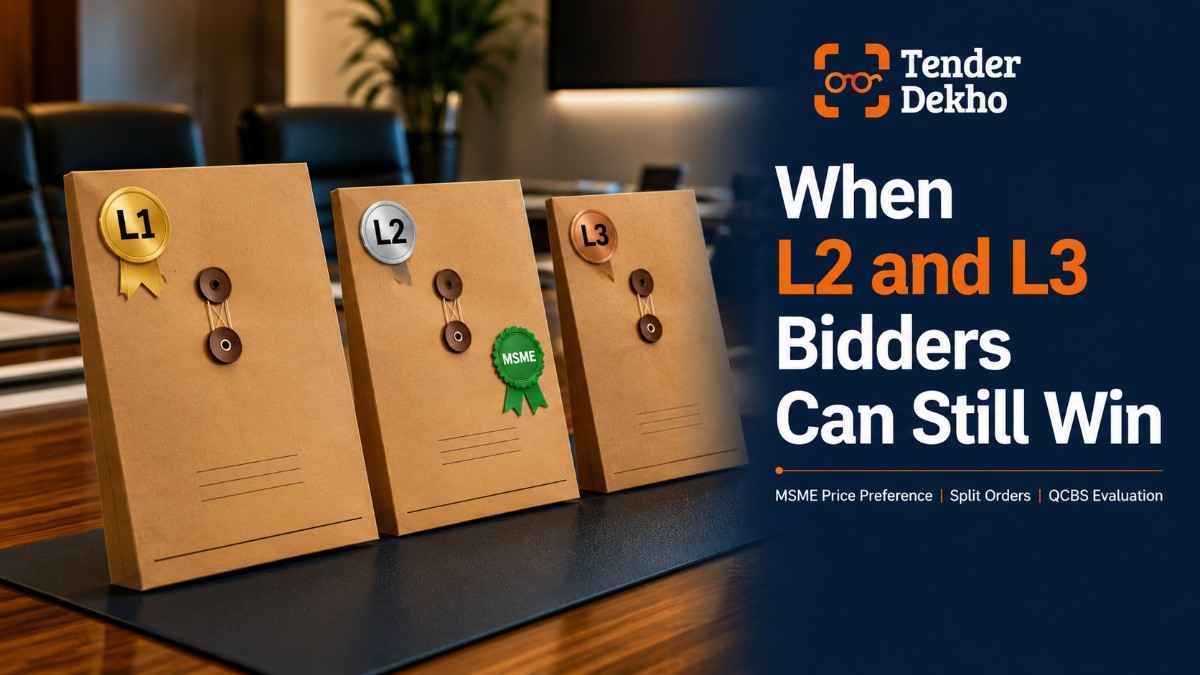
Being L2 or L3 does not mean the contract is completely out of reach. Indian procurement rules and MSME policy create several situations where non-L1 bidders can still receive orders.
Scenario 1: MSME Price Preference (L1 + 15% Rule)
This is the most important exception and directly benefits MSMEs (Micro and Small Enterprises). Under the Public Procurement Policy for MSEs Order 2012, as amended, the following applies:
- If L1 is not an MSME, and an MSME bidder has quoted within the L1 + 15% price band, that MSME bidder gets the opportunity to match the L1 price.
- If the MSME accepts and lowers their price to match L1, they receive at least 25% of the total tendered quantity at that L1 price.
- If multiple MSMEs are in the L1+15% band and all agree to match, the 25% quantity is shared proportionately among them.
- The 25% reserved procurement from MSEs is mandatory for all Central Government Ministries, Departments, and CPSUs.
This is a significant advantage. An MSME quoting ₹10.2 lakhs can still win 25% of a contract where L1 quoted ₹10 lakhs — provided they agree to drop their price to ₹10 lakhs.
Additionally, 358 product and service categories are reserved exclusively for MSE procurement. In these categories, only MSEs can participate, which means every bidder is on an even footing and L1 from among MSEs wins.
Explore government tenders with MSME-preference categories on TenderDekho
Get instant tender alerts — completely free
New government tenders are published daily. Get notified instantly for the ones that match you.
Scenario 2: Split Orders When L1 Cannot Supply Full Quantity
Under GFR 2017, if L1 is unable or unwilling to supply the full tendered quantity, the remaining quantity can be ordered from the next responsive bidder (L2) — but at the rate quoted by L1, not at L2's higher rate. This protects the government's cost while allowing L2 to participate.
Scenario 3: L1 Default or Disqualification
If L1 fails to sign the contract, furnish the required Performance Security (PS), or is found ineligible after financial bids are opened, the tendering authority has two main options:
- Re-tender: Cancel and float the tender fresh.
- Approach L2: Some tender documents include specific clauses that allow the department to offer the work to L2, but only if L2 agrees to execute at the L1 price.
As the Patna High Court clarified in 2025, no bidder — not even L2 — has an enforceable legal right to the contract simply because L1 was disqualified. The decision rests with the tendering authority.
Scenario 4: Quality-cum-Cost Based Selection (QCBS)
Since 2021, the Ministry of Finance revised guidelines to allow an alternative to the pure L1 method for works and non-consultancy services. Under QCBS, both technical quality scores and price are considered in the final evaluation. A bidder with a higher quality score may beat a lower-priced competitor if the combined weighted score works in their favour. This method is increasingly used for complex or high-value projects where the cheapest option may not deliver the required quality.
| Method | How Winner Is Decided | When Used |
|---|---|---|
| L1 (Least Cost Selection) | Lowest responsive price wins | Standard goods, routine services, works |
| QCBS | Weighted score of quality + cost | Complex services, consulting, design work |
| Fixed Budget Based Selection | Best quality within a fixed price ceiling | Consultancy with defined budget |
| Single Source Selection | Directly negotiated | Emergency, proprietary, unique suppliers |
Source: Department of Expenditure revised guidelines, 2021 (2021 data)
Frequently Asked Questions About L1 L2 L3 in Tenders
What happens if I am L2 and L1 withdraws?
There is no automatic right for L2 to receive the contract if L1 withdraws. The tendering authority will check whether the tender document has a clause for awarding to L2. If it does, L2 may be offered the contract at the L1 price — not L2's own quoted price. If no such clause exists, the standard course is a re-tender. Courts have consistently held that even L2 has no enforceable legal right to the work.
Competitor Intelligence Dashboard
6-module analysis platform · Paid feature
Know exactly who's beating you — and how to win next time.
Go beyond basic search. Analyse bid history, win rates, and head-to-head performance for any company across 8 years of government tender results.
7L+
Companies
6
Intel Modules
8 Yrs
Bid History
AI
Insights Engine
Can the government negotiate with L1 after bids are opened?
Under GFR 2017, post-bid negotiation is severely discouraged and generally not permitted. In exceptional cases — such as when L1's price appears unreasonably high compared to market rates and L1 refuses to revise — the government may re-tender. Negotiation, if it happens at all, is only with L1, never with L2 or L3.
I am an MSME and I was L2. Do I automatically get the MSME preference?
Not automatically — you need to be registered on the Udyam Portal and declare your Udyam Registration Number in the bid. If you do this and your quoted price falls within the L1 + 15% band, you will be invited to match L1's price. If you accept, you receive at least 25% of the tendered quantity at L1's price. Failing to declare Udyam registration in the bid means you are treated as a non-MSE.
Does L1 always mean the cheapest overall?
L1 means the lowest evaluated cost — which is not necessarily the lowest quoted price on paper. The evaluation may include taxes, duties, freight, installation, training costs, and annual maintenance charges depending on the tender. A bidder quoting ₹90 lakhs but adding ₹15 lakhs in freight charges may end up being L2, while someone quoting ₹95 lakhs all-inclusive could be L1. Always read the evaluation methodology in the tender document before pricing.
Is the L1 system changing in India?
The pure L1 model remains the dominant method for goods and routine services. However, the 2021 guidelines from the Ministry of Finance have expanded the use of QCBS for works and non-consultancy services — meaning quality now plays a role alongside price in certain procurement categories. Find the latest government tenders updated daily on TenderDekho to stay current on which evaluation method applies to tenders in your sector.
What should I do if I am an MSME registered on GeM and want to use the price preference?
On the GeM portal, the MSME purchase preference system is automated. If you are registered as an MSE seller with your Udyam number linked to your GeM account, the system will automatically identify you as eligible for the L1+15% price preference. For bids where L1 is a non-MSE, GeM sends a price-match request to the top five MSE bidders within the L1+15% band. If you accept the match, you are awarded at least 25% of the order quantity. Explore GeM seller registration and bid participation services for professional support with this process.
Your Next Steps as a Bidder

Understanding L1 L2 L3 in government tenders India is step one. The real advantage comes from applying this knowledge to your bidding strategy. Here is a practical action plan:
| Week | Action | Goal |
|---|---|---|
| Week 1 | Register on Udyam Portal if you are an MSME | Unlock L1+15% price preference and EMD exemption |
| Week 1 | Link Udyam number to GeM account and CPPP profile | Ensure preference is automatically applied |
| Week 2 | Research L1 winning prices for tenders in your category | Understand the typical price range you need to target |
| Week 2 | Read evaluation methodology in tender documents | Know whether pure L1 or QCBS applies to each bid |
| Week 3 | Calculate total evaluated cost — not just quoted price | Avoid surprises during financial opening |
| Week 3 | Set your floor price — the minimum you can profitably accept | Avoid underbidding and contract defaults |
| Week 4 | Track active tenders in your sector daily | Identify opportunities where your MSME status gives an edge |
| Ongoing | Monitor new tenders across Central and state portals | Stay ahead of competition with early visibility |
Every government contract in India begins with a price ranking. Whether you are targeting your first order or optimising an existing bidding pipeline, knowing how L1, L2, and L3 work — and how MSME policy reshapes those outcomes — gives you a real competitive edge. Start discovering government tenders matched to your business on TenderDekho, where active tenders from CPPP, GeM, and 50+ state portals are updated daily.