
Railway Ancillaries Tenders in India 2026: Market Opportunities, Key Buyers & How to Win
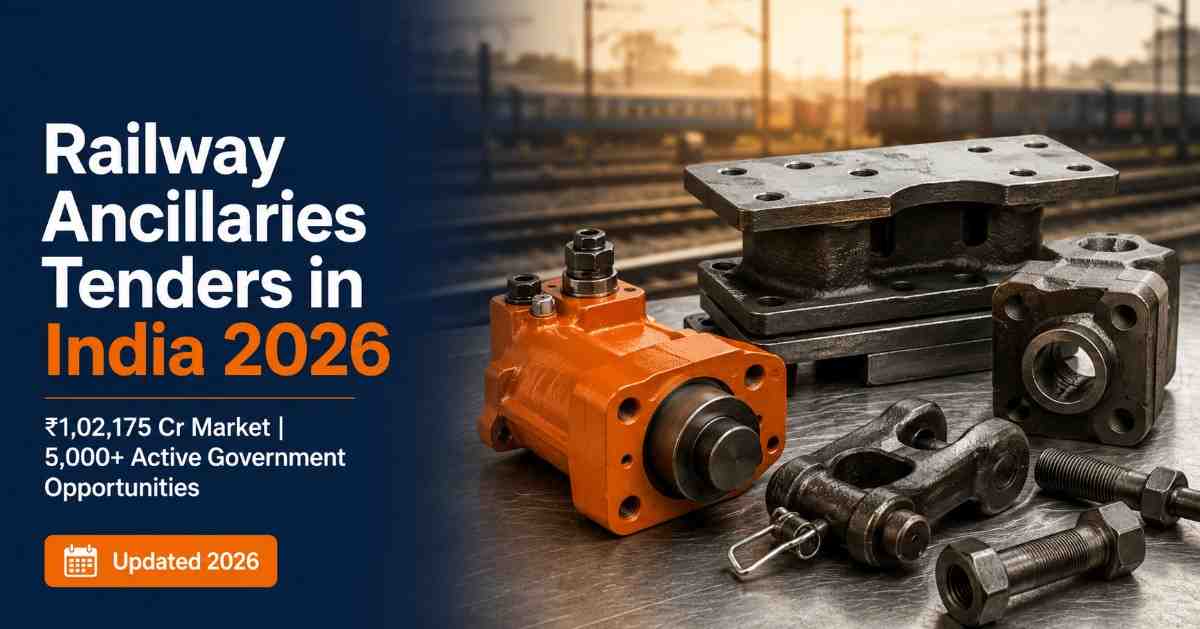
India's railway ancillaries sector is one of the most active procurement categories in government tendering, driven by Indian Railways' ₹3,02,000 crore capital expenditure target for FY 2025-26 (IBEF, 2025 data). From brake assemblies and bogie components to signalling parts and suspension pads, railway ancillaries encompass hundreds of sub-categories continuously procured across 16 zonal railways, metro corporations, and public sector units. Thousands of active tenders are floated every year, making this a high-volume opportunity for MSMEs, component manufacturers, and engineering firms.
This guide covers who buys railway ancillaries, what types of tenders are issued, how to qualify as a vendor, and how to submit your first bid.
Explore active opportunities: Browse active railway ancillaries tenders updated daily from all zonal railways and PSUs.
Market Snapshot
| Indicator | Data | Source |
|---|---|---|
| India Railway Equipment Market (2024) | ~₹1,02,175 crore (USD 12.31 Bn) | TechSci Research (2024) |
| Railway Equipment Market CAGR | 3.61% (2025–2030) | TechSci Research (2024) |
| Rail Components CAGR (India) | 5.2% (2025–2031) | 6Wresearch (Aug 2025) |
| Indian Railways CapEx FY26 Target | ₹3,02,000 crore | IBEF (2025) |
| Avg. Tender Value (Ancillaries) | ₹5–50 lakhs (estimated) | IREPS portal data |
| Top Issuing Authority | Southern Railway | Sector analysis |
Market Overview & Growth Potential
Current Landscape
India's railway equipment and ancillaries market was valued at approximately USD 12.31 billion (₹1,02,175 crore) in 2024, according to TechSci Research (2024 data). Indian Railways registered a record total revenue of ₹2,70,000 crore in FY25, underpinning the enormous scale of procurement demand across all ancillary categories (IBEF, 2025 data). The government has targeted ₹3,02,000 crore in railway capital expenditure for FY 2025-26 alone, representing one of the world's largest single-year infrastructure spending commitments.
The India Rail Components market is projected to expand at a CAGR of 5.2% through 2031, according to 6Wresearch (Aug 2025 data). Indian Railways plans to invest ₹16,70,000 crore by 2031 to modernise 1,309 stations, expand freight corridors, develop high-speed rail, and electrify tracks (IBEF, 2025 data). This long-term commitment translates directly into a sustained pipeline of ancillary procurement tenders for the next decade.
Key Growth Drivers
1. National Rail Plan 2030 and Rolling Stock Expansion
- What it means: Indian Railways plans to add 1,000 new trains and substantially expand rolling stock by 2027, generating massive demand for bogie components, brake systems, and electrical fittings.
- Data point: Demand for rolling stock is expected to surge by 25% between 2026 and 2031, according to Invest India (2025 data).
2. Dedicated Freight Corridors and Wagon Procurement
- What it means: Over 35,000 km of new track has been added as of 2025, and Dedicated Freight Corridors (DFCs) are driving large-scale procurement of specialised wagon components.
- Data point: India's freight wagon market is projected to nearly double to ₹25,000–30,000 crore by 2031 (IBEF, 2025 data).
3. Amrit Bharat Station Scheme and Station Modernisation
- What it means: Over 1,300 stations are being upgraded nationwide, each requiring ancillary works including PA systems, door hardware, fire protection equipment, and passenger fittings.
- Data point: 103 redeveloped Amrit Stations were inaugurated in May 2025 at a combined investment of over ₹1,100 crore (IBEF, 2025 data).
4. Make in India and RDSO Vendor Localisation
- What it means: Indian Railways gives procurement preference to Class-I local suppliers, and RDSO-approved Indian vendors have a structural advantage in all technical tenders.
- Data point: FDI inflows in railway-related components reached ₹9,163 crore for April 2000 to June 2025, reflecting growing global confidence in India's railway manufacturing ecosystem (IBEF, 2025 data).
Year-on-Year Market Projection (India Railway Equipment)
| Year | Market Size (₹ Crores) | YoY Growth |
|---|---|---|
| 2023 | ~96,500 | — |
| 2024 | ~1,02,175 | ~5.9% |
| 2025 (Est.) | ~1,05,840 | ~3.6% |
| 2027 (Proj.) | ~1,13,600 | ~3.6% |
| 2030 (Proj.) | ~1,26,800 | ~3.6% |
Source: TechSci Research (2024 base), projections at 3.61% CAGR
With thousands of tenders published annually for ancillary parts — from brake blocks and fasteners to compressor kits and master controllers — this growth trajectory directly translates to a steady pipeline of government procurement opportunities.
Major Tender-Issuing Organizations
Railway ancillaries are procured by all 16 zonal railways, railway production units (RPUs), PSUs, and metro corporations. Each entity has distinct procurement volumes, product requirements, and preferred supplier profiles.
Top Departments & Organizations
| Rank | Organisation | Sector | Est. Annual Tender Activity | Avg. Value |
|---|---|---|---|---|
| 1 | Southern Railway | Zonal Railway | 800+ tenders annually | ₹5–30 lakhs |
| 2 | BHEL | PSU (Electrical/Mfg) | 700+ tenders annually | ₹5–50 lakhs |
| 3 | Central Railway | Zonal Railway | 680+ tenders annually | ₹5–30 lakhs |
| 4 | Northern Railway | Zonal Railway | 650+ tenders annually | ₹5–30 lakhs |
| 5 | Western Railway | Zonal Railway | 570+ tenders annually | ₹5–30 lakhs |
| 6 | South Central Railway | Zonal Railway | 520+ tenders annually | ₹5–30 lakhs |
| 7 | Eastern Railway | Zonal Railway | 480+ tenders annually | ₹5–30 lakhs |
| 8 | RDSO, Lucknow | Standards & R&D Body | Moderate volume | ₹5 lakhs–2 crores |
1. Southern Railway (Headquartered in Chennai)
- Procures coach components, electrical fittings, braking systems, and station ancillaries across Tamil Nadu, Kerala, and Andhra Pradesh
- High-frequency buyer for consumable and replaceable parts with short lead-time requirements
- Portal: ireps.gov.in (zone: Southern Railway)
2. Bharat Heavy Electricals Limited (BHEL)
- Issues tenders for traction motor components, transformers, and electrical locomotive sub-assemblies
- BHEL units at Bhopal, Hyderabad, Haridwar, and Jhansi float separate tenders with differing specifications
- Participation requires RDSO/BHEL drawing compliance for technical items
3. Chittaranjan Locomotive Works (CLW) and Banaras Locomotive Works (BLW)
- CLW (West Bengal) issues tenders for electric loco components including traction motors and control equipment
- BLW (Varanasi, UP) procures diesel-electric locomotive parts and maintenance kits
- Recent example: IOH kit for ELGI compressor TRC-1000 (37-item kit), Mughalsarai, UP, February 2026
Types of Railway Ancillaries Tenders
Railway ancillaries is a broad category spanning mechanical, electrical, signalling, and passenger comfort components. Understanding the sub-categories helps you identify the right tenders for your product line. Browse all active tender categories to explore related procurement opportunities beyond railways.
Category Comparison
| Type | Est. Tender Share | Typical Value | Complexity | Key Buyers |
|---|---|---|---|---|
| Mechanical & Structural Parts | ~35% | ₹5–30 lakhs | Medium | Zonal Railways, RPUs |
| Electrical & Electronic Components | ~25% | ₹5–50 lakhs | High | BHEL, RDSO, CLW, BLW |
| Braking & Safety Systems | ~15% | ₹5–25 lakhs | High | Zonal Railways, RDSO |
| Signalling & Communication | ~10% | ₹10 lakhs–2 crores | Very High | RailTel, RDSO, Metro Corps |
| Passenger Amenities & Fittings | ~15% | ₹5–20 lakhs | Low–Medium | Zonal Railways, IRCTC |
Mechanical & Structural Parts (~35% of Tenders)
The highest-volume sub-category, covering components used in bogie frames, axle assemblies, couplings, and wagon structures.
What is typically procured:
- Bogie components: bolsters, side bearer pads, secondary suspension pads, bogie frames
- Coupling hardware: screw couplings, draw gear, buffer assemblies
- Wagon fittings: door handles, floor panels, lock nuts, flap door rivet kits
Common specifications:
- Standard: RDSO drawing numbers (e.g. WD-series, SK-series drawings)
- Quantity: 100–10,000 units per order depending on item
- Delivery: 60–180 days from purchase order date
Pricing range: ₹200 per unit (small fasteners) to ₹2 lakhs per unit (complex assemblies)
Electrical & Electronic Components (~25% of Tenders)
Includes master controllers, traction motor parts, compressor maintenance kits, and control equipment for electric and diesel locomotives.
What is typically procured:
- Master controllers for WAG-7, WAP-4 class electric locomotives
- IOH (Intermediate Overhaul) kits for compressors such as ELGI TRC-1000 series
- Collar microphones, lapel mics, and PA system accessories for station communication
- Slack adjuster lock nuts and brake cylinder components
Pricing range: ₹50,000 per set (communication accessories) to ₹50 lakhs per lot (complete overhaul kits)
Passenger Amenities & Fittings (~15% of Tenders)
A growing sub-category driven by station modernisation under the Amrit Bharat Scheme and coach upgrades for Vande Bharat trains.
What is typically procured:
- Door handles, coach glass panels, TR/TK/TB glass for coaches
- Fire protection equipment: water monitors, landing valves, hose nozzles
- Interior seating components and anti-vibration pads
Pricing range: ₹5 lakhs to ₹30 lakhs per tender
Where the Opportunities Are: State-Wise Distribution
Railway ancillaries tenders are concentrated in states with major railway production units, zonal headquarters, manufacturing clusters, and freight corridor activity.
Top States for Railway Ancillaries Tenders
| Rank | State | Est. Tender Volume | Key Sectors | Growth Driver |
|---|---|---|---|---|
| 1 | Uttar Pradesh | Highest (3,000+ active) | Locos, wagons, signalling | BLW Varanasi, RDSO Lucknow, ECR |
| 2 | Maharashtra | High (3,000+ active) | Coaches, metro, station works | CR Mumbai, WR, Pune Metro |
| 3 | West Bengal | High (2,800+ active) | Loco manufacturing, freight | CLW Chittaranjan, ER, SER |
| 4 | Tamil Nadu | Moderate-High (2,300+ active) | Coach supply, metro | SR Chennai, ICF Chennai |
| 5 | Madhya Pradesh | Moderate (1,500+ active) | BHEL units, RDSO supply | BHEL Bhopal, WCR |
| 6 | Odisha | Moderate (1,500+ active) | Freight wagons, East Coast corridor | ECoR, DFC supply chain |
| 7 | Karnataka | Moderate (1,500+ active) | Metro, SWR, station works | SWR Hubballi, Bengaluru Metro |
| 8 | Rajasthan | Moderate (1,400+ active) | NWR supply, desert corridor | NWR Jaipur, Ajmer workshops |
Regional Highlights
North India:
- Uttar Pradesh leads all states, anchored by BLW (Banaras Locomotive Works, Varanasi), RDSO (Lucknow), and East Central Railway headquartered at Hajipur
- Northern Railway (New Delhi) and North Eastern Railway (Gorakhpur) are active buyers of diverse ancillary items from safety kits to electrical spares
- Explore UP railway ancillaries tenders for the highest concentration of RDSO-approved vendor opportunities nationally
South India:
- Tamil Nadu is home to ICF (Integral Coach Factory, Chennai) and Southern Railway headquarters, both among the most prolific tender-issuing bodies in the country
- Karnataka and Andhra Pradesh are growing markets driven by metro expansions and new freight corridor activity in the region
East India:
- West Bengal hosts Chittaranjan Locomotive Works (CLW) and serves as the base for Eastern Railway and South Eastern Railway, all major buyers of electrical and mechanical ancillaries
- CLW regularly issues tenders for electric locomotive components and traction motor assemblies
- Discover railway ancillaries tenders in West Bengal to track CLW and Eastern Railway procurement notices
West India:
- Maharashtra accounts for a large share of coach hardware and station fitting tenders through Central Railway and Western Railway headquartered in Mumbai
- The Mumbai-Ahmedabad High Speed Rail corridor under active construction will generate ancillary supply tenders through 2030
- View Maharashtra railway tenders to monitor Central Railway and Western Railway procurement
How to Participate in Railway Ancillaries Tenders
Railway ancillaries procurement is primarily routed through IREPS (Indian Railway E-Procurement System), with selected items also procured via GeM. Participation requires specific registrations and, for technical items, RDSO vendor approval through the UVAM module.
Phase 1: Registrations & Setup
| Registration | Timeline | Cost | Portal |
|---|---|---|---|
| GST Registration | 7–10 days | Free | gstin.gov.in |
| MSME/Udyam Registration | 1–2 days | Free | udyamregistration.gov.in |
| Digital Signature Certificate (Class III) | 2–3 days | ₹1,000–₹2,000 | Any CCA-licensed CA |
| IREPS Registration | 3–5 days | Free | ireps.gov.in |
| GeM Seller Registration | 3–5 days | Free | gem.gov.in |
| RDSO Vendor Approval (UVAM) | 3–12 months | As per item spec | ireps.gov.in (UVAM module) |
Required certifications for this category:
- ISO 9001:2015 Quality Management System (strongly recommended, often mandatory in NIT)
- RDSO vendor approval via UVAM for all RDSO-controlled items (mandatory)
- BIS/ISI certification where applicable to specific components per mandatory BIS marking orders
- IRS (Indian Railway Standard) compliance for all supplied items as specified in individual NITs
Phase 2: Finding the Right Tenders
Shortlist checklist:
- RDSO vendor approval obtained for the specific item code (for RDSO-controlled items)
- Minimum turnover requirement in the NIT is met
- ISO 9001 or equivalent QMS certification is in place
- Past supply experience of 2–3 years to relevant railways (required for Part 1 vendor status)
- Delivery capacity available within specified lead time
- DSC is active and IREPS login is configured
Discover matching tenders daily: Railway ancillaries tenders updated daily across all 16 zonal railways, PSUs, and production units in one place.
Key platform features:
- State filter — Focus on your nearest railway zone for faster logistics and shorter lead times
- Value filter — Match tenders to your working capital and EMD payment capacity
- Keyword search — Search by RDSO drawing number, item name, or product specification code
- Email alerts — Get notified the moment new NIT notices are published in your category
If you are new to government procurement, TenderDekho's GeM seller registration service can guide you through the full setup process for GeM-based railway procurement.
Phase 3: Bid Preparation
Technical proposal must include:
- RDSO vendor approval certificate (for controlled items) or product test report from approved test laboratory
- Company profile with manufacturing and supply capability statement
- ISO or QMS certification copies (self-attested)
- Past supply experience: purchase orders, inspection certificates, and consignment receipts from railways
- Drawing compliance sheet referencing RDSO drawing numbers where specified in NIT
Financial proposal must include:
- Itemised price per unit in the rate unit prescribed in the tender schedule
- EMD / Bid Security: typically 2% of tender value (deposited via IREPS integrated e-payment)
- GST-inclusive pricing breakdown
- Bid validity: typically 90–180 days from closing date
Phase 4: Submission Checklist
- Login to IREPS with your Class III DSC and confirm the certificate is active
- Download and read the full NIT document, including all annexures and special conditions
- Fill the comparative statement accurately within the IREPS bid submission module
- Attach all technical documents in PDF format within the portal's size limits (5–10 MB)
- Pay EMD online via IREPS integrated payment gateway before the submission deadline
- Submit at least 2–3 hours before the closing date — never at the final hour
- Save acknowledgment receipt and tender reference number for tracking and future query responses
Frequently Asked Questions
Q1. Do I need RDSO approval to participate in railway ancillaries tenders?
- RDSO approval is mandatory for all items listed in the RDSO-controlled items directory, accessible via UVAM on IREPS
- For non-RDSO items such as general hardware, consumables, and station fittings, RDSO approval is not required
- Vendors on the RDSO Part 2 list can quote for up to 15% of the tendered quantity; Part 1 vendors can quote for the full quantity
- RDSO approval typically takes 3–12 months depending on the item category and prototype testing requirements
- MSMEs with valid Udyam registration receive relaxations in EMD requirements and experience criteria under the Public Procurement Policy for MSEs
Q2. What capital is needed to start bidding?
- EMD/Bid Security: ₹10,000–₹5 lakhs (typically 2% of tender value, paid online via IREPS)
- Working Capital: ₹5–20 lakhs for initial supply orders at the lower end of tender values
- Registration Costs: ₹1,000–₹2,000 one-time (DSC only; IREPS and GeM are free)
- RDSO Approval Costs: Varies by item category and includes testing fees, inspection travel, and certification charges
Q3. What is the average tender value in railway ancillaries?
Most supply tenders range from ₹5 lakhs to ₹50 lakhs per order for standard mechanical and electrical components. High-value items such as signalling systems, traction equipment, and locomotive sub-assemblies can reach ₹2 crores or more per tender notice. Micro and small enterprises typically begin with ₹5–15 lakh tenders to build track record before targeting higher-value contracts (estimated from IREPS portal data).
Q4. What certifications are mandatory?
- ISO 9001:2015 (QMS) — expected by most zonal railways for technical suppliers
- RDSO vendor approval via UVAM — mandatory for all RDSO-controlled items
- BIS/ISI certification — for items under mandatory BIS marking orders
- IRS (Indian Railway Standard) compliance — as specified in individual NIT documents
Q5. How do I stay informed about new tenders in this category?
Set up keyword-based email alerts on TenderDekho to receive daily notifications when new railway ancillaries NITs are published. You can also filter by state, issuing authority, and tender value to focus on the most relevant opportunities for your business.
Conclusion & 30-Day Action Plan
Railway ancillaries represent one of India's most consistent and high-volume government procurement categories, backed by ₹3,02,000 crore in FY26 capital outlay and a long-term investment commitment of ₹16,70,000 crore through 2031 (IBEF, 2025 data). With rolling stock expansion, freight corridor growth, station modernisation, and the Make in India localisation push all creating sustained demand, this is an exceptionally strong market for component manufacturers and engineering suppliers.
Start in 30 Days
Week 1–2: Foundation
- Complete GST, Udyam, DSC, IREPS, and GeM registrations
- Apply for ISO 9001 certification if not already in place
- Identify your relevant RDSO item codes and initiate UVAM vendor approval application
- Set up daily alerts: Explore railway ancillaries tenders on TenderDekho and configure notifications by state and authority
Week 3: Research
- Browse 15–20 active tenders in your product category on IREPS and TenderDekho
- Study past NIT documents to understand RDSO drawing compliance requirements
- Identify 3–5 target zonal railways or PSUs based on your product specialisation and geography
Week 4: First Bid
- Prepare reusable documentation templates: capability statement, QMS certificate, experience certificates
- Submit your first bid on a mid-range tender (₹5–15 lakh value) to gain IREPS submission experience
- Track the comparative statement and respond to technical queries within 24–48 hours
Your next step: Find active railway ancillaries government tenders and start building your pipeline today.