
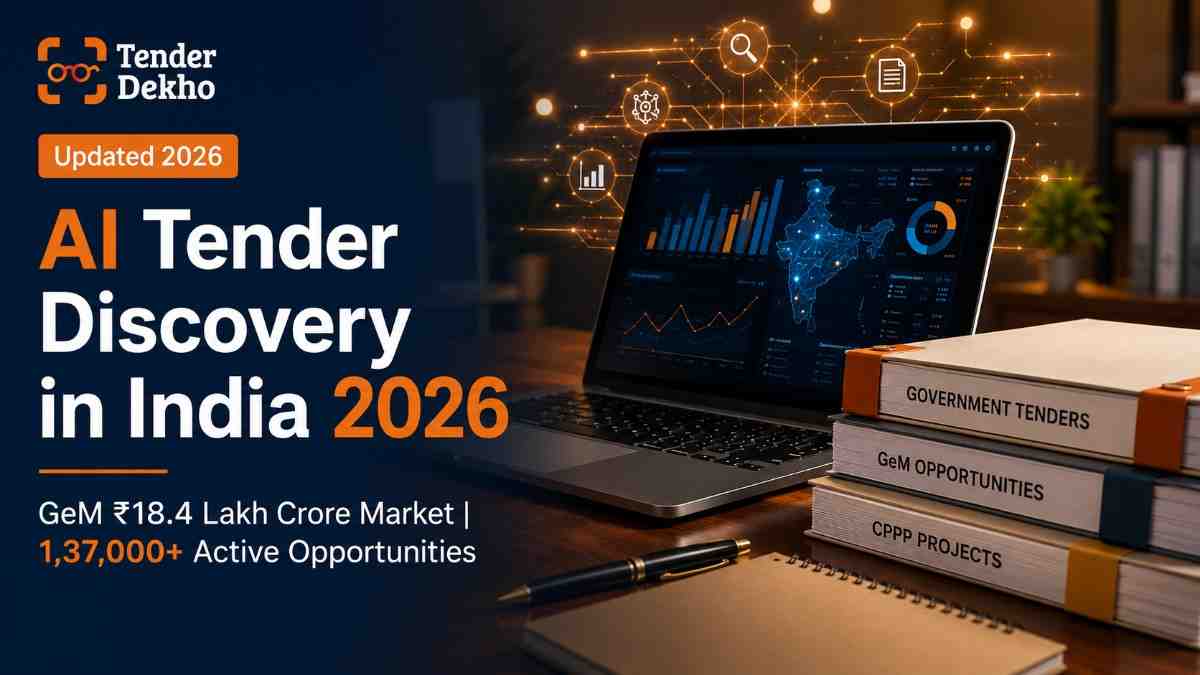
Every week, thousands of government tenders are published across GeM, CPPP, state e-procurement portals, PSU websites, and departmental notice boards. For a mid-sized business in India, manually tracking even a fraction of these opportunities means assigning full-time staff to a task that yields inconsistent results. According to the Ministry of Finance, public procurement in India accounts for nearly 20% of the country's GDP — making it one of the largest addressable markets for businesses of all sizes. Yet most MSMEs miss tenders simply because they never knew they existed.
Artificial Intelligence (AI) is changing that reality. From automated tender alerts and NLP-based (Natural Language Processing) document analysis to predictive bid scoring, AI-powered tools are turning a fragmented, manual process into a systematic, data-driven workflow. If you are a vendor, contractor, or supplier looking to grow through government contracts, understanding how AI is reshaping tender discovery in 2026 is no longer optional — it is a strategic advantage. Explore 1,37,000+ active government tenders on TenderDekho to see how AI-aggregated discovery works in practice.
| Market Snapshot | Data Point |
|---|---|
| India public procurement value | ~20% of GDP, per Ministry of Finance estimates |
| GeM cumulative GMV (as of FY 2025-26) | ₹18.4 lakh crore (GeM portal, 2025 data) |
| MSE share of GeM orders (FY 2025-26) | 68% of total orders by count (GeM CEO statement, 2025 data) |
| MSME sellers on GeM | 11+ lakh registered (GeM portal, 2025 data) |
| AI adoption barrier (SMEs) | 45% cite cost and training gaps (NASSCOM Report, 2025 data) |
| AI procurement cost savings | Up to 20% projected over traditional methods (Gartner, 2025 data) |
Source: GeM portal, Ministry of Finance, NASSCOM, Gartner, 2025 data
The Old Way: Why Manual Tender Discovery Was Failing Businesses

Before AI-powered discovery tools became available, the tendering process was heavily reliant on human effort and institutional memory. A procurement manager at a small construction firm might spend hours each morning checking GeM, CPPP, state portals, and PSU websites — each with a different interface, different document formats, and different deadline conventions.
The fragmentation was costly in two ways. First, relevant tenders were regularly missed, especially from smaller departments or state-level portals that received less attention. Second, time spent on discovery was time not spent on bid preparation — the part that actually wins contracts.
For MSMEs in particular, this was a structural disadvantage. Larger firms could afford dedicated teams for tender tracking. Small businesses could not. The result was that many capable vendors simply stopped trying, leaving viable contracts on the table and reducing healthy competition in the government procurement ecosystem.
The challenges were not just on the supplier side. According to research on AI integration in GeM (IJISRT, 2025 data), evaluating hundreds of manually submitted documents increased the risk of human oversight, duplication, and delays in contract awards on the buyer side as well. The system needed to scale — and manual processes could not keep up.
What AI Actually Does in Tender Discovery: The Core Technologies
AI in government tender discovery is not a single technology — it is a stack of complementary capabilities working together. Understanding what each layer does helps you evaluate which tools are genuinely useful for your business.
Automated Multi-Portal Aggregation
India's tendering ecosystem spans GeM, CPPP (Central Public Procurement Portal), state e-procurement portals across 28+ states, PSU-specific portals like IREPS (Indian Railways), and departmental websites. AI platforms crawl all of these continuously, normalising different data formats and timestamps into a unified feed.
For a vendor, this means you no longer need to log into eight portals every morning. Relevant tenders arrive in a single dashboard, filtered by your category, region, and eligibility profile.
Natural Language Processing for Document Analysis
A typical government tender document can run to 80–200 pages, including technical specifications, eligibility conditions, BOQ (Bill of Quantities), compliance annexures, and corrigenda issued after the original publication. Reading each document thoroughly takes hours — and that is before you determine whether you even qualify.
NLP-based AI can parse these documents in minutes. It extracts eligibility criteria, deposit requirements, submission deadlines, and technical scope, presenting a structured summary that tells you whether a tender is worth pursuing before you invest time in a full read.
Platforms like Minaions (2025) note that AI-driven NLP systems can also handle multi-language annexures — an important feature given that many state-level tenders include documents in regional languages like Kannada, Telugu, or Marathi.
Predictive Bid Scoring and Opportunity Ranking
Not all tenders are worth bidding on, even if you are technically eligible. AI systems can analyse historical win-rate data, competitor participation patterns, budget ranges, and departmental procurement histories to assign a probability score to each opportunity.
According to Gartner (2025 data), organisations using AI-driven procurement strategies are projected to achieve cost savings 20% above those using traditional methods by 2026. McKinsey (2025 data) found that procurement teams applying AI decision-making reduced supplier selection time by 30%. These efficiency gains translate directly to how many bids you can realistically prepare in a month — and how well you can target the ones with genuine win potential.
Real-Time Alerts and Deadline Tracking
One of the most practical applications of AI in tender management is automated alert systems. Once your profile is set up with your business category, Udyam registration status, preferred states, and typical contract size, the system monitors all relevant portals and sends you a notification the moment a matching tender is published.
This matters because early awareness is a genuine competitive advantage. Vendors who discover a tender on day one have more time to assess the document, gather required certificates, and prepare a stronger proposal than those who find it four days before the deadline.
| AI Capability | What It Does | Time Saved (estimated) |
|---|---|---|
| Multi-portal aggregation | Consolidates tenders from GeM, CPPP, state portals | 2–4 hours/day |
| NLP document parsing | Extracts eligibility, scope, and deadlines automatically | 1–3 hours per tender |
| Predictive bid scoring | Ranks opportunities by win probability | Prioritisation of 3–5 best bids/week |
| Real-time alerts | Instant notification for matching tenders | Eliminates daily manual checks |
| Compliance pre-screening | Flags eligibility gaps before you apply | Reduces disqualifications |
Source: Industry estimates, Minaions (2025 data), Gartner (2025 data)
GeM's Own AI Push: What the Government Platform Is Building
The Government e-Marketplace (GeM) itself has become an active adopter of AI, signalling that the technology is not just a private-sector tool but a core part of India's public procurement infrastructure.
GeMAI: India's First Public Sector Generative AI Chatbot
In May 2025, GeM launched GeMAI — India's first generative AI-powered chatbot in the public sector, according to PIB (Press Information Bureau, 2025 data). GeMAI supports both voice and text interactions in 10 Indian languages, making it accessible to vendors across linguistic regions. The chatbot helps sellers navigate registration, product listing, and bid participation queries without requiring a human support representative.
This multilingual capability is significant. A vendor from rural Odisha or a small manufacturer from Tamil Nadu can now interact with India's largest procurement portal in their own language — a barrier that previously excluded many capable but less English-proficient businesses.
GeM 5.0 AI Features
Beyond the chatbot, GeM 5.0 (introduced in 2024) brought several AI-driven enhancements to the platform:
- AI-driven vendor ranking: Algorithmically surfaces the most relevant and reliable sellers for each product category
- Predictive demand analytics: Helps buying departments forecast procurement needs and plan budgets
- Automated compliance checks: Flags mismatches between a seller's registration data and tender eligibility requirements before bid submission
- Real-time fraud detection: GeM's CTO Pankaj Dikshit confirmed to Analytics India Magazine (2025 data) that the platform uses ML and deep learning to detect collusion and price manipulation through bidding behaviour patterns and IP analysis
The Digital Procurement Mission (2023–2026)
The Government of India's Digital Procurement Mission is a three-year initiative aimed at embedding AI across both GeM and CPPP. The mission includes MSME Digital Readiness Fund support for small vendors adopting AI-powered tools, and NITI Aayog pilot projects integrating AI into Smart Cities Mission and rural electrification tenders, according to tenderbook.in (2025 data).
These initiatives indicate that AI in Indian government procurement is not a pilot phase — it is becoming standard infrastructure. Browse government tenders from all ministries and departments to track categories most actively adopting digital tools.
| GeM AI Initiative | Feature | Status (as of 2026) |
|---|---|---|
| GeMAI Chatbot | Multilingual generative AI support | Live — 10 Indian languages |
| GeM 5.0 | Vendor ranking, compliance AI, fraud detection | Deployed |
| Digital Procurement Mission | AI integration across GeM and CPPP | In progress (2023–2026) |
| MSME Digital Readiness Fund | AI adoption subsidies for small vendors | Active |
| NITI Aayog AI Pilots | Smart Cities and rural procurement AI | Piloting |
Source: PIB, GeM portal, tenderbook.in, NASSCOM, 2025 data
Get instant tender alerts — completely free
New government tenders are published daily. Get notified instantly for the ones that match you.
How MSMEs Benefit Most from AI-Powered Tender Discovery
MSMEs (Micro, Small and Medium Enterprises) stand to gain more from AI-powered tender tools than any other segment — precisely because they start from the biggest disadvantage under manual processes.
Levelling the Playing Field Against Larger Competitors
As of FY 2025-26, more than 11 lakh MSEs are registered on GeM and received orders worth ₹2.36 lakh crore during the financial year — a growth of over 20% compared to the previous year, according to GeM CEO Mihir Kumar (2025 data). Yet, according to a NASSCOM report (2025 data), nearly 45% of SMEs still cite cost and lack of training as barriers to adopting AI tools. This gap represents both a challenge and an opportunity.
The businesses that close this gap first will hold a structural advantage: they will see more tenders, respond faster, and submit stronger bids with fewer disqualifications. AI tools effectively replicate the procurement intelligence capacity of a large firm's dedicated team — at a fraction of the cost.
MSME-Specific Discovery Advantages
Several AI platforms now include MSME-specific filters that surface only the tenders for which your business qualifies based on Udyam registration status. This includes:
- Tenders with EMD (Earnest Money Deposit) exemption for registered MSMEs
- MSME-only procurement categories under the Public Procurement Policy
- Tenders with relaxed prior-experience or prior-turnover eligibility norms
- Contracts up to ₹200 crores reserved for MSME participation under GeM rules
For an MSME that previously avoided tendering because of the compliance burden, AI-driven eligibility screening eliminates the uncertainty of whether you qualify before you invest hours in document preparation.
Regional Language and Geographic Filtering
State-level tenders are often overlooked by businesses that primarily monitor central government portals. AI aggregation platforms that pull from state e-procurement systems in Uttar Pradesh, Maharashtra, Gujarat, and other major procurement states give MSMEs access to a much wider pool of opportunities closer to home — with lower logistics costs and stronger local knowledge advantages.
If you are based in Maharashtra, for instance, government tenders in Maharashtra represent some of the highest-value infrastructure and services procurement in India. AI filters let you surface only the categories relevant to your business within that geography.
| MSME Benefit | Without AI | With AI |
|---|---|---|
| Tenders reviewed per week | 10–20 (manual, multi-portal) | 100+ (automated, filtered) |
| Time on document review | 2–5 hours per tender | 20–30 minutes (AI summary) |
| Eligibility pre-check | Manual, often missed | Automated before applying |
| EMD/MSME filter | Requires knowing the rules | Built-in, automatic |
| Regional tender coverage | Central portals only | All 28+ state portals |
Source: Industry estimates, Minaions (2025 data)
State-Level Adoption: Where AI in Procurement Is Growing Fastest
While the central government has moved fastest on AI procurement infrastructure, several states have begun their own digital procurement upgrades — creating both more opportunities and more complexity for vendors tracking tenders across geographies.
Uttar Pradesh, Maharashtra, Tamil Nadu, and Karnataka have the highest tender volumes on state e-procurement portals. These states also have the most diverse procurement categories — infrastructure, healthcare, IT services, and education — making them particularly valuable for businesses with broad service capabilities.
For vendors in these states, AI aggregation that pulls from both central and state portals is essential. A manufacturer in Bengaluru, for instance, may be missing relevant Karnataka state government contracts that appear only on the state's own portal, not on GeM.
States like Madhya Pradesh and Rajasthan are also increasing their digital procurement adoption, opening up new markets for businesses willing to monitor less-saturated tender pools. Explore tender opportunities from Madhya Pradesh or check Rajasthan government tenders for a sense of state-level volume.
| State | Key Tender Categories | AI Discovery Value |
|---|---|---|
| Uttar Pradesh | Infrastructure, healthcare, education | Very high — large tender volume |
| Maharashtra | IT services, construction, transport | Very high — diverse categories |
| Tamil Nadu | Manufacturing, power, healthcare | High — strong PSU presence |
| Karnataka | IT, defence, pharma | High — tech procurement growth |
| Madhya Pradesh | Agriculture, infrastructure | Medium — growing digital adoption |
Source: State e-procurement portals, 2025 data (estimated)
How to Start Using AI for Tender Discovery: A Practical Action Plan
Knowing AI exists is one thing. Implementing it into your procurement workflow is another. Here is a practical, week-by-week plan to shift from manual to AI-assisted tender discovery in 30 days.
Step 1: Build Your Procurement Profile
Every AI tender discovery system works from a profile. Before you sign up for any platform, document the following:
- Your NIC (National Industrial Classification) codes and service categories
- Your Udyam registration number and MSME classification
- States where you can deliver goods or services
- Typical contract value range you target
- Key certifications: ISO, BIS, NABL, or sector-specific credentials
This profile is the input that AI uses to filter thousands of tenders down to the ones you should actually consider. A vague profile produces vague results. Find government tenders matched to your business category after setting up your profile on an AI-powered discovery platform.
Step 2: Set Up Automated Alerts Across All Portals
Once your profile is ready, configure real-time alerts for:
- GeM tenders matching your category and Udyam status
- CPPP notices for your NIC codes
- State portal tenders in your operating geography
- Corrigendum alerts for tenders you are already tracking
Most AI platforms allow you to set keyword exclusions — useful for filtering out tenders in your category that you cannot fulfil (e.g., filtering out defence-classified contracts if you supply commercial goods).
Competitor Intelligence Dashboard
6-module analysis platform · Paid feature
Know exactly who's beating you — and how to win next time.
Go beyond basic search. Analyse bid history, win rates, and head-to-head performance for any company across 8 years of government tender results.
7L+
Companies
6
Intel Modules
8 Yrs
Bid History
AI
Insights Engine
Step 3: Use AI Document Summaries Before Committing Time
Not every alerted tender deserves a full read. Use your platform's AI document summary to check:
- Eligibility: Does your turnover, experience, and certification profile match?
- EMD requirement: Is it waived for MSMEs? If not, can you fund it?
- Submission deadline: Do you have enough time to prepare?
- Technical scope: Is this exactly what you do, or a stretch category?
If three of the four answers are positive, proceed to full document review. If two or fewer are positive, note the tender for future reference but do not invest preparation time now.
Step 4: Track Your Bid History and Improve with Data
AI systems that log your bid history can surface patterns over time — which categories, departments, or states produce your best win rates. This data-driven feedback loop is what separates businesses that use AI as a convenience from those that use it as a competitive advantage.
For GeM-specific procurement, the platform's own GeM seller registration and bid participation services can complement your AI discovery workflow with structured onboarding support.
| Week | Action | Outcome |
|---|---|---|
| Week 1 | Build procurement profile — NIC codes, Udyam, states, contract range | Accurate AI filter setup |
| Week 2 | Activate multi-portal alerts — GeM, CPPP, state portals | Daily automated tender feed |
| Week 3 | Review first AI-summarised tenders — test eligibility pre-screening | 5–10 qualified tenders identified |
| Week 4 | Shortlist top 3 bids using AI scoring — submit your first AI-guided tender | First data-driven bid in pipeline |
FAQs: AI in Government Tender Discovery
What is AI tender discovery and how does it work?
AI tender discovery uses machine learning, NLP, and automated web crawling to:
- Aggregate tenders from multiple government portals into one feed
- Parse lengthy documents to extract key eligibility and deadline data
- Score opportunities based on your profile and historical win data
- Alert you the moment a relevant tender is published
Instead of manually checking 8–10 portals daily, you receive a filtered, ranked list of tenders matched to your business.
Is AI tender discovery useful for MSMEs or only large companies?
AI discovery is arguably most valuable for MSMEs. Large companies have dedicated procurement teams; MSMEs typically do not. AI replicates that capacity at a fraction of the cost. Specifically, MSME-aware AI platforms can filter for:
- EMD-exempt tenders under the Public Procurement Policy
- MSME-reserved procurement categories
- Udyam-eligible tenders with relaxed experience norms
- Contracts up to ₹200 crores reserved for MSME bidders on GeM
Does the government itself use AI in the tendering process?
Yes. GeM launched GeMAI — India's first generative AI chatbot in the public sector — in May 2025, supporting 10 Indian languages. GeM 5.0 also introduced AI-driven vendor ranking, predictive demand analytics, and automated fraud detection. The Digital Procurement Mission (2023–2026) is embedding AI across both GeM and CPPP at the infrastructure level.
How accurate is AI eligibility pre-screening for tenders?
Accuracy depends on how complete your business profile is. With a full profile — NIC codes, Udyam number, certifications, turnover, and target geography — AI eligibility filters correctly identify qualified tenders in the large majority of cases. However, tender documents can contain unusual clauses or department-specific requirements that AI may not flag. Always verify the original document before final bid submission.
Can AI help with bid writing, not just discovery?
Yes. The next layer of AI tools beyond discovery includes document drafting support — generating compliant bid templates from past submissions, highlighting mandatory forms, and cross-checking your document set against the tender's checklist. This is particularly useful for reducing disqualifications caused by missing declarations or incorrectly formatted annexures.
How do I start using AI for tender discovery today?
Begin with three steps:
- Register your business profile (NIC codes, Udyam, states, contract range) on an AI-powered tender platform
- Activate real-time alerts for GeM, CPPP, and relevant state portals
- Use AI document summaries to shortlist the top 3–5 tenders per week for full review
For a comprehensive starting point, find AI-aggregated government tenders updated daily on TenderDekho — covering 50+ national and state portals with MSME-specific filtering built in. You can also visit the TenderDekho blog and guides hub for more resources on building a winning bid strategy.
Conclusion: The AI Advantage Is Already Here

The shift to AI-powered tender discovery in India is not a future scenario — it is already underway. GeM has crossed ₹18.4 lakh crore in cumulative GMV with AI embedded at its core. The government's Digital Procurement Mission is extending AI to every major procurement portal. And private platforms are giving even the smallest vendor access to the kind of intelligent, multi-portal discovery that was previously only available to large procurement teams.
For businesses that have found tendering too time-consuming or opaque to pursue seriously, AI removes the two biggest barriers: finding the right tenders and determining whether you qualify. What remains — preparing a strong, compliant bid — is still a skill you develop over time. But it is a much more productive skill to develop when you are spending it on the right opportunities.
The vendors who integrate AI into their procurement workflow in 2026 will have a compounding advantage. Every bid teaches the system more about your win patterns. Every discovery shortens the gap between publishing and your awareness. Start now, build your profile, and begin your AI-powered government tender search on TenderDekho today.