
Most businesses that lose large government tenders don't lose on price — they lose on eligibility. A ₹50 crore infrastructure tender requires ₹75 crore in average annual turnover. A highway project demands five years of similar completed works. For a growing firm bidding alone, these walls are impassable. Consortium bidding and Joint Ventures (JVs) exist precisely to break them.
India's public procurement market is estimated at ₹60–64 lakh crore annually, according to market data compiled in 2025. Much of this spending goes into large-scale infrastructure, IT, and services contracts that no single MSME or mid-sized firm can access independently. By forming a consortium or JV, two or more eligible firms pool their financial strength, technical experience, and manpower to bid as a single unit — qualifying together for work that none could win alone.
This guide explains the legal framework, eligibility rules, step-by-step process, and common mistakes around consortium bidding in India in 2026. If you are eyeing larger government tenders but find yourself just short of the qualifying criteria, a JV may be the most practical path forward.
| Quick Facts: Consortium Bidding in India | |
|---|---|
| Legal basis | GFR 2017, DoE Procurement Manuals |
| Common sectors | Infrastructure, IT, EPC, healthcare, defence |
| Typical threshold | Tenders above ₹5 crore (works), ₹2–5 crore (services) |
| Max partners (recommended) | 3 (varies by tender document) |
| Lead partner requirement | Usually meets 50% of financial/technical criteria |
| Key document | Notarised JV/Consortium Agreement or MoU |
Source: DoE Manual for Procurement of Consultancy and Other Services, 2022
What Is Consortium Bidding and How Does It Differ from a JV?
The terms "consortium" and "Joint Venture (JV)" are used interchangeably in many Indian tender documents, but there is a practical distinction worth understanding.
A Joint Venture is a new legal entity formed by two or more businesses specifically to bid for and execute a project. It has its own registration, bank account, and legal identity. A consortium, by contrast, is an arrangement where existing companies collaborate under a formal agreement — without creating a new entity. Each partner continues to operate under its own name, bound by a consortium agreement that defines roles, responsibilities, and liability.
In Indian government tenders, both structures are accepted depending on the tender conditions. The key requirement in either case is:
- A notarised MoU or JV/Consortium Agreement submitted with the bid
- Identification of one firm as the Lead Bidder (or Lead Partner)
- Clear definition of each partner's scope, contribution, and financial stake
- Joint and several liability — each partner is accountable for the entire contract
Government authorities correspond exclusively with the Lead Bidder. If the contract is awarded, penalties and performance obligations bind all partners jointly.
| Feature | Joint Venture | Consortium |
|---|---|---|
| Legal entity | New company formed | No new entity; existing firms |
| Registration needed | Yes (MCA or state) | No |
| Liability | Joint and several | Joint and several |
| Preferred for | Long-term, complex projects | Single tenders, shorter projects |
| Time to form | 4–8 weeks | 1–2 weeks |
| Common in | Defence, highways, power | IT, services, EPC packages |
When Should You Form a Consortium?
Not every large tender requires a consortium. Before forming one, check three things against the NIT (Notice Inviting Tender).
1. Does the tender explicitly allow consortium/JV bids?
Many tenders — especially below ₹5 crore — restrict bidding to single entities. If the NIT says "JV/consortium not permitted," submitting a consortium bid results in automatic disqualification. According to the ICLG Public Procurement India report (2026), any change to consortium membership after bid submission is treated as a material change that can render the bid non-responsive.
2. Do you fall short of eligibility criteria?
The most common reason to form a consortium is to collectively meet turnover, experience, or technical qualification thresholds that no single partner can satisfy alone. Per the DoE Consultancy Procurement Manual (2022), for JV bids on consultancy assignments above ₹5 crore, the lead partner must meet at least 50% of the qualifying criteria individually, while each other partner must meet at least 25%.
3. Does the project require multi-disciplinary expertise?
Large EPC (Engineering, Procurement, and Construction) projects, smart city assignments, and defence contracts often require capabilities no single firm possesses — civil works, IT integration, supply chain, and maintenance rolled into one package. Consortium bidding in EPC India helps firms combine technical strengths and meet infrastructure tender eligibility criteria, according to Tata NexArc (2026 data).
If the answer to two or more of these questions is yes, a consortium is the right path. Browse active construction and infrastructure tenders to identify opportunities that match your combined profile.
Before You Form a Consortium: What You Need
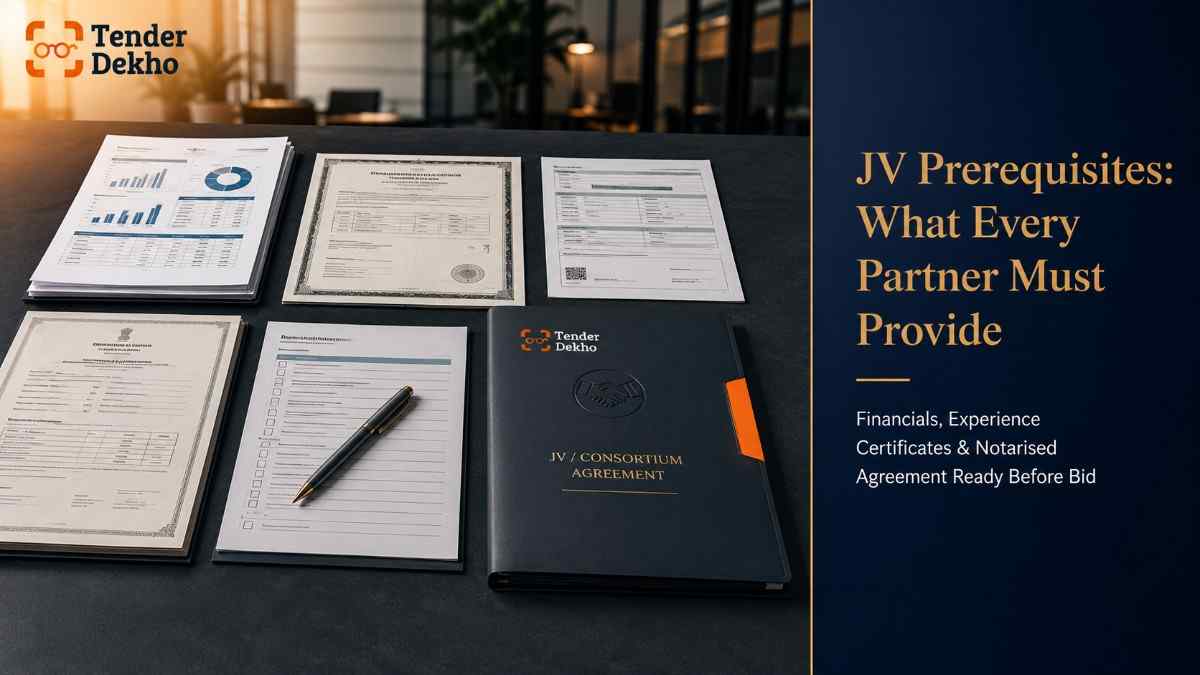
Rushing into a consortium agreement without preparation is one of the most common reasons for bid failure. Do this groundwork before approaching potential partners.
Eligibility gap analysis
Pull the NIT and list every criterion: minimum annual turnover, similar completed works in value, technical certifications, and financial soundness. Calculate your firm's individual score against each criterion. The gap between your score and the requirement tells you exactly what a partner must contribute.
Partner due diligence checklist
- ✅ PAN, GST, and MCA registration — active and matching
- ✅ Audited financial statements for last 3 years
- ✅ Work completion certificates for similar projects
- ✅ No blacklisting or debarment order from any government authority
- ✅ No pending litigation that could be flagged as a disqualifying event
- ⚠️ Check for overlapping clients or conflict of interest
- ⚠️ Verify MSME/Udyam status if claiming MSME benefits on the consortium bid
Scope and stake agreement (pre-bid)
Before the JV agreement is drafted, the partners must agree — in writing — on:
- Percentage share in the JV (e.g., 60:40 or 50:30:20)
- Who leads the bid and becomes the primary point of contact
- How costs and revenues are split
- What happens if one partner withdraws
- Dispute resolution mechanism
| Prerequisite | Who Provides It | Timeline Before Bid |
|---|---|---|
| Audited financials | Each partner | 4–6 weeks before |
| Work completion certificates | Each partner | 3–4 weeks before |
| Notarised JV/Consortium Agreement | Lead partner's lawyer | 2–3 weeks before |
| Board Resolution / PoA | Each partner | 1–2 weeks before |
| EMD/Bid Security | Lead partner's bank | 3–5 working days before |
| DSC (Digital Signature Certificate) | Lead partner | 1–2 weeks before |
Get instant tender alerts — completely free
New government tenders are published daily. Get notified instantly for the ones that match you.
Step-by-Step: How to Form a JV for a Government Tender in 2026
Following the right sequence avoids the single biggest risk in consortium bids — submitting a technically complete package with a procedurally defective agreement.
Step 1: Identify the tender and confirm JV eligibility
Read the NIT fully. Confirm that consortium/JV bids are explicitly permitted. Note the maximum number of allowed partners (typically 2–3), the lead partner criteria, and whether a pre-bid JV agreement or a Letter of Intent (LoI) is acceptable at the bidding stage.
Portal: eprocure.gov.in (CPPP) for central tenders; state portals for state tenders.
Time: 1–2 days.
Step 2: Conduct eligibility gap analysis
Map every criterion in the NIT against your firm's current credentials. Identify the exact financial and technical gap. This gap defines what your consortium partner must bring. Use this to shortlist potential partners — approach firms whose credentials are complementary, not overlapping.
Time: 2–3 days.
Step 3: Approach and evaluate partners
Sign a Non-Disclosure Agreement (NDA) before sharing financials. Verify their audited accounts, work experience records, and legal standing. Confirm they hold valid GST, PAN, and are not debarred from any government tender. The Supreme Court of India ruled in December 2025 that JV experience must be considered proportionately in tender evaluation unless explicitly excluded — making the quality of your partner's past JV work legally usable as experience.
Time: 5–10 days.
Step 4: Draft and notarise the JV/Consortium Agreement
The JV Agreement is the single most scrutinised document in a consortium bid. It must clearly state:
- Names and registered addresses of all partners
- Designated Lead Partner with authority to bind all parties
- Each partner's scope of work and percentage stake
- Joint and several liability clause (mandatory in most NITs)
- Confirmation that the agreement is specifically for this tender
- Authorised signatory details and Board Resolutions from each firm
Get the agreement notarised. Some tenders also require it to be stamped as per the Indian Stamp Act. Check the NIT for specific formatting requirements.
Time: 5–7 days. Cost: ₹5,000–₹25,000 in legal and notarisation fees.
Step 5: Prepare the technical and financial bid
All documents from all partners must be combined into a single bid package. The bid is signed by the Lead Partner on behalf of the consortium. Combine turnover figures and experience certificates across partners as per the NIT's pooling rules — typically, figures are added together to arrive at collective capacity.
Key rule: The bid, once submitted, cannot be altered. A 2025 Supreme Court ruling (Prakash Asphaltings case) reaffirmed that no post-bid corrections are permissible even if they could benefit the government. Get every page right before submission.
Portal: Submit through the portal specified in the NIT. The Lead Partner's DSC is used for digital submission.
Time: 7–14 days.
Step 6: Submit EMD under the Lead Partner's name
Earnest Money Deposit (EMD) must be submitted in the name of the Lead Partner unless the NIT specifies otherwise. The Lead Partner is responsible for all financial instruments — EMD, Performance Bank Guarantee — and all penalties or invocations on behalf of the consortium.
Time: 3–5 working days for bank instruments.
| Stage | Key Action | Responsible Party | Approx. Time |
|---|---|---|---|
| 1. Tender identification | Read NIT, confirm JV allowed | All partners | 1–2 days |
| 2. Partner selection | Gap analysis + due diligence | Lead partner | 7–10 days |
| 3. Agreement drafting | JV Agreement + notarisation | Lawyer + all partners | 5–7 days |
| 4. Bid preparation | Combine docs, sign, upload | Lead partner | 7–14 days |
| 5. EMD submission | Bank instrument in Lead's name | Lead partner | 3–5 days |
| Total timeline | 3–5 weeks |
Source: DoE Procurement Manual (2022), Standard NIT practices
Find upcoming large-value tenders requiring consortium bids: Explore 137,000+ active government tenders filtered by sector and value.
MSME Advantage in Consortium Bidding
If one or more partners in your consortium is a Udyam-registered MSME, check carefully whether MSME benefits — EMD exemption, price preference, relaxed experience norms — apply to the consortium as a whole. This depends on the tender's specific MSME clause.
- If the Lead Partner is an MSME, some tenders extend MSME benefits to the full consortium.
- If only a minority partner is an MSME, most tenders treat the consortium as a non-MSME entity.
- GeM (Government e-Marketplace) currently does not support consortium bidding. MSME benefits on GeM apply only to individual registered sellers.
As of late 2025, over 11.25 lakh MSME sellers were registered on GeM with orders worth over ₹7.44 lakh crore according to GeM portal data (2025). For tenders above the GeM threshold — particularly in construction, IT systems integration, and large service contracts — consortium bidding remains the primary route for MSMEs to access high-value opportunities.
| MSME Benefit | Applies to Consortium? | Condition |
|---|---|---|
| EMD exemption | ⚠️ Conditional | Lead partner must be MSME-registered |
| Price preference (up to 15%) | ⚠️ Conditional | Depends on tender-specific MSME clause |
| Relaxed experience norms | ⚠️ Conditional | Only if NIT explicitly extends to consortiums |
| 25% procurement reservation | ❌ No | Not applicable to consortium bids |
| GeM bidding as consortium | ❌ No | GeM does not support JV/consortium bids |
Competitor Intelligence Dashboard
6-module analysis platform · Paid feature
Know exactly who's beating you — and how to win next time.
Go beyond basic search. Analyse bid history, win rates, and head-to-head performance for any company across 8 years of government tender results.
7L+
Companies
6
Intel Modules
8 Yrs
Bid History
AI
Insights Engine
Common Mistakes to Avoid
Around 30% of bids in India fail due to compliance errors, according to a procurement audit analysis by ACESNWS (2025 data). Consortium bids are especially vulnerable because a mistake by any one partner can disqualify the entire bid.
Mistake 1: Submitting a consortium bid where JV is not permitted
Always read Clause 1 of the NIT. If the document is silent on JV eligibility, do not assume it is allowed — confirm with the tendering authority before the pre-bid meeting.
Mistake 2: Changing consortium membership after submission
Any substitution, addition, or withdrawal of consortium members after bid submission is a material change under Indian GFR rules. The bid becomes non-responsive. Lock your consortium before the first submission.
Mistake 3: Improper lead partner clause in JV Agreement
The JV Agreement must explicitly state that the Lead Partner has the authority to sign the bid, submit EMD, and legally bind all partners. A missing or vague authority clause is grounds for rejection.
Mistake 4: Misunderstanding experience pooling rules
Experience certificates must be distributed among JV partners in proportion to their stake. A 40% partner in a ₹10 crore project contributes ₹4 crore of experience — not ₹10 crore. Match your pooled experience to the NIT threshold carefully.
Mistake 5: Name mismatches across documents
The entity name on PAN, GST, bank instruments, and bid documents must be identical for every partner. "Pvt" vs "Private" or a missing comma in the company name can trigger rejection.
| Mistake | Consequence | Fix |
|---|---|---|
| JV not permitted but submitted | Automatic disqualification | Check NIT Clause 1 first |
| Consortium member change post-submission | Bid declared non-responsive | Finalise partners before bid |
| Vague authority in JV Agreement | Rejection at technical stage | Lawyer-drafted, notarised agreement |
| Wrong experience pooling | Failure to meet eligibility | Read NIT experience clause carefully |
| Name mismatch on documents | Rejection at document check | Verify all entity names before upload |
Source: DoE Procurement Manual (2022), ICLG India Public Procurement Report (2026)
FAQs: Consortium Bidding in Government Tenders India 2026
Q1. Can two MSMEs form a consortium to bid for government tenders?
- Yes, two or more MSMEs can form a consortium if the tender permits JV/consortium bids.
- The combined turnover and experience credentials are pooled.
- Check whether MSME benefits extend to the full consortium under the specific tender's MSME clause.
- Udyam registration for each partner should be current and active.
Q2. Is a formal JV Agreement required at the bidding stage or only at contract award?
- Most central government tenders (CPWD, NHAI, Railways) require a notarised JV or Consortium Agreement at bid submission itself.
- Some tenders accept a Letter of Intent (LoI) at the bidding stage, with the full agreement required before contract signing.
- Always read the specific NIT — do not assume the LoI route is acceptable.
Q3. How is the EMD (Earnest Money Deposit) handled in a consortium bid?
- EMD is submitted in the name of the Lead Partner.
- The Lead Partner's bank issues the EMD instrument.
- The Lead Partner bears full financial liability including any EMD forfeiture.
- MSME EMD exemption applies only if the Lead Partner is MSME-registered and the tender's MSME clause covers consortium bids.
Q4. What does "joint and several liability" mean for consortium partners?
- Each partner is individually liable for the full contract obligations.
- If the Lead Partner defaults, the tendering authority can claim damages from any other partner.
- This makes partner selection critical — choose firms with proven financial stability.
- Dispute resolution and exit clauses in the JV Agreement protect each partner internally.
Q5. Can experience gained through a JV be used for future tender bids?
- Yes. The Supreme Court of India ruled in December 2025 that experience gained as a JV partner must be considered proportionately in tender eligibility assessments, unless the NIT explicitly excludes JV experience.
- A 40% partner in a ₹20 crore JV project can claim ₹8 crore of experience for future bids.
- Obtain a work completion certificate that specifies your stake percentage.
Q6. Are there MSME-specific consortium opportunities in government tenders?
- Some state governments and PSUs release cluster-based tenders encouraging MSME consortiums.
- NSIC (National Small Industries Corporation) facilitates MSME consortiums for specific product categories.
- Individual MSME benefits (EMD exemption, price preference) are strongest when bidding solo; consortium benefits depend on tender-specific clauses.
30-Day Action Plan: From Idea to JV-Ready Bid

If you have already identified a large tender that requires consortium participation, use this timeline.
| Week | Actions | Output |
|---|---|---|
| Week 1 | Read NIT fully; confirm JV permitted; list all eligibility criteria; conduct gap analysis | Gap analysis document |
| Week 2 | Identify and shortlist 2–3 potential partners; sign NDAs; exchange financials | Partner shortlist with due diligence notes |
| Week 3 | Negotiate consortium terms; engage a lawyer for JV Agreement drafting; get notarisation done | Notarised JV/Consortium Agreement |
| Week 4 | Compile bid documents from all partners; prepare technical and financial bids; arrange EMD; submit | Bid submitted before deadline |
For identifying the right tenders to apply as a consortium — filtered by value, sector, and eligibility threshold — find consortium-eligible government tenders updated daily across all major portals.
If you have questions about the process, the TenderDekho FAQ section covers common queries on bid eligibility, MSME exemptions, and portal registration. For further reading on tendering strategy, the TenderDekho Blog publishes research-backed guides across procurement topics. And if your team needs hands-on support with bid preparation or consortium structuring, reach out to TenderDekho's expert team.