

Thousands of manufacturers walk away from crores in government business every year because they skip one critical step: completing Vendor Assessment to unlock their OEM panel on GeM. The Government e-Marketplace (GeM) has crossed a cumulative Gross Merchandise Value (GMV) of ₹18.4 lakh crore since its launch, according to GeM portal data (April 2026). Yet many manufacturers never access their full share of this demand because they remain invisible to government buyers without a verified OEM status.
If you manufacture goods, assemble products, or own a brand sold to government departments, this guide covers every step to claim your OEM panel — from eligibility to RITES Vendor Assessment to managing your reseller network.
You can explore live GeM-related government tenders on TenderDekho to identify the product categories where OEM status gives you the highest competitive edge.
| Quick Facts: GeM OEM Panel Status | Details |
|---|---|
| Who can apply | Manufacturers, assemblers, brand owners, deemed OEMs |
| Assessment agency | RITES Ltd. (replaced QCI in 2025) |
| Assessment stages | Desktop Assessment + Video Assessment |
| Completion timeline | Within 15 days of fee payment |
| Certificate validity | 3 years (renewal required before expiry) |
| Mandatory for | Q1 and Q2 category products; OEMs managing resellers |
| Official portal | gem.gov.in |
Source: GeM Vendor Validation Policy v3.4 (effective October 2025)
What Is OEM Panel Status on GeM and Why Does It Matter?

An OEM (Original Equipment Manufacturer) panel is a dedicated dashboard on the GeM portal that gives verified manufacturers direct control over their product catalogue, brand listing, and reseller network. Without this panel, your products either cannot be listed in high-value procurement categories or can be undercut by unverified sellers without brand accountability.
GeM classifies products into four quadrants — Q1, Q2, Q3, and Q4 — to regulate how OEMs and resellers interact. Understanding these quadrants is the foundation of everything that follows:
- Q1 (Direct OEM only): Only the OEM can sell — no resellers permitted. Requires mandatory Vendor Assessment.
- Q2 (OEM + authorised resellers): OEM sells directly and generates authorization codes for resellers. Vendor Assessment mandatory.
- Q3 (OEM + approved resellers): OEMs approve or reject reseller catalogue requests within 72 hours. Vendor Assessment required for OEM role.
- Q4 (OEM + open resellers): Resellers can pair with existing catalogues without OEM approval. OEM still needs VA for brand control.
Once you pass Vendor Assessment and activate your OEM panel, you receive the "VA Verified" tag on your GeM profile. This tag signals to over 1.6 lakh government buyers that your manufacturing credentials have been independently verified, which directly improves your chances in competitive bids.
According to GeM CEO Mihir Kumar (April 2026), 68% of all orders in FY 2025-26 were executed by Micro and Small Enterprises, with more than 11 lakh MSEs receiving orders worth ₹2.36 lakh crore. OEM status is one of the fastest routes to capturing this demand at scale.
Before You Start: Eligibility and Prerequisites
Not every seller qualifies as an OEM. Before you begin the Vendor Assessment process, confirm you meet the eligibility criteria and have the right documents ready.
Who Can Apply for OEM Panel Status?
- Manufacturers: Businesses that own and operate a manufacturing facility in India
- Assemblers: Companies that assemble components into a finished product (even if parts are sourced externally)
- Third-party manufacturers: Businesses that outsource manufacturing — must provide a valid manufacturing agreement
- Deemed OEMs: Brand owners whose products are manufactured outside India but sold by an Indian entity
- Brand owners: Companies holding a registered or unregistered trademark with manufacturing evidence
Resellers and traders are not eligible for OEM panel status. They must link under an assessed OEM's brand using authorization codes.
What You Must Have Before Applying
| Document / Prerequisite | Details | Status Check |
|---|---|---|
| GeM Seller Account | Active registered account on gem.gov.in | ✅ Mandatory |
| GST Registration | Matching address for company and manufacturing site | ✅ Mandatory |
| PAN Card | Company PAN | ✅ Mandatory |
| Company Registration Certificate | Private Limited, LLP, Proprietorship, or Partnership | ✅ Mandatory |
| Factory / Manufacturing License | Valid license for production site | ✅ Mandatory |
| Bank Account Details | Active business account | ✅ Mandatory |
| Udyam Registration | For MSME — unlocks exemptions and benefits | ⚠️ Strongly recommended |
| BIS Certification | Required for applicable product categories | ⚠️ Conditional |
| DSC (Digital Signature Certificate) | For bid participation post-OEM activation | ⚠️ Conditional |
| Sales invoices (last 3 years) | Raw material purchase + sales evidence for RITES | ✅ Mandatory for VA |
Source: GeM Vendor Validation Policy v3.4, October 2025
Who Is Exempt from Vendor Assessment?
Certain businesses can skip the assessment and upload exemption documents directly on the GeM portal:
- Companies with annual turnover above ₹500 crore in any of the last 3 years
- Central or State PSUs and government-backed organizations
- Small sellers with annual turnover at or below ₹5 lakh (direct sales only, capped at ₹25,000 per unit)
- Businesses in handicrafts, artwork, and non-standard manufacturing categories
- KVIC, WDO, Coir Board, TRIFED, and government societies or trusts
- OEMs holding NSIC registration, BIS license, or UCC from DRDO, OFB, or SITRA
- Sellers specifically recommended by CPSEs or government departments
If you qualify for exemption, navigate to the "Assessment Exemption Documents" section in your GeM seller dashboard, select the applicable criteria, and upload supporting documents. No RITES process is required.
Step-by-Step Process to Get OEM Panel Status on GeM
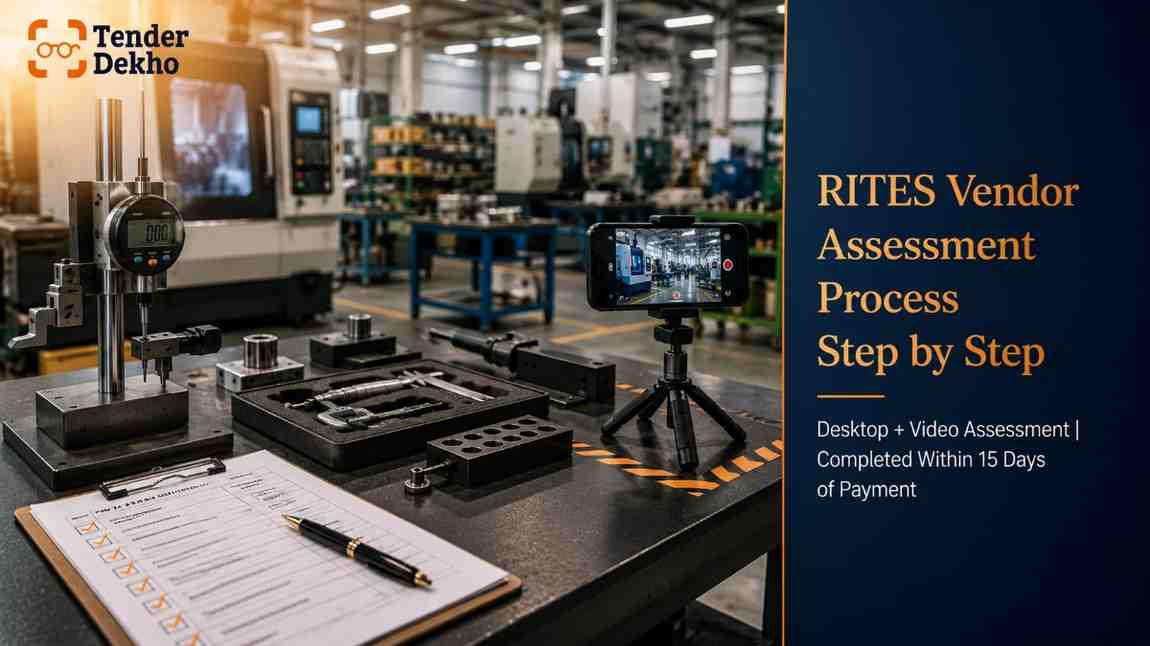
The GeM OEM panel activation follows a clear sequence. Skipping any step — especially vendor assessment — results in application rejection and delays that could run into months. Follow this exact order.
Step 1: Register as a Seller on GeM (gem.gov.in)
What: Create your seller account on the official portal.
How:
- Visit gem.gov.in and click "Sign Up" under Seller
- Enter your Aadhaar-linked mobile number and validate with OTP
- Enter PAN details — these auto-fetch your GST and bank information
- Fill in your business type, address, and contact details
- Pay caution money: ₹5,000 for turnover below ₹1 crore; ₹10,000 for ₹1–10 crore; ₹25,000 for above ₹10 crore
Time: 30–60 minutes | Cost: Caution money as above | Portal: gem.gov.in
Step 2: Initiate Vendor Assessment Request on GeM Portal
What: Raise a Vendor Assessment (VA) request from within your GeM seller dashboard.
How:
- Log in to your GeM seller dashboard
- Navigate to the "Vendor Assessment" section
- Select your role: Manufacturer / OEM
- Choose the assessment type (Video Assessment for OEMs)
- Update your vendor profile with contact details, production capacity, sales data, and financial information
- Submit raw material purchase invoices and sales invoices from the last 3 years
- Submit the application — RITES login credentials are sent to your registered email and mobile
Time: 1–2 working days to set up | Cost: VA fee paid directly to RITES (non-refundable; varies by category and turnover) | Portal: gem.gov.in → Seller Dashboard → Vendor Assessment
While waiting for RITES login credentials, use this time to browse current GeM tenders on TenderDekho and shortlist the product categories you plan to target after OEM activation.
Get instant tender alerts — completely free
New government tenders are published daily. Get notified instantly for the ones that match you.
Step 3: Complete Desktop Assessment on RITES Portal
What: Upload all required documents on the RITES vendor portal for verification.
How:
- Log in to the RITES Vendor Portal using credentials received via email/SMS
- Upload the complete document set:
- Company Registration Certificate
- GST Certificate (company + manufacturing site)
- Factory or manufacturing license
- PAN card
- Bank account details
- Sales invoices (3 years)
- Raw material purchase invoices (3 years)
- Manufacturing agreements (if using third-party production)
- Quality certifications (ISO, BIS — if applicable)
- Pay the RITES Vendor Assessment fee online
- If RITES finds discrepancies, you must resolve them within 2 working days
Time: Document preparation takes 2–5 days; RITES evaluation begins within 15 days of payment | Portal: RITES Vendor Portal (credentials provided after GeM application)
| Assessment Stage | What Is Verified | Who It Applies To | Timeline |
|---|---|---|---|
| Desktop Assessment | Physical presence, financial profile, business credentials, supply capability | All OEMs and resellers | Part of 15-day window |
| Video Assessment | Manufacturing process, production capacity, quality control — via video call with geo-tagging | OEMs / Manufacturers only | Part of 15-day window |
Source: GeM Vendor Validation Policy v3.4 / RITES assessment framework, 2025
Step 4: Complete Video Assessment
What: RITES conducts a live, remote inspection of your manufacturing facility via video call.
How:
- RITES schedules the video call after Desktop Assessment clears
- Ensure your manufacturing floor, equipment, and production lines are visible and operational during the call
- Keep all licenses, quality certifications, and raw material stocks accessible for camera review
- The inspector uses a mobile-based application with geo-tagging to validate the physical location
- Respond to all questions about production capacity, processes, and quality control procedures
Tips for passing Video Assessment:
- Ensure strong internet connectivity at the factory
- Brief your floor supervisor about the inspection before the call
- Keep all documents visible and organized
- Match the exact address registered on your GeM and GST certificates — any mismatch is a common rejection trigger
Step 5: Review Draft Report and Receive VA Certificate
What: RITES provides a draft Vendor Assessment Report before final submission to GeM.
How:
- Review the draft report carefully for any inaccuracies
- If you disagree with any observation, raise a dispute with RITES within 5 days of receiving the draft
- After resolution (or no dispute), the final report is submitted to GeM
- Your OEM Panel is activated and the "VA Verified" tag appears on your seller profile
- Your Vendor Assessment ID (VA ID) is generated — this is proof of completion
Validity: 3 years. Apply for renewal at least 2 months before expiry to avoid a lapse in OEM panel access.
Step 6: Activate Your OEM Panel and List Products
What: Use your OEM panel to list your brand, upload products, and manage resellers.
How:
- Go to your GeM seller dashboard — the OEM Panel tab is now active
- List your brand (registered or unregistered trademark)
- Upload product catalogues with specifications, images, and pricing
- For Q2 products: generate authorization codes for approved resellers
- For Q3 and Q4 products: review reseller catalogue requests within 72 hours (failure to respond within 72 hours freezes your own product uploads until pending requests are cleared)
For OEM panel registration support and catalogue listing, TenderDekho's GeM services team can guide manufacturers through the complete process from document preparation to OEM panel activation.
| Action in OEM Panel | Q1 | Q2 | Q3 | Q4 |
|---|---|---|---|---|
| Direct product listing | ✅ Yes | ✅ Yes | ✅ Yes | ✅ Yes |
| Reseller authorization codes | ❌ N/A | ✅ Generate codes | ✅ Approve/reject catalogues | ✅ Approve/reject catalogues |
| Resellers allowed | ❌ No | ✅ Yes (authorized) | ✅ Yes (approved) | ✅ Yes (open) |
| VA mandatory | ✅ Yes | ✅ Yes | ✅ Yes | ✅ Yes |
Source: GeM portal OEM framework; compiled from GeM policy documents, 2025
Common Mistakes to Avoid During GeM Vendor Assessment
The Vendor Assessment process has several checkpoints where applications stall or get rejected. Most failures come from avoidable documentation errors rather than genuine ineligibility.
| Common Mistake | Why It Causes Rejection | Fix |
|---|---|---|
| GST address mismatches company address | RITES cannot verify physical presence | Update GST with correct manufacturing site address before applying |
| Missing sales invoices for 3-year period | Cannot establish business track record | Collect all invoices upfront — RITES requires complete 3-year data |
| Weak internet during Video Assessment | Geo-tagging fails; assessment cannot be completed | Use a wired internet connection or strong mobile data at factory |
| Submitting outdated BIS or ISO certificates | Expired documents trigger Desktop Assessment failure | Renew all quality certifications before initiating VA |
| Inconsistent PAN-GST data | Data mismatch triggers automatic flag in system | Verify PAN and GST data match before GeM registration |
| Not responding to RITES queries within 2 days | Application gets stalled; clock restarts | Monitor RITES portal and registered email daily after submission |
| Applying in wrong product category | Assessment is category-specific; wrong category wastes time and fees | Map your product to the correct category before applying |
According to published RITES guidelines (2025), vendors who fail assessment receive written observations from RITES with the specific reasons for non-compliance. They can rectify the issues and reapply — but the fee is non-refundable.
MSME Advantage in the OEM Panel Process
If your manufacturing business is registered as an MSME under Udyam, the GeM OEM journey comes with significant built-in advantages that larger businesses do not get.
According to the Public Procurement Policy enforced by the government, at least 25% of total central government procurement must come from MSMEs. With GeM processing over ₹5 lakh crore in annual procurement in FY 2025-26 per GeM portal data (2026), that translates to over ₹1 lakh crore in procurement where MSME sellers receive mandated preference.
Key MSME benefits for OEMs on GeM:
- EMD exemption: Udyam-registered OEMs are exempt from paying Earnest Money Deposit (EMD) — a saving of 1–2% of tender value on every bid, according to TenderDekho's GeM bidding data (2025 data)
- Price preference (L1 matching): If your bid is within 15% of the lowest bid (L1), you can match the L1 price and win the contract
- Relaxed experience norms: Prior work experience criteria are significantly relaxed for MSMEs, making it easier to qualify for your first large government contracts
- Caution money reduction: MSMEs with Udyam certificates get 60% reduction on caution money for sellers with turnover below ₹1 crore, according to GeM portal policy (2025)
- Assessment exemption for small sellers: Sellers with annual turnover at or below ₹5 lakh are exempt from the VA process entirely
- Access to MSME-only tenders: Certain procurement categories are reserved exclusively for MSME OEMs — these bids face fewer competitors by design
If you have not yet completed Udyam registration, do that at udyamregistration.gov.in before initiating your GeM OEM panel application. The process takes under 10 minutes with Aadhaar and PAN.
For GeM seller registration support for MSMEs, TenderDekho's dedicated MSME GeM onboarding service helps manufacturers complete registration, VA documentation, and catalogue setup in one streamlined workflow.
Competitor Intelligence Dashboard
6-module analysis platform · Paid feature
Know exactly who's beating you — and how to win next time.
Go beyond basic search. Analyse bid history, win rates, and head-to-head performance for any company across 8 years of government tender results.
7L+
Companies
6
Intel Modules
8 Yrs
Bid History
AI
Insights Engine
FAQs: GeM OEM Panel and Vendor Assessment in 2026
Is Vendor Assessment mandatory for every GeM seller?
No. It is mandatory for OEMs in Q1 and Q2 product categories, and for any OEM who wants to manage resellers through the OEM panel. For other categories, it is optional but strongly recommended — the "VA Verified" tag directly improves buyer confidence and bid selection probability.
Who conducts Vendor Assessment on GeM in 2026?
RITES (Rail India Technical and Economic Service) is the designated Vendor Assessment agency for GeM as of 2025, replacing QCI (Quality Council of India). All Desktop Assessment and Video Assessment processes are handled by RITES online and via video call. Existing QCI certificates remain valid until their expiry date, but all new applications and renewals go through RITES.
How long does the GeM OEM Vendor Assessment take?
RITES is committed to completing the assessment within 15 days of fee payment, per GeM policy. However, document preparation — collecting three years of invoices, quality certificates, and facility details — can take an additional 1–2 weeks before you even submit. Plan for a total timeline of 4–6 weeks from starting document collection to receiving your VA certificate.
What is the validity period of the Vendor Assessment certificate?
The VA certificate is valid for 3 years. You must apply for renewal at least 2 months before expiry. If your certificate lapses, your OEM panel access and product listings can be suspended until reassessment is complete.
Can an MSME get OEM panel status on GeM?
Yes. MSMEs are fully eligible and actively encouraged. In fact, Udyam-registered MSMEs benefit from EMD exemptions, price preference in bids, caution money reductions, and — for very small sellers — potential exemption from the Vendor Assessment process altogether. MSMEs should complete Udyam registration before applying for OEM status to maximise all available benefits.
What happens if my Vendor Assessment is rejected?
RITES provides written observations explaining the reasons for rejection. You can rectify the identified issues and reapply. Common rejection reasons include document mismatches, inadequate production evidence, and technical failures during the Video Assessment. Note that the assessment fee is non-refundable, so thorough document preparation before submission significantly reduces this risk.
Your 30-Day OEM Panel Activation Plan

Getting your OEM panel on GeM is achievable in 30 days with disciplined preparation. Here is a week-by-week roadmap:
| Week | Actions | Outcome |
|---|---|---|
| Week 1 | Complete Udyam registration (if MSME); open GeM seller account; map your products to correct GeM categories | GeM seller account active; categories confirmed |
| Week 2 | Collect all 3-year invoices, factory license, GST, BIS/ISO certificates; verify PAN-GST address match | Full document package ready |
| Week 3 | Initiate Vendor Assessment on GeM portal; pay RITES fee; log in to RITES portal; complete Desktop Assessment document upload | RITES Desktop Assessment submitted |
| Week 4 | Complete RITES Video Assessment; review draft report; dispute any inaccuracies within 5 days; receive VA certificate | OEM panel activated; VA Verified tag live |
| After activation | List brand, upload product catalogue, set up reseller authorization (Q2/Q3/Q4) | Ready to win government contracts |
Once your OEM panel is active, the next priority is identifying the right tenders to bid on. Find government procurement tenders matched to your product categories on TenderDekho — the platform aggregates live alerts from GeM and 50+ other portals daily.
For comprehensive support from document preparation through OEM panel activation, TenderDekho's GeM OEM panel services and GeM bid participation support give manufacturers an end-to-end pathway to government sales without navigating RITES processes alone.
The GeM platform processed over ₹5 lakh crore in FY 2025-26 alone. Every month you operate without an active OEM panel is a month your products remain invisible to the government buyers who need them. Start your document preparation today — your 3-year VA certificate is worth far more than the weeks it takes to get it.