
Over ₹1.64 lakh crore in projects. Eight thousand contracts across 100 cities. And yet, as the original Smart Cities Mission (SCM) formally wound down in March 2025, a new procurement wave is already taking shape. If you supply ICT solutions, surveillance systems, urban mobility technology, or civil infrastructure services, the smart city tender market in India 2026 is not shrinking — it is transforming.
The Special Purpose Vehicles (SPVs) set up under SCM continue to operate. States are issuing new contracts under AMRUT (Atal Mission for Rejuvenation and Urban Transformation) 2.0. And city governments are running their Integrated Command and Control Centres (ICCCs), which require annual maintenance, upgrades, and tech refresh tenders. Explore smart city and urban infrastructure tenders on TenderDekho updated daily across all 36 states and union territories.
| Market Snapshot | Value |
|---|---|
| Total SCM projects completed (Dec 2025) | 7,741 projects worth ₹1,55,386 crore |
| Ongoing projects as of Dec 2025 | 323 projects worth ₹9,425 crore |
| Cities with fully operational ICCCs | All 100 smart cities |
| India smart city market CAGR (2023–2031) | 25.2% (estimated) |
| Budget 2026 urban infrastructure unlocked | ₹15.39 lakh crore over 7 years |
| AMRUT 2.0 cities covered | 500+ cities |
Source: Parliament reply (Rajya Sabha, December 2025); IBEF (2025 data); Mordor Intelligence (2026 data)
Why Smart City Tenders in India 2026 Still Represent Major Opportunity
The common misconception is that smart city tenders ended when the SCM closed. That is not accurate. Three separate procurement streams are now active simultaneously in 2026.
Stream 1 — SCM Residual Contracts: According to a Rajya Sabha reply from the Ministry of Housing and Urban Affairs (December 2025), 323 projects worth ₹9,425 crore were still ongoing as of December 1, 2025. These contracts involve civil completion works, system commissioning, and final acceptance testing — all of which generate sub-contracts and O&M (operation and maintenance) tenders.
Stream 2 — ICCC Operations and Upgrades: The Ministry issued an advisory in June 2025 to all states and UTs, directing SPVs to continue operating their ICCCs and outlining a roadmap for long-term functioning. This means software maintenance, hardware refresh, sensor network upgrades, and cybersecurity audits are now an annual procurement cycle in all 100 cities.
Stream 3 — AMRUT 2.0 and New Urban Schemes: AMRUT 2.0, covering 500+ cities, funds water supply, drainage, urban mobility, and green space development. Many of these contracts incorporate smart technology components — from IoT-based water metering to AI-powered traffic signal systems. This stream alone represents thousands of fresh tenders in 2026.
For vendors and contractors, the question is not whether smart city contracts exist. It is: which cities are issuing the most, and in which categories?
The Cities Awarding the Most Smart City Contracts in 2026
City-level procurement activity in 2026 is best understood through two lenses: expenditure under SCM (which signals SPV maturity and ongoing O&M capacity) and AMRUT 2.0 pipeline activity.
Top Cities by SCM Expenditure and Project Volume
According to RTI data cited by Trak.in (February 2026) sourced from the Ministry of Housing and Urban Affairs, the following cities recorded the highest total project expenditure under SCM:
| City | State | Projects Completed | Approx. Expenditure | Key Focus Areas |
|---|---|---|---|---|
| Indore | Madhya Pradesh | 231 | ₹3,751 crore | Smart roads, ICCC, waste management |
| Varanasi | Uttar Pradesh | 117 | ₹3,342 crore | Heritage area smart infra, command centres |
| Tripura (Agartala) | Tripura | — | ₹2,833 crore | City digitisation, urban mobility |
| Surat | Gujarat | 87 | ₹2,694 crore | PPP smart mobility, BRTS tech |
| Salem | Tamil Nadu | 114 | ₹1,861 crore | Water management, smart streets |
| Shivamogga | Karnataka | — | ₹1,381 crore | Greenfield smart infrastructure |
Source: RTI reply from Ministry of Housing and Urban Affairs, cited in Trak.in (February 2026 data)
Higher historic expenditure cities tend to generate more O&M and upgrade contracts in 2026, because their smart systems are already operational and require active maintenance. Indore, Surat, and Varanasi are three cities where vendors should monitor procurement portals closely for refresh and operations tenders.
States with the Highest Number of Smart Cities
Understanding state-level distribution helps you plan where to register as a vendor and which state procurement portals to track.
| State | No. of Smart Cities | Notable Cities | Central Allocation (approx.) |
|---|---|---|---|
| Uttar Pradesh | 10 | Lucknow, Varanasi, Agra, Kanpur | ₹4,900 crore |
| Maharashtra | 10 | Pune, Nagpur, Nashik, Aurangabad | ₹4,300 crore |
| Tamil Nadu | 12 | Chennai, Madurai, Coimbatore, Salem | ₹3,000 crore+ |
| Karnataka | 6 | Belagavi, Shivamogga, Hubballi-Dharwad | — |
| Rajasthan | 6 | Jaipur, Udaipur, Ajmer | — |
| Gujarat | 6 | Surat, Rajkot, Ahmedabad, Vadodara | — |
Source: IndiaDataMap (November 2025 data); IBEF Smart Cities Mission overview (2025)
Tamil Nadu with 12 smart cities is the largest single state by city count. Both Madurai and Coimbatore completed all SCM projects by early 2025, according to IndiaDataMap, making them prime candidates for the next round of AMRUT 2.0 contracts. Track government tenders across Maharashtra and Tamil Nadu in real time.
What Types of Smart City Tenders Are Being Issued in 2026
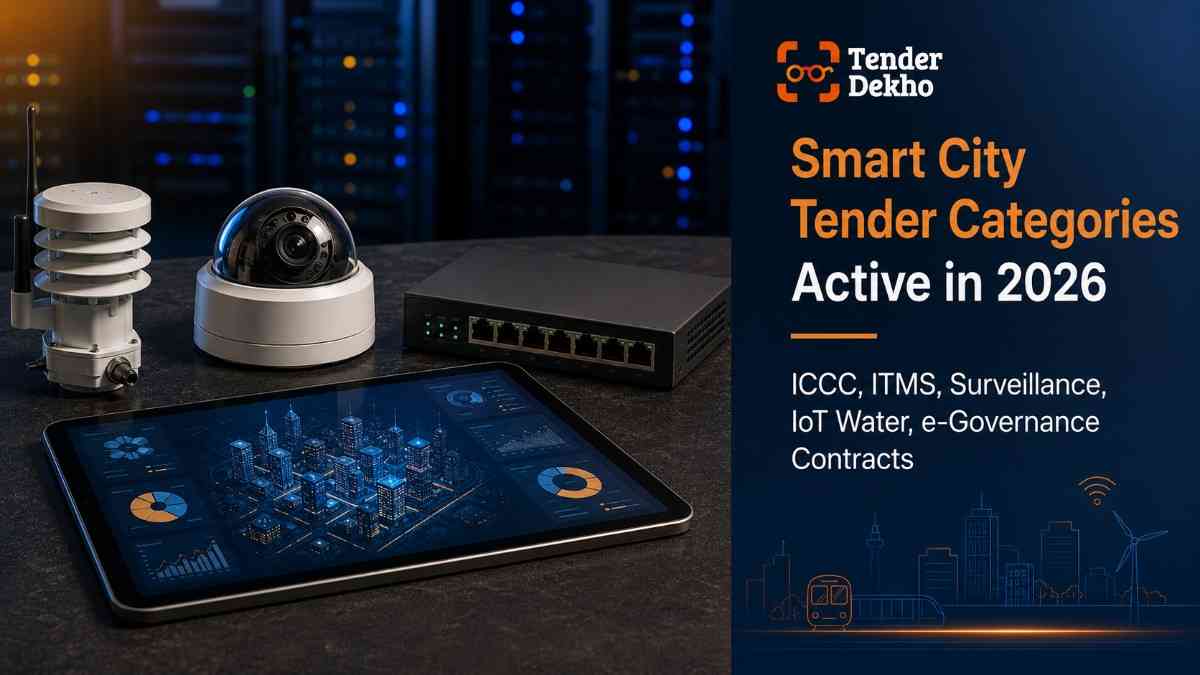
Smart city procurement in 2026 has shifted from large greenfield projects to a more fragmented mix of O&M, technology upgrades, and new AMRUT 2.0 civil works. Understanding the tender categories helps you identify where your business fits.
Key Contract Categories Active in 2026
- ICCC Operations and Maintenance: All 100 smart cities now have operational ICCCs. Annual O&M contracts for hardware, software, and network infrastructure are issued every financial year. Values typically range from ₹2 crore to ₹50 crore per city.
- Integrated Traffic Management Systems (ITMS): Traffic signal automation, AI-based enforcement cameras, and variable message signs continue to generate new tenders — both fresh installations in AMRUT cities and upgrades in SCM cities.
- Smart Surveillance and Safety: Intelligent City Surveillance Systems (ICSS) covering CCTV expansion, facial recognition integration, and gunshot detection systems. According to Mordor Intelligence (2026 data), smart public safety is the fastest-growing segment globally at a 17.24% CAGR.
- Smart Water and Utility Management: IoT-based water metering, leak detection, and SCADA systems for water supply — core to AMRUT 2.0 which mandates water security for all covered cities.
- Smart Roads and Urban Mobility: Construction of smart roads, EV charging infrastructure, non-motorised transport lanes, and bus rapid transit technology upgrades.
- e-Governance and Citizen Services: Online building permission systems, integrated citizen portals, grievance redressal systems, and digital payment infrastructure.
- Data Analytics and GIS Services: Geospatial surveys, GIS-based master plan formulation, and city data platform management — a growing category with AMRUT 2.0 mandating GIS-based planning for all covered cities.
| Tender Category | Typical Value Range | MSME Accessible? | Primary Portal |
|---|---|---|---|
| ICCC O&M | ₹2–50 crore | ⚠️ Consortium preferred | State eprocurement |
| ITMS and traffic tech | ₹1–30 crore | ⚠️ Joint venture possible | CPPP / state portals |
| Smart surveillance | ₹50 lakh–15 crore | ✅ Sub-₹2 crore is common | State SPV portals |
| Smart water / IoT | ₹25 lakh–5 crore | ✅ Yes | AMRUT 2.0 ULB portals |
| e-Governance platforms | ₹50 lakh–10 crore | ✅ IT MSMEs eligible | State / NIC portals |
| GIS surveys | ₹15 lakh–2 crore | ✅ Yes | State eprocurement |
Note: MSME accessibility assessed by typical eligibility criteria; always read specific tender conditions. Data estimated.
Regional Procurement Patterns: Where to Focus Your Bidding in 2026
Not all smart city tenders are equally concentrated. Procurement intensity in 2026 follows historic mission investment, state administrative capacity, and AMRUT 2.0 pipeline.
North India
Uttar Pradesh leads the north with 10 smart cities and the largest state-level allocation at ₹4,900 crore, 100% of which had been drawn by July 2025 (IndiaDataMap, 2025 data). Lucknow, Varanasi, and Agra are the most active cities for ICT and urban governance contracts. Lucknow's ICCC is one of the most sophisticated in the country, generating recurring annual O&M tenders. Browse UP urban development and smart city tenders across all 10 cities.
Delhi NCT benefits from NDMC (New Delhi Municipal Council) procurement, separate from UP's SCM cities. NDMC contracts for smart street lighting, surveillance, and citizen services tend to be high-value and competitive.
Get instant tender alerts — completely free
New government tenders are published daily. Get notified instantly for the ones that match you.
West India
Gujarat's Surat achieved 100% project completion by 2024 through a combination of government funding and public-private partnerships (PPPs) that brought in an additional ₹5,000 crore, according to IndiaDataMap (2025 data). Surat is now in maintenance mode — meaning smaller, more accessible O&M contracts are available regularly. Rajkot is another Gujarat city where surveillance and traffic enforcement tenders are actively issued through the Rajkot Smart City Development Ltd (RSCDL).
Maharashtra's 10 smart cities include Pune, Nagpur, and Nashik. Pune's Smart City Development Corporation is one of the most active SPVs in the country, issuing tenders for VMS (Variable Messaging Sign) monetisation, urban mobility systems, and ICT infrastructure. Nagpur, with its focus on transport innovation, regularly issues BRTS-linked technology tenders.
South India
Tamil Nadu has the most smart cities of any state at 12, making it the highest-volume procurement state in the south. Salem and Coimbatore have both completed all SCM projects and are transitioning to AMRUT 2.0 contracts for water and sanitation. Thiruvananthapuram (Kerala) recently won a national award for innovative transportation solutions, signalling continued technology procurement activity.
Karnataka's Shivamogga, Belagavi, and Hubballi-Dharwad have recorded significant expenditure and are in active O&M phases. Bengaluru, though not an SCM city, issues urban tech tenders through the BBMP and Bengaluru Metropolitan Region Development Authority.
Central India
Madhya Pradesh won the Best State Award at the India Smart Cities Award (ISAC) 2022 (Deccan Herald, 2022 data), and Indore topped the national city ranking with 231 projects completed and the highest total expenditure at ₹3,751 crore. Bhopal and Jabalpur round out MP's three active smart cities. All three are mature SPV cities with active maintenance and upgrade procurement cycles.
How MSMEs Can Participate in Smart City Tenders
The smart city procurement ecosystem can look intimidating from the outside. Large ICT companies like Larsen & Toubro and Tech Mahindra have historically led the big system integration contracts. But the reality is that every large contract is supported by a supply chain of smaller vendors — and many direct tenders are sized for MSMEs.
Where MSMEs Fit in the Smart City Supply Chain
- Component suppliers: Sensors, cameras, enclosures, networking hardware
- Software service providers: Mobile apps, dashboards, analytics modules
- Civil contractors: Smart road construction, footpath upgrades, EV charging bays
- Operations partners: Daily maintenance, security manpower, data entry operations
- Consultants: GIS surveys, feasibility reports, master plan formulations
MSMEs registered on Udyam get two key benefits that make smart city bidding more accessible. First, they can claim exemption from paying the EMD (Earnest Money Deposit), which for a ₹2 crore project can mean not having to lock up ₹2–4 lakh in bank guarantees per bid. Second, they receive a 15% price preference in procurement — meaning even if you are not the lowest bidder, you may still win. Find MSME-eligible smart city and urban tenders filtered by state, category, and value.
MSME Entry Strategy for Smart City Tenders
- Start with sub-works and supply contracts under ₹50 lakh — eligibility criteria are simpler and EMD exemption applies fully.
- Register on the SPV portal of your target city. Cities like Indore, Surat, and Pune publish many tenders directly on their SPV websites and CPPP.
- Track AMRUT 2.0 tenders through state urban development portals. ULB (Urban Local Body) tenders under AMRUT 2.0 are smaller in scale and better suited to MSME capacity.
- Form consortiums for larger contracts — many smart city tenders explicitly allow joint bidding where you can combine turnover and experience certificates.
- Build sector experience first — one executed smart city sub-contract becomes the eligibility credential for the next, larger direct tender.
How to Position Your Business for Smart City Tenders in 2026
Winning smart city contracts requires more than just price competitiveness. These are technology-first contracts, and procurement officers evaluate technical capability as seriously as financial capacity.
| Preparation Area | What to Do | Timeline |
|---|---|---|
| Udyam registration | Register at udyamregistration.gov.in for MSME benefits | 1–3 days |
| DSC (Digital Signature Certificate) | Obtain Class 3 DSC for eprocurement portals | 3–5 days |
| CPPP registration | Register at eprocure.gov.in for central tenders | 1 day |
| State SPV portal registration | Register on SPV portals of target cities | 1 day each |
| Technical pre-qualification | Prepare project experience certificates, ISO certifications | Ongoing |
| Sector-specific credentials | STQC certification, NICSI empanelment for IT tenders | 30–60 days |
Once registrations are in place, the key discipline is consistent monitoring. Smart city tenders can have bid deadlines as short as 14 days from publication date. Set up daily smart city tender alerts on TenderDekho so you never miss a bid window.
Competitor Intelligence Dashboard
6-module analysis platform · Paid feature
Know exactly who's beating you — and how to win next time.
Go beyond basic search. Analyse bid history, win rates, and head-to-head performance for any company across 8 years of government tender results.
7L+
Companies
6
Intel Modules
8 Yrs
Bid History
AI
Insights Engine
FAQs: Smart City Tenders India 2026
Is the Smart Cities Mission still issuing new tenders in 2026?
The original SCM formally closed on March 31, 2025 without new budgetary allocations. However, ongoing projects, SPV O&M contracts, and AMRUT 2.0 continue generating substantial procurement. All 100 city SPVs remain operational. The Ministry's June 2025 advisory confirmed SPVs will continue running ICCCs and can raise funds independently through PPPs, bonds, and state contributions.
Which city issues the highest value smart city tenders?
Based on cumulative SCM expenditure data from an RTI reply (February 2026), Indore leads with ₹3,751 crore spent across 231 projects, followed by Varanasi (₹3,342 crore) and Surat (₹2,694 crore). In terms of ongoing 2026 procurement activity, Pune, Lucknow, Rajkot, and Surat are among the most consistently active cities for new tender issuance.
Can MSMEs win smart city tenders directly?
Yes. Many categories — including GIS surveys, software services, civil sub-works, sensor supply, and operations — have individual tender values well within MSME reach. Udyam-registered MSMEs get EMD exemption and 15% price preference, which are significant advantages. The most practical approach is to target tenders under ₹1 crore in the first year and build a track record.
Which government portals should I monitor for smart city tenders?
- CPPP (Central Public Procurement Portal): eprocure.gov.in — central ministry and many SPV tenders
- State eprocurement portals: Each state has its own portal (e.g., mptenders.gov.in for MP, mahatenders.gov.in for Maharashtra)
- Individual SPV websites: Cities like Surat, Indore, and Pune maintain separate tender sections on their SPV websites
- AMRUT 2.0: Tenders flow through state urban development departments and ULBs
What sectors within smart city tenders are growing fastest in 2026?
According to Mordor Intelligence (2026 data), smart public safety systems are the fastest-growing segment at a projected 17.24% CAGR globally. In India, AI-based traffic enforcement, intelligent surveillance, and emergency response technology are the most active categories for new contract issuance. Smart utilities (water metering, smart grids) follow closely.
Is there a benefit for MSME vendors in joining a consortium for large tenders?
Yes. Most smart city tenders above ₹5 crore allow or explicitly encourage joint venture or consortium bidding. One lead bidder handles the financial qualification, while technical partners contribute specific domain credentials. This lets MSMEs participate in larger contracts without meeting the full eligibility criteria independently. Always confirm the consortium structure rules in the specific tender document before forming one.
Conclusion: Building Your Smart City Tender Pipeline in 2026

The Smart Cities Mission was only the first chapter of India's urban technology procurement story. With all 100 city ICCCs now operational, AMRUT 2.0 covering 500+ additional cities, and Budget 2026 unlocking ₹15.39 lakh crore in infrastructure investment over seven years (IBEF, 2025 data), the volume of smart-city-linked tenders is set to grow — not shrink.
The cities issuing the most contracts today — Indore, Varanasi, Surat, Pune, Lucknow, and Rajkot — are not starting fresh procurement cycles. They are managing operational systems that require continuous technology support. That is a more stable, more repeatable procurement opportunity than a one-time greenfield contract.
Your 30-Day Action Plan:
| Week | Action |
|---|---|
| Week 1 | Complete Udyam registration and obtain Class 3 DSC |
| Week 2 | Register on CPPP, state eprocurement portal, and SPV portals of 2–3 target cities |
| Week 3 | Identify 5 active smart city tenders in your service category; download and read bid documents |
| Week 4 | Prepare your first bid — focus on a sub-₹50 lakh tender to build initial track record |
Start your smart city tender search on TenderDekho — browse active urban and ICT tenders across all 100 smart cities and 500+ AMRUT cities. For further reading on government procurement strategy and tender guides, explore the TenderDekho blog. Questions? Visit the TenderDekho FAQ for answers on registration, eligibility, and bidding.
Smart city procurement in India 2026 rewards the bidder who shows up consistently, registers on the right portals, and bids on the right-sized opportunities. The cities are issuing contracts. The question is whether your business will be ready to respond.