
Water Supply Tenders in India 2026: Market Opportunities, Key Buyers & How to Win
India's water supply and water infrastructure sector is one of the largest government procurement arenas in the country — and in 2026, it is also one of the most active. With the Jal Jeevan Mission backed by a total central outlay of ₹2.08 lakh crore and AMRUT 2.0 committing a further ₹2.98 lakh crore to urban water and sewerage networks, water supply tenders now span everything from rural pipe-laying and RO plant installation to smart SCADA systems and mega water treatment plants. There are currently 2,225+ active water supply tenders across India — a combined opportunity value of ₹280.9 crore for the current active batch alone. This guide covers the market landscape, top issuing organisations, tender types, regional distribution, and a practical step-by-step roadmap for contractors, pipe suppliers, and service providers looking to participate.
Market Snapshot
| Indicator | Data | Source |
|---|---|---|
| Sector Market Size | ₹86,300+ crores (~USD 10.4 billion, FY25) | Equity Edge Research (2026) |
| Growth Rate | 7.2% CAGR (FY25–FY34) | Equity Edge Research (2026) |
| Active Tenders | 2,225+ (as of May 2026) | TenderDekho |
| Combined Active Value | ₹280.9 crore (current batch) | TenderDekho |
| Top Issuing Dept. | PHE / PHED | TenderDekho (May 2026) |
This guide covers everything from understanding the market and identifying the right buyers, to meeting eligibility requirements and submitting a winning bid.
Explore live opportunities: Browse active water supply tenders from all states and departments, updated daily.
Market Overview & Growth Potential
Current Landscape
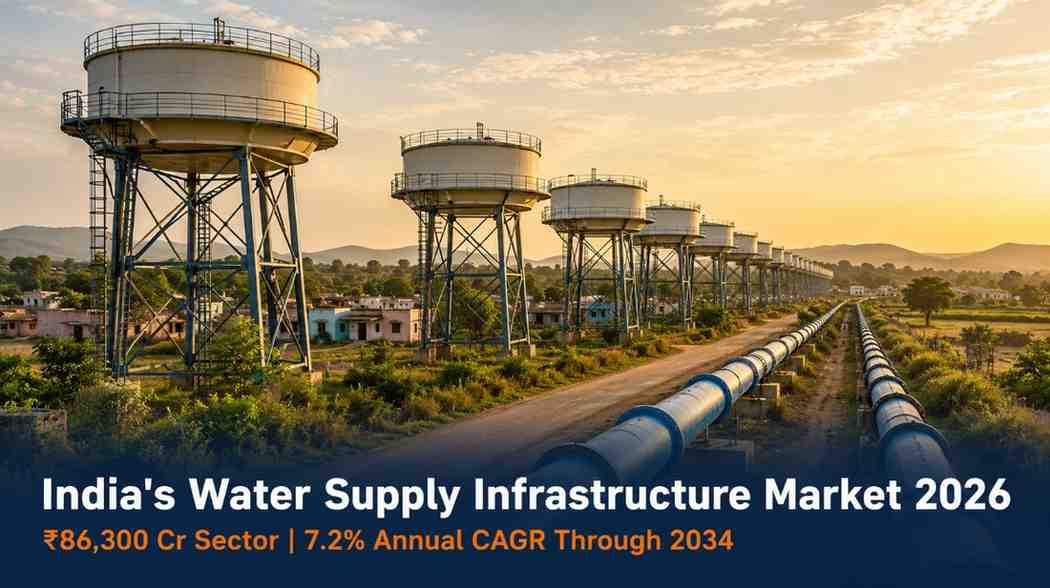
India's water and wastewater infrastructure sector was valued at approximately USD 10.4 billion (₹86,300 crores) in FY25 and is projected to reach USD 19.4 billion by FY34, growing at a 7.2% CAGR, according to Equity Edge Research (2026). Within this, the water and wastewater treatment technology segment alone stands at USD 2.98 billion (₹24,700 crores) in 2025 and is forecast to reach USD 5.17 billion by 2031 at a 9.62% CAGR, according to Mordor Intelligence (2025 data). The government's water infrastructure programme is among the largest public spending programmes in Indian history — Jal Jeevan Mission (Har Ghar Jal) has extended tap water connections to over 15.72 crore rural households, bringing rural coverage from 16.7% in 2019 to 81.71% by March 2026, as documented by the Ministry of Jal Shakti (March 2026).
Key Growth Drivers
1. Jal Jeevan Mission — Functional Water Security Phase
- What it means: With physical infrastructure largely built, the mission has shifted focus to service delivery quality — regular supply, O&M contracts, and water quality testing — generating sustained maintenance and upgrade tenders through 2028.
- Data point: The 2024 Functionality Assessment Survey found that while nearly 98% of rural households had tap connections, only around three-fourths received regular, safe, and adequate water supply — signalling a new wave of remediation and O&M procurement.
2. AMRUT 2.0 — Urban Water and Sewerage Expansion
- What it means: AMRUT 2.0 has outlined investments of approximately USD 36 billion (₹2.98 lakh crore) to provide universal water supply coverage and sewerage infrastructure across all statutory towns in India.
- Data point: By June 2025, AMRUT 2.0 had approved 10,647 MLD of water treatment plant capacity and 6,739 MLD of sewage treatment plant capacity — per Ministry of Housing and Urban Affairs documentation — creating a large forward pipeline of construction and equipment tenders.
3. Smart Water Management Adoption
- What it means: State utilities are adopting SCADA systems, IoT-enabled metering, and AI-driven leak detection platforms — creating entirely new technology procurement categories alongside traditional civil works.
- Data point: Lucknow Municipal Corporation announced a ₹193-crore SCADA smart water management project under AMRUT in February 2025, reflecting a shift toward tech-intensive water tenders across major cities.
4. Water Pump and Pipeline Infrastructure Demand
- What it means: Jal Jeevan Mission and AMRUT together are generating massive demand for submersible and centrifugal pumps, HDPE/uPVC pipes, valves, and overhead tank construction across rural and urban India.
- Data point: India's water and wastewater pump market was valued at approximately USD 1.05 billion in 2025 and is projected to reach USD 1.7 billion by 2032 at an 8.22% CAGR, driven directly by government water supply programmes — per MarkNtel Advisors (2025 data).
Year-on-Year Market Projection
| Year | Water & Wastewater Sector (₹ Crores) | YoY Growth |
|---|---|---|
| 2023 | ~69,000 | — |
| 2024 | ~74,000 | ~7.2% |
| 2025 (Est.) | ~86,300 | ~7.2% |
| 2027 (Proj.) | ~99,000 | ~7.2% |
| 2031 (Proj.) | ~1,30,000 | ~7.2% |
Source: Equity Edge Research (2026); USD-INR conversion at ₹83/USD (estimated)
For contractors, pipe suppliers, pump manufacturers, and technology integrators, this trajectory means consistent government procurement activity at scale across every state for the rest of the decade.
Major Tender-Issuing Organizations
Water supply tenders are issued by a structurally diverse set of government bodies — from state PHE departments and urban local bodies to central PSUs and military engineering services. Understanding this landscape is the key to targeting the right opportunities.
Top Departments & Organizations
| Rank | Organization | Sector | Est. Annual Tenders | Avg. Value |
|---|---|---|---|---|
| 1 | PHE / PHED (State-level) | Rural & Urban Water Supply | 500–2,000+ | ₹5–500 lakhs |
| 2 | E-in-C Branch, Military Engineer Services | Defence Water Infrastructure | 100–250 | ₹5–50 lakhs |
| 3 | Municipal Affairs Department (WB) | Urban Water Distribution | 100–300 | ₹5–100 lakhs |
| 4 | Urban Development / AMRUT Departments | Urban Infrastructure | 80–200 | ₹50 lakhs–50 crores |
| 5 | Jal Boards (Delhi, Mumbai, state entities) | Urban Bulk Supply | 50–150 | ₹1–50 crores |
| 6 | Department of Local Government | Gram Panchayat Schemes | 100–400 | ₹2–50 lakhs |
| 7 | Border Roads Organisation (BRO) | Remote Area Infrastructure | 20–60 | ₹5–30 lakhs |
| 8 | Nuclear Power Corporation / ONGC / PSUs | Industrial Water Supply | 20–50 | ₹10–100 lakhs |
1. Public Health Engineering Department (PHE/PHED)
- Focus: Design, supply, construction, and O&M of piped water supply schemes in rural and peri-urban areas; Jal Jeevan Mission implementation at district level; water quality surveillance
- Recent example: WBPHED NIeT-69/AD/2025–2026, water supply carriage via motor van, ₹13.82 lakhs, Kultali Block, South 24 Parganas, West Bengal (eProcure, March 2026)
- Portal: State eProcure portals (West Bengal, Rajasthan, MP, Punjab); eprocure.gov.in
2. E-in-C Branch — Military Engineer Services
- Focus: Water supply infrastructure at military stations, cantonments, and defence establishments — pipelines, pump houses, water treatment, storage tanks
- Recent example: Water supply and piping maintenance contracts at multiple stations across India (GeM/CPPP, 2026)
- Portal: CPPP / eprocure.gov.in; GeM for smaller service and goods tenders
3. Urban Local Bodies and Municipal Departments
- Focus: AMRUT 2.0-funded water distribution network upgrades, 24x7 water supply projects, road restoration after pipe-laying, NRW (non-revenue water) reduction
- Recent example: Laying of 300mm MS water supply main to Mindspace IT Park, Hyderabad — ₹13.4 crores (eProcure Telangana, May 2026)
- Portal: State-level eProcure portals; NMMC, MCGM, DJB procurement portals
All active tenders from PHE departments, municipalities, military engineers, and central PSUs are consolidated in one searchable interface. Discover water supply tender opportunities across all states on TenderDekho.
Types of Water Supply Tenders
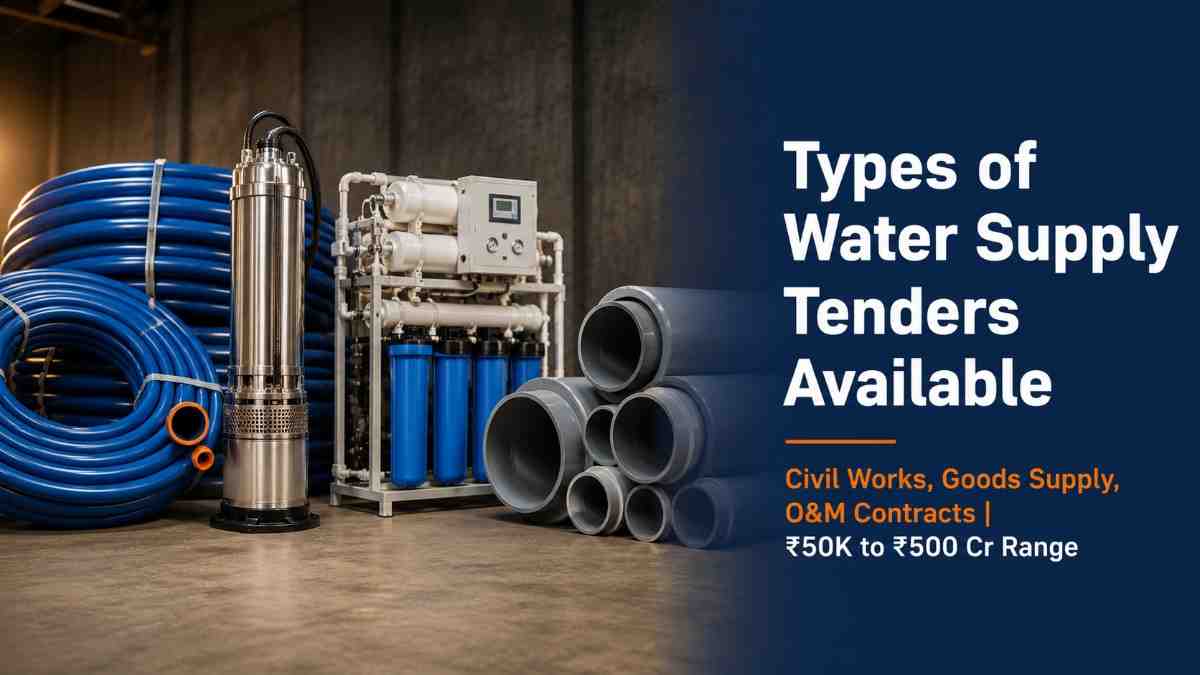
Water supply procurement spans a wide spectrum — from rural pipeline works costing ₹5 lakhs to mega urban water treatment plants worth hundreds of crores. Knowing your category is essential before bidding.
Category Comparison
| Type | Est. Share | Typical Value | Complexity | Key Buyers |
|---|---|---|---|---|
| Civil Works (Pipeline, OHT, Pump Houses) | ~40% | ₹10 lakhs–50 crores | High | PHE, AMRUT ULBs, PWD |
| Goods Supply (Pipes, Pumps, Valves, RO Systems) | ~30% | ₹1 lakh–5 crores | Medium | PHE, BRO, MES, PSUs |
| O&M / AMC Contracts | ~20% | ₹2–200 lakhs | Low–Medium | PHE, Municipalities, Defence |
| Technology / SCADA / Smart Systems | ~10% | ₹50 lakhs–200 crores | Very High | Urban bodies, AMRUT cities |
Civil Works Tenders (~40% of Tenders)
These are the backbone of Jal Jeevan Mission and AMRUT 2.0 procurement — construction of pipelines, overhead tanks, pump houses, intake structures, and water treatment plants. They require contractor registration with the relevant state PHE or PWD department.
What's typically procured:
- Laying and jointing of HDPE/DI/uPVC/MS pipelines (20mm to 2,000mm diameter)
- Construction of overhead water storage tanks (20,000 litres to 10 MLD capacity)
- Water treatment plant (WTP) civil and electrical works
- Pump house construction and electromechanical works
- Road restoration after pipe-laying works
Common specifications:
- Standard: IS 4985 (uPVC pipes), IS 8329 (DI pipes), IS 1239 (MS pipes), IS 3114 (CI pipes)
- Quantity: Single-village schemes to multi-village regional schemes
- Completion: 6 months to 3 years depending on scale
Pricing range: ₹5 lakhs (small village scheme) to ₹500 crores+ (mega urban WTP)
Goods Supply Tenders (~30% of Tenders)
Government departments procure water supply goods across GeM and eProcure portals year-round. This segment is accessible to manufacturers, authorised dealers, and MSMEs.
What's typically procured:
- uPVC pipes for water supply (IS 4985) — all pressure classes
- Ductile iron (DI) K7/K9 pipes and fittings
- Reverse Osmosis (RO) water treatment systems (above 50 LPH capacity)
- Submersible and centrifugal pump sets
- Water meters, pressure gauges, gate/butterfly valves
- HDPE float pontoons and pump installation infrastructure
Common specifications:
- Standard: BIS/ISI marking mandatory for pipes (IS 4985, IS 8329); IS 16240 compliance for RO systems
- GeM listing: Sellers must list under the correct GeM product category with valid BIS certificates
Pricing range: ₹50,000 (small RO unit) to ₹5 crores (bulk pipe supply)
O&M and AMC Contracts (~20% of Tenders)
Operation and maintenance contracts are the steadiest revenue stream in this category — repeat annual tenders from PHE departments, municipalities, and defence establishments for pump operation, scheme maintenance, and water quality monitoring.
What's typically procured:
- Annual rate contracts for leakage removal and pipeline repairs
- Pump operation and guarding contracts at water supply pumping stations
- Annual maintenance contracts for RO plants and water treatment units
- Water carriage contracts for emergency supply in water-stressed areas
Pricing range: ₹2 lakhs (small pumping station) to ₹200 lakhs (multi-scheme district O&M)
Where the Opportunities Are: State-Wise Distribution
Water supply tender activity is driven by programme intensity, population density, and infrastructure gaps. States with large rural populations under Jal Jeevan Mission and active AMRUT cities generate the highest volumes.
Top States for Water Supply Tenders
| Rank | State | Active Tenders | Key Drivers | Major Bodies |
|---|---|---|---|---|
| 1 | West Bengal | 479 | Dense rural population; JJM implementation | WB PHE, Municipal Affairs Dept |
| 2 | Madhya Pradesh | 155 | Large rural coverage gaps; PHE district divisions | MP PHED, Urban bodies |
| 3 | Maharashtra | 153 | AMRUT 2.0 urban projects; large municipalities | MCGM, Pune MC, NMMC, MIDC |
| 4 | Punjab | 143 | PHED rural schemes; border area military MES | Punjab PHED, MES |
| 5 | Gujarat | 123 | AMRUT cities; industrial water supply | GWSSB, AMC, Surat MC |
| 6 | Uttar Pradesh | High (leading overall portal) | Largest rural JJM rollout in India | UP Jal Nigam, Directorate of Local Bodies |
| 7 | Rajasthan | High | Water-stressed districts; PHED district tenders | Rajasthan PHED |
| 8 | Odisha | Medium | Tribal area JJM schemes; Kalahandi district | Odisha PHE |
Regional Highlights
East India:
- West Bengal leads by a wide margin with 479 active water supply tenders — the highest of any state on TenderDekho as of May 2026. Districts in West Midnapore, Malda, and the 24 Parganas consistently generate high PHE tender volumes for rural piped water schemes.
- Explore procurement from this region: West Bengal water supply tenders
Central India:
- Madhya Pradesh (155 active tenders) and Rajasthan both generate steady PHE and PHED district-level tenders for rural water supply construction, O&M contracts, and source development works.
- Madhya Pradesh water supply tenders span from small panchayat schemes to large district-level packages.
West India:
- Maharashtra (153 active tenders) and Gujarat (123) are driven by AMRUT 2.0 urban projects in Mumbai, Pune, Nagpur, Ahmedabad, and Surat — including large 24x7 supply conversion projects and WTP upgrades.
- Maharashtra water supply opportunities include both rural JJM and urban AMRUT streams.
North India:
- Punjab (143 tenders) combines PHED rural works with Military Engineer Services contracts at border cantonments, creating a dual-stream opportunity for contractors registered with both civilian and defence departments.
- Uttar Pradesh, as India's largest state, generates substantial Jal Jeevan Mission and Directorate of Local Bodies tenders, from panchayat overhead tanks to district multi-village schemes.
How to Participate in Water Supply Tenders
Water supply tenders span civil construction, goods supply, and operations — each with different registration requirements. This phase-by-phase guide covers the essentials for all three tracks.
Phase 1: Registrations & Setup
| Registration | Timeline | Cost | Portal |
|---|---|---|---|
| GST Registration | 7–10 days | Free | gstin.gov.in |
| MSME/Udyam Registration | 1–2 days | Free | udyamregistration.gov.in |
| Digital Signature (DSC) Class 3 | 2–3 days | ₹1,000–₹2,000 | Authorised CA |
| GeM Seller Registration | 3–5 days | Free | gem.gov.in |
| State eProcure Portal Registration | 1–3 days | Free | State-specific portals |
| PWD/PHE Contractor Registration | 15–60 days | ₹500–₹10,000 | State PWD/PHE offices |
Required certifications and licences:
- BIS/ISI marking on all pipes and fittings (IS 4985, IS 8329, IS 1239 — mandatory for goods supply)
- IS 16240 compliance for RO water treatment systems listed on GeM
- ISO 9001 certification preferred for larger civil contracts above ₹1 crore
- Plumber / Electrical Contractor Licence for installation and O&M tenders
- Class B, C, or D contractor registration with state PHE/PWD (based on contract value)
For sellers new to GeM, TenderDekho's GeM seller registration service covers the complete process — from entity setup to catalogue listing for water supply goods categories.
Phase 2: Finding the Right Tenders
With 73% of active water supply tenders published on eProcure and 10% on GeM (per TenderDekho, May 2026), and the remainder spread across state portals (Karnataka, Telangana, others), monitoring the full landscape manually is impractical. Consolidated discovery platforms dramatically reduce the search overhead.
Shortlist checklist:
- PHE/PWD contractor registration class matches the contract value
- Minimum average annual turnover of 1.5–2× the contract value over 3 years
- Experience in at least 2 similar completed projects (certified)
- BIS/ISI certificates valid for all goods being supplied
- EMD funds available (2–5% of tender value)
- Geographic reach — can supply or deploy to the relevant district
Find matching tenders daily: Explore water supply government tenders with filters for state, value range, and source portal.
Key platform features:
- State filter — Focus on West Bengal, Maharashtra, Punjab, or your target state
- Value filter — Match to your registered class and working capital
- Source filter — eProcure, GeM, or state portal as needed
- Email alerts — Receive notifications the moment new tenders are published
Phase 3: Bid Preparation
Technical proposal must include:
- PWD/PHE contractor registration certificate (class appropriate to contract value)
- Relevant experience certificates — 2 similar completed works with value, client name, and period
- BIS/ISI certificates for all materials proposed (pipes, fittings, pumps, RO systems)
- Machinery and manpower availability statement
- Technical compliance sheet against the Schedule of Requirements
Financial proposal must include:
- Rate analysis / Bill of Quantities (BOQ) — percentage rate or item rate as specified
- Bid Security / EMD: 2–5% of estimated cost (ranges from ₹5,200 to ₹13.4 lakhs in current TenderDekho listings)
- Turnover certificate from CA (last 3 financial years)
- Bank solvency certificate (required for tenders above ₹50 lakhs typically)
- GST registration certificate
For GeM-based goods tenders (pipes, pumps, RO systems), TenderDekho's GeM bid participation support provides end-to-end assistance from catalogue review to bid submission.
Phase 4: Submission Checklist
- Check portal — eProcure portals have state-specific document formats; download the correct BOQ and forms
- Apply Class 3 DSC — mandatory for all state eProcure and central CPPP submissions
- Upload all documents — technical bid + financial bid separately as per two-cover or three-cover system
- Pay EMD — via online NEFT/RTGS, BG, or portal payment gateway as specified
- Submit 2–3 hours before deadline — eProcure servers slow significantly near closing time
- Save acknowledgment — screenshot or download the bid receipt with timestamp
- Monitor for queries — buyers post clarification queries within 24–48 hours of technical bid opening
Frequently Asked Questions
Q1. What is the minimum eligibility to participate in water supply tenders?
- Valid GST registration, MSME/Udyam certificate, and Class 3 DSC
- Contractor registration with the relevant state PWD or PHE department (class depends on contract value)
- Minimum average annual turnover of 1.5–2× the contract value over the last 3 years
- Relevant experience in similar completed works (typically 2 orders)
- BIS/ISI-marked materials for goods supply tenders
Q2. What capital is needed to start bidding?
- EMD/Bid Security: ₹5,200 – ₹13.4 lakhs depending on contract value (current active range per TenderDekho listings)
- Working Capital: ₹5–100 lakhs depending on whether you are supplying goods or executing civil works
- Registration Costs: ₹5,000–₹50,000 one-time (DSC + state contractor registration)
Q3. What is the typical project size in this category?
Tender values range from ₹1.5 lakhs (small pump O&M or carriage contract) to ₹500 crores+ (mega urban WTP projects). The most accessible entry point for MSMEs is goods supply on GeM (RO systems, pipes, pumps starting from ₹50,000) and small PHE O&M contracts in the ₹5–50 lakh range.
Q4. What certifications are mandatory for goods supply?
- uPVC pipes: BIS/ISI mark under IS 4985
- Ductile iron pipes: IS 8329 compliance
- RO water treatment systems: IS 16240 compliance (mandatory for GeM listing)
- Pump sets: BEE star rating preferred; ISI marking for some categories
Q5. How do I find tenders specific to my state?
West Bengal currently leads with 479 active tenders, followed by MP (155), Maharashtra (153), and Punjab (143). You can filter by state directly — for example, water supply tenders in Punjab or water supply tenders in Gujarat — to see current opportunities in your operating geography.
Conclusion & 30-Day Action Plan
India's water supply procurement cycle is among the most reliable in government contracting — PHE departments, urban local bodies, and military engineering services publish new tenders every single month across all states, driven by mandatory programme targets and annual maintenance budgets. With Jal Jeevan Mission now pivoting to quality and functionality, and AMRUT 2.0 driving a new wave of urban water infrastructure, the procurement pipeline through 2030 is both deep and diverse. Whether you manufacture pipes, supply RO systems, operate pump stations, or execute civil works, the opportunity landscape in 2026 is broader than it has ever been.
Start in 30 Days
Week 1–2: Foundation
- Complete GST, MSME/Udyam, DSC, and GeM seller registrations
- Apply for PHE/PWD contractor registration in your primary state
- Ensure BIS/ISI certificates are current for all materials you supply
- Set up TenderDekho alerts for your category and states: View live water supply tender listings
Week 3: Research
- Browse 10–15 active tenders on TenderDekho — filter by your state and value range
- Study PHE district NIT documents to understand standard BOQ formats
- Identify 3–5 target organisations: PHE district division, municipal body, or GeM buyer
Week 4: First Bid
- Prepare documentation templates — compliance statement, experience certificates, BOQ
- Submit your first bid on a small O&M or goods supply tender in the ₹5–30 lakh range
- Track queries at bid opening and respond within 24 hours
Your next step: Explore water supply tenders on TenderDekho and register today to start receiving daily alerts for new procurement opportunities across every state in India.