
Over 70% of first-time bidders in India lose their initial government tender — not because they lacked the capability to deliver, but because they had no track record to show. Procurement officers and evaluation committees trust past performance above almost everything else. Without it, even a competitive price quote can fall flat at the technical stage.
The good news: building a credible tender track record is a structured process, not a matter of luck or connections. India's government procurement market — worth ₹50–70 lakh crore annually, roughly 20–22% of GDP according to TenderDekho Research (2025 data) — has more entry points for new businesses today than at any point in the past decade. GeM (Government e-Marketplace) alone crossed ₹5 lakh crore in GMV during FY 2025–26, according to IBEF (2026 data), and 68% of all orders on the platform were fulfilled by Micro and Small Enterprises.
This guide maps out a step-by-step strategy for businesses starting from zero — whether you are an MSME, a startup, or a service provider entering government procurement for the first time. Explore 1,37,000+ active government tenders to find your starting point while reading.
| Quick Facts | Detail |
|---|---|
| Government procurement market size | ₹50–70 lakh crore annually (2025 data, TenderDekho Research) |
| GeM GMV in FY 2025–26 | ₹5 lakh crore+ (IBEF, 2026 data) |
| MSE share of GeM orders | 68% of total orders (GeM CEO statement, April 2026) |
| EMD exemption for MSMEs | 100% — saves 1–2% of bid value per tender |
| Prior experience relaxation | Available for MSME and DPIIT-recognised startups under GFR 2017 |
| Minimum GeM bid value | ₹3 lakhs |
The Problem: Why Most New Bidders Get Stuck in a Catch-22

The most common frustration for first-time bidders sounds like this: "Every tender requires three years of similar work experience — but I can't get experience without winning a tender first."
This feeling is real, but the trap is not as airtight as it seems. Understanding how the catch-22 works — and where it breaks — is the first step toward escaping it.
Most government tenders in India specify eligibility criteria under three broad buckets:
- Financial eligibility: Minimum average annual turnover over the past three financial years, typically 30–50% of the tender value, according to GFR 2017 guidelines.
- Technical eligibility: Proof of completing similar work — usually one or more projects costing 30–60% of the advertised tender value, within the past 5–7 years. Railway tenders, for example, require at least one similar completed work costing not less than 60% of the tender value within the past seven years, per GFR 2017.
- Legal compliance: Valid GST, PAN, DSC (Digital Signature Certificate), and no debarment history.
Here is where many new bidders misread the situation: the experience requirement varies dramatically by tender size and type. Small-value tenders — those under ₹5–25 lakhs — often carry minimal or no experience requirements. GeM orders below ₹3 lakhs require no prior experience at all. The trick is knowing which tenders are within reach right now, and using those wins to qualify for the next tier.
| Tender Size | Typical Experience Requirement | Recommended for New Bidders? |
|---|---|---|
| GeM catalogue/direct purchase (< ₹3 lakhs) | None | ✅ Yes — ideal starting point |
| Small-value CPPP tenders (₹3–25 lakhs) | Minimal or none for MSMEs | ✅ Yes |
| Mid-value tenders (₹25 lakhs – ₹1 crore) | 1–2 years, 1 similar project | ⚠️ After 6–12 months of track record |
| Large tenders (₹1 crore+) | 3–5 years, multiple projects | ❌ Not recommended without track record |
| Mega tenders (₹10 crore+) | 5–7 years, high-value similar projects | ❌ Target only after strong portfolio |
Source: GFR 2017; TenderDekho Research (2025 data)
Strategy 1: Use GeM and MSME Benefits to Get Your First Wins
The fastest path to a government track record in 2026 runs through GeM. The platform has evolved into the world's largest public procurement portal, and its design explicitly favours new, smaller suppliers over established large vendors.
If your business is registered under Udyam (the MSME registration portal at udyamregistration.gov.in), you qualify for a set of advantages that effectively bypass many of the experience barriers:
- EMD (Earnest Money Deposit) exemption: You save 1–2% of the bid value on every tender, which can mean ₹10,000–₹2 lakhs per bid depending on contract size.
- Prior experience relaxation: Under GFR 2017 (Rule 1.9(ix) and Rule 4.5.2), departments cannot impose prior experience conditions on Micro and Small Enterprises for most categories of goods and services.
- 15% price preference: If you are an MSME and your bid is within 15% of the L1 (lowest) price, you get the chance to match the L1 and win the order.
- 25% procurement reservation: 25% of all central government procurement is mandatorily reserved for MSMEs, with 4% specifically set aside for SC/ST-owned enterprises.
- MSME-only tenders on GeM: Tenders valued up to ₹200 crores can be reserved exclusively for MSME bidders.
DPIIT-recognised startups receive similar relaxations. According to the Startup India portal (2025 data), both Gujarat and Haryana state governments have also formally removed turnover and experience criteria for startups participating in state-level procurement.
Your first practical step is to register on GeM as a seller, list your products or services, and begin responding to GeM bids in your category. Start with catalogue-based orders — where the government buyer directly places an order from your listed product — before moving to competitive bids. Browse GeM-eligible opportunities on TenderDekho to identify categories where your business fits.
What to Submit on GeM for Your First Order
- Complete Udyam registration (free, takes under 10 minutes at udyamregistration.gov.in)
- Register as a GeM seller with GST, PAN, and bank account details
- List your product or service with complete specifications, pricing, and delivery terms
- Obtain a Class III DSC (Digital Signature Certificate) from authorised providers like eMudhra or Capricorn
- Activate your GeM seller dashboard and monitor bid invitations in your category daily
Strategy 2: Build Experience Through Subcontracting and Consortium Bidding

Subcontracting and consortium arrangements are legitimate, widely-used routes to gain government work experience — and they are specifically acknowledged in Indian procurement rules.
Here is how each approach works:
Subcontracting
When a larger contractor wins a government tender, they often subcontract portions of the work to smaller firms. As a subcontractor, you execute real government-funded work under the prime contractor's umbrella. This gives you:
- On-the-ground delivery experience on government projects
- Completion certificates and work orders from the prime contractor
- Testimonials and references that can support future bids
Important caveat: Most government tenders prohibit subletting "the work as a whole," but partial subcontracting with prior departmental approval is permitted, as outlined in standard NIT (Notice Inviting Tender) conditions. Your job as a subcontractor is to request a formal completion certificate from the prime contractor at project end. Get it in writing — recovering these documents years later is difficult, as procurement consultants consistently note.
Consortium or Joint Venture (JV) Bidding
For tenders that allow JVs or consortiums, two or more firms can bid together, pooling their financial and technical credentials. Rules vary by tender, but common provisions include:
- The lead partner must meet a specified portion of the eligibility criteria (usually 60–70%)
- Other JV partners contribute the remaining credentials
- A notarised MoU or JV agreement must be submitted with the bid
For a new business, joining as a JV partner with an experienced firm lets you participate in larger tenders that would otherwise be out of reach. The experience gained — and the completion certificate issued — counts toward your own track record in subsequent bids.
| Entry Route | How It Builds Track Record | Time to First Record | Best For |
|---|---|---|---|
| GeM catalogue orders | Direct government orders in your name | 1–3 months | Products, services, IT |
| GeM competitive bids | Formal bid wins with order letters | 2–6 months | Services, supplies |
| CPPP small-value tenders | NIT wins with completion certificates | 3–9 months | Works, consulting |
| Subcontracting | Completion certs from prime contractor | 6–18 months | Civil, electrical, IT |
| JV/consortium bidding | Participation in larger tenders | 6–12 months | Infrastructure, EPC |
Source: TenderDekho Research (2025 data)
For government tenders in Maharashtra and government tenders in Uttar Pradesh — India's two largest procurement markets — subcontracting opportunities are particularly abundant in civil construction, electrical works, and facility management.
Get instant tender alerts — completely free
New government tenders are published daily. Get notified instantly for the ones that match you.
Strategy 3: Document Everything — Your Track Record Is Only as Good as Your Paper Trail
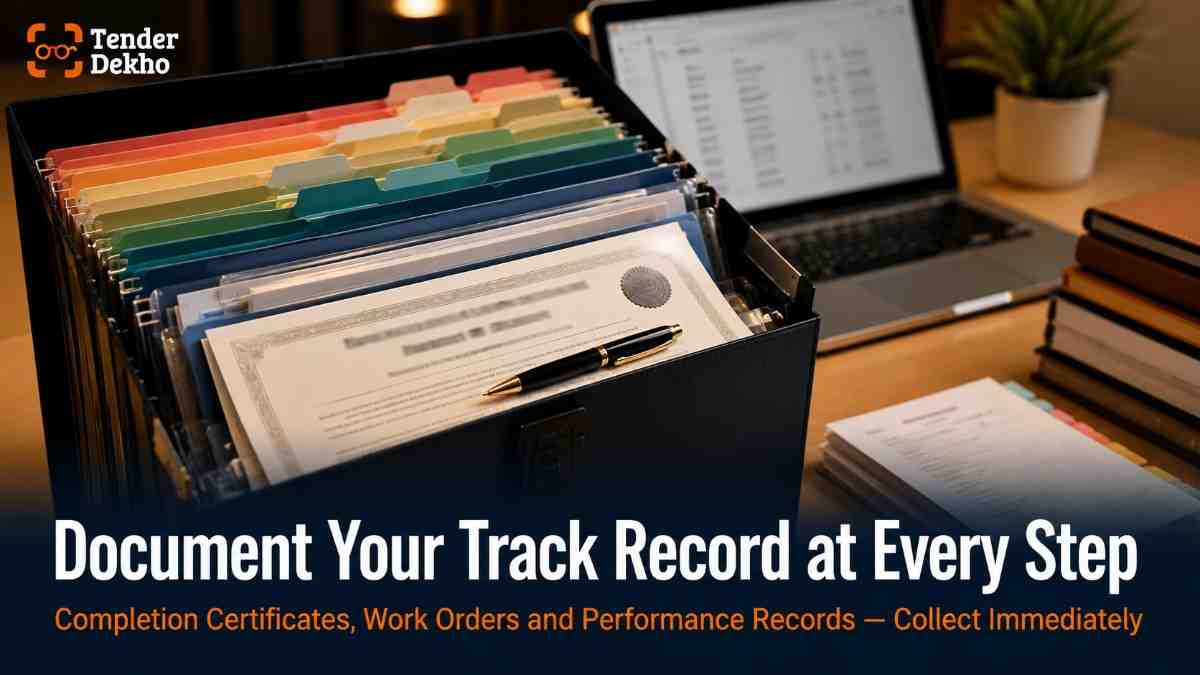
Many businesses execute excellent government work but fail to capitalise on it in future bids because they never collected the right documentation at the right time. This is one of the most common and most avoidable mistakes in tender management.
For every project you complete — whether as a prime contractor, subcontractor, or JV partner — collect these documents immediately upon handover:
- Completion certificate: Issued by the client department or prime contractor, stating the scope, value, and date of completion. For private firms acting as clients, the certificate must be accompanied by TDS Form 26AS to verify the actual work value, as required under many CPPP tender conditions.
- Work order / LOA (Letter of Award): Proof that the contract was awarded to you, including the contract value.
- Performance certificate: Issued after satisfactory completion, confirming delivery quality. Not all departments issue these automatically — you must request them.
- Payment receipts: Bank statements or GST invoices showing funds received from the client.
- Photographs and site records: For civil and infrastructure work, timestamped photographs of ongoing and completed work strengthen your technical bid narrative.
Build a "bid-ready" digital folder that you update after every project. Maintain scanned, self-attested copies of all documents. Consistency in entity name across PAN, GST, and bid documents is critical — even small variations ("Pvt" vs "Private") can trigger technical disqualification.
| Document | When to Collect | Who Issues It | Valid For (Approx.) |
|---|---|---|---|
| Completion certificate | At project handover | Client / prime contractor | Until superseded by newer work |
| Work order / LOA | At contract award | Tendering department | 5–7 years (most tenders) |
| Performance certificate | After client satisfaction confirmed | Client department | 5 years |
| Turnover certificate | After financial year close | Chartered Accountant | 1 financial year |
| Udyam certificate | One-time (renewable) | MSME Ministry portal | Lifetime (auto-renews) |
Source: Standard government NIT conditions; Tenderkart Blog (2025)
Strategy 4: Target the Right Tenders at the Right Stage
The biggest strategic error new bidders make is targeting tenders that are too large for their current credentials. This wastes money on EMD deposits, DSC renewals, and bid preparation time — with zero return.
A better approach is to think in phases:
Phase 1 (Months 1–6): Credential building
- Focus on GeM catalogue orders and bids under ₹10 lakhs
- Target MSME-reserved tenders where experience conditions are relaxed
- Bid in 1–2 specific categories where your business has actual capability
- Accept that early margins may be thin — the goal is completion certificates, not profit maximisation
Phase 2 (Months 7–18): Track record leverage
- Use Phase 1 wins to qualify for tenders in the ₹10 lakh–₹1 crore range
- Submit on CPPP alongside GeM for broader exposure
- Begin attending pre-bid meetings — a visible presence signals seriousness to procurement officers
- Maintain a 3–5 category focus: vendors concentrating on a narrow range achieve 34% higher win rates than those spreading widely, according to GeM vendor data analysis (2025 data)
Phase 3 (Month 18 onwards): Scaling up
- Bid for tenders up to ₹5–10 crores using a documented 2–3 year track record
- Explore JV bids for larger contracts in your sector
- Apply for relevant ISO certifications and quality marks that open further tender categories
- Build relationships with state-level departments where procurement by states grew 38.3% in FY 2025–26, according to GeM CEO (April 2026)
Selective bidding pays off compounding dividends. A rejected bid costs you EMD float time, bid preparation effort, and sometimes a document retrieval fee. A won bid — even at ₹5 lakhs — gives you a completion certificate, a client reference, and a step up the qualification ladder.
Find tenders filtered by value and sector on TenderDekho to identify opportunities matching your Phase 1 or Phase 2 criteria today.
Common Track Record Mistakes to Avoid
Even businesses with genuine delivery capability damage their track record prospects through avoidable errors. Here are the most frequent ones:
- Not collecting completion certificates promptly. Once a project ends and team members move on, getting documentation from the client becomes exponentially harder. Request the certificate the day you submit your final invoice.
- Misrepresenting project values or scope. Under CPPP guidelines (December 2023 update), misrepresentation of turnover, experience, or certifications can lead to bid cancellation at any stage — even post-award — and permanent blacklisting. Never inflate work order values or claim scope you did not personally execute.
- Bidding across too many unrelated categories. A track record in five unrelated sectors carries less weight than a focused record in one or two. Evaluators look for category-specific experience — "similar work" is the key phrase in eligibility criteria.
- Ignoring MSME benefits. Many first-time bidders pay EMD and miss price preference opportunities simply because they did not register under Udyam. The registration is free, takes minutes, and unlocks lifetime benefits worth lakhs per year.
- Submitting bids without a pre-bid checklist. Documentation errors cause 35% of all GeM bid rejections, according to GeM portal vendor feedback data (2025 data). An entity name mismatch between your GST and PAN alone is enough to disqualify an otherwise strong bid.
| Mistake | Consequence | Fix |
|---|---|---|
| Missing completion certificate | Cannot prove similar work | Request immediately at project handover |
| Inflated experience claims | Blacklisting, bid cancellation | Submit only verified, documented figures |
| Spreading across many categories | Low win rate, thin track record | Focus on 3–5 related categories |
| Skipping Udyam registration | Loss of EMD exemption and price preference | Register free at udyamregistration.gov.in |
| Name mismatch in documents | Technical disqualification | Verify entity name consistency across all documents |
| No pre-bid meeting attendance | Missed clarifications, specification misreads | Attend pre-bid sessions for every significant tender |
Source: CPPP Guidelines (2023); GeM portal vendor feedback (2025 data)
FAQs on Building a Tender Track Record
Can I bid for government tenders if my company is brand new with no experience?
Yes, with the right approach. If you are an MSME or a DPIIT-recognised startup, prior experience conditions are relaxed or waived under GFR 2017 for most goods and service categories. Start with GeM catalogue orders and small-value CPPP tenders where experience requirements are minimal.
Competitor Intelligence Dashboard
6-module analysis platform · Paid feature
Know exactly who's beating you — and how to win next time.
Go beyond basic search. Analyse bid history, win rates, and head-to-head performance for any company across 8 years of government tender results.
7L+
Companies
6
Intel Modules
8 Yrs
Bid History
AI
Insights Engine
How do I prove experience if I only have private sector clients?
Private sector experience can be listed, but it carries less weight than government work in most procurement evaluations. If the certificate comes from a private firm, procurement departments may ask for TDS Form 26AS to verify the actual payment. Present private experience alongside turnover certificates signed by a Chartered Accountant.
Is subcontracting experience accepted in government tenders?
It depends on the tender. Some tenders explicitly state that only prime contract experience counts. Others accept subcontractor experience with a valid completion certificate from the prime contractor. Always read the eligibility clause carefully before bidding. Subcontracting remains a valuable route for building real delivery experience even when it cannot be immediately cited in bids.
How many projects do I need before I can bid for ₹1 crore+ tenders?
Most mid-value tenders (₹25 lakhs–₹1 crore) require one similar completed project costing 30–40% of the tender value within the past 3–5 years. This means a single ₹8–10 lakh completed GeM or CPPP contract can make you eligible for ₹25–30 lakh tenders. Building upward from there is a matter of 12–18 months of consistent execution.
What is the fastest way to build a tender track record in India?
GeM seller registration followed by active participation in catalogue orders and MSME-reserved bids is the fastest route. Combine this with Udyam registration to unlock experience relaxations, and request completion certificates from every order you fulfil. Vendors focusing on 3–5 closely related categories achieve 34% higher win rates, per GeM vendor data (2025 data), which also means faster track record accumulation.
Does MSME registration help with experience requirements?
Yes significantly. Under GFR 2017, prior experience conditions may be relaxed for Micro and Small Enterprises, subject to meeting quality and technical specifications. This relaxation is mandatory for central government departments and is increasingly adopted by state governments across India.
Your 30-Day Starter Plan to Build a Track Record
Building a tender track record is a long game, but the first 30 days set the foundation for everything that follows. Use this week-by-week plan to get started:
| Week | Actions | Output |
|---|---|---|
| Week 1 | Register on Udyam (free); obtain Class III DSC; open GeM seller account | Registration documents ready |
| Week 2 | List products/services on GeM with complete specs and pricing; set up CPPP profile | Active seller profile |
| Week 3 | Identify 5–10 active GeM bids in your category; create a bid-ready document folder | First bids submitted |
| Week 4 | Monitor results; request feedback on any rejections; identify 2–3 CPPP tenders to pursue | Lessons documented; pipeline established |
| Month 2–3 | Continue bidding weekly; request completion certificate on every fulfilled order | First completion certificates |
| Month 4–6 | Use early certificates to qualify for mid-value tenders; attend pre-bid meetings | Track record established; escalate bid size |
Remember: consistency beats intensity. Submitting five well-researched bids per month across two focused categories will build your track record faster than submitting thirty bids across ten sectors.
For ongoing discovery of tenders matched to your category, value range, and state, find government tender opportunities updated daily on TenderDekho. The platform aggregates 20,000+ daily tender alerts from GeM, CPPP, and 50+ other portals — so you never miss a winnable opportunity as your track record grows.
For further reading on procurement strategy and compliance, visit the TenderDekho blog and guides hub for sector-specific insights and regular updates on MSME benefits and policy changes.