
Approximately 30% of government tenders in India result in technical bid rejection — meaning nearly one in three bidders never gets their price even considered, no matter how competitive it is, according to industry data (2025). You can have the sharpest pricing in the room and still walk away empty-handed because your technical envelope didn't clear the first gate.
This is the core reality of India's two-bid system. Understanding how technical and financial bids work — and how to excel at both — is the single most important skill you can develop as a government tender participant. Explore 1,37,000+ active government tenders on TenderDekho to find opportunities where your preparation gives you the edge.
What the Two-Bid System Actually Means
The two-bid system, also called the two-envelope system, is the standard bidding format used in government procurement across India for most medium to large contracts. Instead of submitting one combined bid, you submit two separate sealed packets — one containing your technical proposal and one containing your financial quote.
The process follows a strict sequence:
- All bidders submit both envelopes before the deadline
- The technical bids are opened first and evaluated against eligibility and compliance criteria
- Only bidders who qualify technically move forward
- Financial bids are opened exclusively for technically qualified bidders
- The L1 (Lowest Price) bidder among qualified bidders is awarded the contract
This structure exists for a reason. The government wants to confirm that a supplier can actually deliver before engaging in any price discussion. A vendor who cannot meet quality or compliance standards should not win based on price alone.
| Feature | Technical Bid | Financial Bid |
|---|---|---|
| Contents | Eligibility documents, experience, certifications, methodology | Price schedule, BOQ, rate analysis |
| Opened | First, always | Only after technical clearance |
| Evaluation basis | Compliance, qualifications, specifications | Price (L1 wins in most cases) |
| Outcome | Qualified (TQ) or Not Qualified (TNQ) | L1, L2, L3 ranking |
| MSME benefit | Relaxed eligibility in some tenders | 15% price preference over non-MSME L1 |
| Typical timeline | 7–15 working days for evaluation | 3–7 working days post-technical |
Source: GFR 2017, Manual for Procurement of Goods (2024), TenderDekho Research
If your technical bid is rejected, your financial envelope is returned unopened. There is no second chance, no appeal on price grounds. This is why technical compliance must be treated as non-negotiable.
Technical Bid Evaluation: What Government Committees Look For
Your technical bid is not just a document stack. It is a formal argument that your business is eligible, capable, and compliant. Government evaluation committees use the technical bid to filter out unqualified bidders before price enters the picture.
Under GFR 2017 Rule 173, technical specifications form the benchmark against which evaluators assess each bidder's responsiveness. Understanding what evaluators check at each stage helps you prepare a bid that survives every filter.
Core Technical Evaluation Criteria
Most government tenders evaluate the technical bid across four broad areas:
- Eligibility criteria — registration status, Udyam/MSME certificate, company type, blacklisting declarations
- Financial standing — minimum annual turnover (for the past 3 years in most cases), net worth, credit rating if specified
- Past performance — similar work completed, completion certificates, work order copies, experience in the domain
- Technical specifications — product certifications, ISO standards, technical data sheets, compliance with item specifications
| Criterion | What You Submit | Common Rejection Reason |
|---|---|---|
| Registration | Company PAN, GST certificate, incorporation certificate | Missing or expired documents |
| Turnover | CA-certified audited financials (last 3 years) | Turnover falls short of minimum threshold |
| Past experience | Work completion certificates, work orders | Experience in dissimilar domain, insufficient project value |
| Technical compliance | Product datasheets, test reports, certifications | Minor spec deviation (e.g., CRI 70 vs required ≥80) |
| Personnel strength | CVs, qualification certificates for key staff | Missing team documentation |
| Certifications | ISO, BIS, NABL, sector-specific approvals | Expired certificate (even by one day) |
Source: Procurement Audit Manual 2025, NIT Warangal Procurement Manual 2025
Note that in September 2025, the Supreme Court of India reaffirmed that a technical bid cannot be rejected for failure to produce a document not expressly required in the NIT (Notice Inviting Tender). If you are rejected for a document not mentioned in the tender notice, you have grounds to raise a formal objection or seek legal recourse.
The QCBS System: When Quality Gets a Weighted Score
Not all tenders use simple pass/fail technical evaluation. For consultancy, IT, research, audit, and professional service tenders, government departments often use QCBS — Quality and Cost Based Selection — where the technical proposal carries a weighted score.
Under QCBS, your technical bid is scored out of 100 across sub-criteria such as team qualifications, methodology, and past experience. Only bidders who score above a minimum cut-off (typically 70–75 marks) have their financial bids opened. The final selection uses a combined score formula.
According to GFR 2017 Rule 192, QCBS weightage in India commonly follows these patterns:
- 70:30 (Technical:Financial) — most common for consultancy tenders
- 80:20 — used when quality is critical and price is secondary
- 60:40 — used in non-consulting service contracts where cost matters more
For works contracts under QCBS, the maximum weight for non-financial parameters cannot exceed 30%, per Department of Expenditure guidelines (2025 data). This means pricing dominates most works contracts while quality dominates service contracts.
Browse government service and consultancy tenders filtered by category on TenderDekho to identify which evaluation method applies to your target opportunities before you invest time in bid preparation.
How to Build a Winning Technical Bid
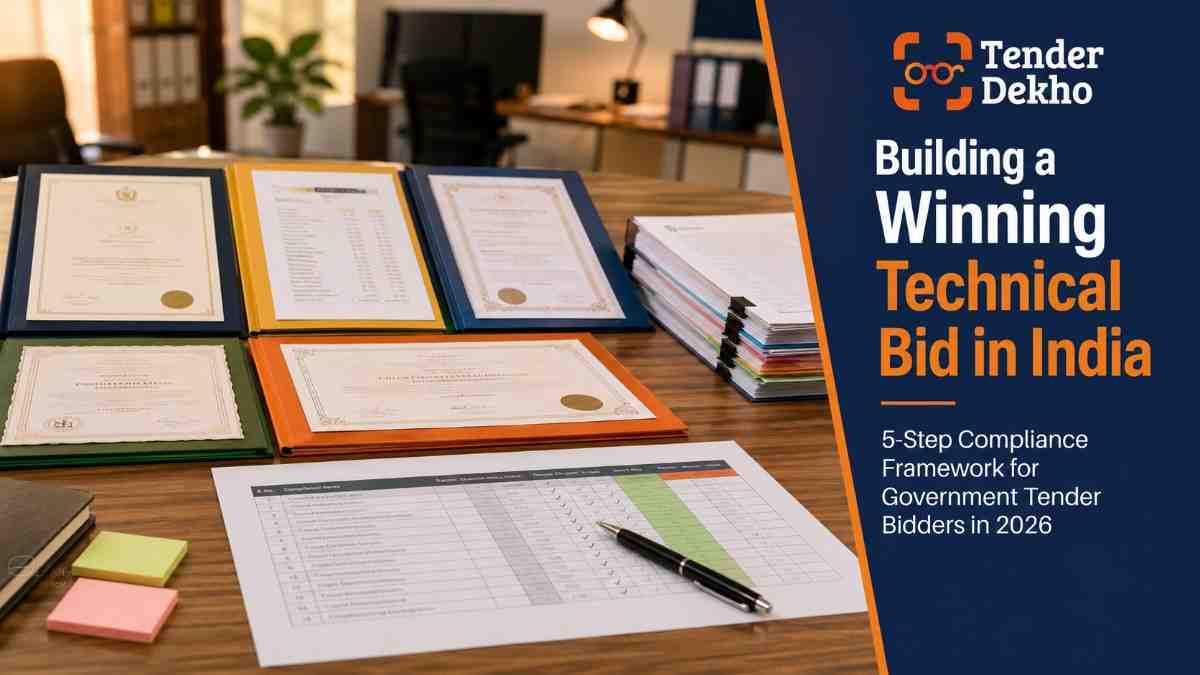
A strong technical bid is systematic, not creative. Your goal is 100% compliance before adding any value-additions. The following approach is used by experienced bidders who consistently pass the technical gate.
Step 1: Download and annotate the tender document
Before preparing a single document, read the complete NIT, RFP, and Schedule of Requirements. Create a compliance matrix — a simple table listing every requirement and the document you will submit against it. Flag gaps early so you have time to address them.
Step 2: Verify eligibility first
Confirm that your company meets every stated criterion before bidding. Check:
- Minimum turnover (do not include turnover from unrelated divisions if the tender restricts it)
- Similar work experience — match the definition of "similar" exactly as stated
- Certificate validity — every certificate must be valid on the bid submission date, not just the bid opening date
- Blacklisting status — ensure no director or partner is debarred
Step 3: Prepare your document package in the correct sequence
Most portals require documents in a specified order. Uploading a certificate in the wrong section can trigger rejection even if the document is valid. Follow the format specified in the bid document exactly.
Step 4: Use the pre-bid meeting
Every significant government tender allows a pre-bid meeting where bidders can seek clarifications. Attend this meeting or submit written queries. Responses issued after the pre-bid meeting form part of the official tender document and can change eligibility conditions or specification requirements.
Get instant tender alerts — completely free
New government tenders are published daily. Get notified instantly for the ones that match you.
Step 5: Run a final checklist before submission
- ✅ All mandatory documents uploaded in correct format (PDF/PDF-A)
- ✅ Digital Signature Certificate (DSC) valid and correctly applied to all documents
- ✅ Company name consistent across all documents (any variation can cause rejection)
- ✅ No price information included in the technical envelope
- ✅ EMD (Earnest Money Deposit) submitted or exemption certificate uploaded
- ✅ All certificates within validity period
- ✅ Bid submitted before closing time and acknowledgement saved
| Document Type | Common Mistakes | How to Fix |
|---|---|---|
| Financial statements | Submitting unaudited figures | Always use CA-certified audited statements |
| Experience certificates | Submitting work orders without completion certificates | Both required in most tenders |
| Product certifications | BIS/ISO expired | Maintain a document tracker with expiry alerts |
| DSC | Token not working on submission day | Test DSC 48 hours before deadline |
| EMD | BG issued by non-scheduled bank | Always use a scheduled commercial bank |
Financial Bid Evaluation: How the L1 Winner Is Decided

Once technically qualified bidders are shortlisted, the financial bid determines who wins. Most government tenders in India use the L1 (Lowest Cost Selection) method — the lowest total bid price from a technically compliant bidder wins the contract. Understanding how financial evaluation works helps you price intelligently.
How L1 Is Calculated
For supply of goods tenders, L1 is typically the lowest quoted price for the full BOQ (Bill of Quantities). For works contracts, it is the lowest total of all line items. For service contracts, it may be the total annual cost or cost per unit of service.
Watch for these nuances:
- Item rate vs lump sum — some tenders require per-item rates which are summed. Pricing one item unrealistically low while inflating another (front-loading or back-loading) is checked by evaluators and can disqualify bids
- Taxes and levies — state clearly whether your price is inclusive or exclusive of GST. Ambiguity in this area leads to post-award disputes
- Validity — your financial bid must remain valid for the period specified (typically 90–180 days). Quote accordingly to absorb potential input cost changes
MSME Price Preference: A Significant Financial Advantage
If your business is registered under Udyam, you have a material advantage in the financial evaluation. According to the Public Procurement Policy for MSEs, MSMEs get a 15% price preference over non-MSME bidders in central government tenders.
This means: if the L1 bidder (non-MSME) quotes ₹10 lakhs, and you quote up to ₹11.5 lakhs as an MSME, you may still receive 25% of the order quantity at the L1 price. In tenders reserved exclusively for MSMEs, your competition is limited to other MSME bidders only.
Additionally, MSMEs are exempt from paying EMD — saving thousands to lakhs of rupees per bid — and the central government mandates that at least 25% of its procurement value comes from MSMEs, according to MSME Ministry guidelines (2025 data).
Find MSME-eligible government tenders updated daily on TenderDekho and filter by reservation category to spot tenders where your Udyam registration gives you a direct edge.
Pricing Strategy: Winning the Financial Bid Without Sacrificing Margin
Winning on price does not mean undercutting recklessly. Experienced bidders in India's procurement ecosystem use several deliberate strategies to secure L1 without eroding profitability.
Strategy 1: Know Your Floor Before You Bid
Before quoting any number, calculate your actual cost of delivery including materials, labour, overheads, delivery logistics, insurance, performance bond costs, and a margin buffer for delays or scope clarifications. Your floor price is the minimum below which you take a loss. Never bid below it.
For service contracts, factor in:
- Manpower costs with PF/ESI/bonus at actual statutory rates
- Equipment hire or deployment costs
- Supervision and compliance overhead
- Working capital interest for the contract period
Strategy 2: Research Market Rates Before Quoting
Most government departments maintain rate schedules for standard items (Schedule of Rates or SOR). For construction materials, CPWD publishes annual SOR data. For IT equipment, GeM's historical transaction data shows what similar items have been procured at. Use this intelligence to benchmark your quote before submission.
| Pricing Mistake | Impact | Correct Approach |
|---|---|---|
| Bidding below floor price | Unviable contract, potential default | Always cost-build before quoting |
| Ignoring GST treatment | Price ambiguity, post-award dispute | Explicitly state GST inclusion/exclusion |
| Front-loading BOQ | Detected by evaluators, may disqualify | Price line items at realistic market rates |
| Not accounting for payment delays | Cash flow crisis mid-contract | Add financing cost buffer to your price |
| Overlooking penalty clauses | LD (Liquidated Damages) of 0.5%–1%/week can eliminate profit | Price penalty risk into your quote |
Source: GFR 2017, Manual for Procurement of Works 2025, TenderDekho Research
Strategy 3: Read the Evaluation Method Before Deciding How to Compete
Not every financial evaluation is pure L1. In QCBS tenders, your financial score is just one component. The formula used by most Indian government QCBS tenders to compute financial score is:
Financial Score = (Lowest Bid / Your Bid) × 100
This means a bidder quoting ₹14.85 lakh scores higher than one quoting ₹28.35 lakh on the financial parameter. But if your technical score is 91 versus a competitor's 83, you can afford to price slightly higher and still win on the combined score — as long as the QCBS weights favour quality.
In pure L1 tenders, aggressive pricing matters most. In QCBS tenders, a strong technical score buys you pricing headroom. Identify the evaluation method in Section 1 of the tender document before deciding your bid strategy.
Competitor Intelligence Dashboard
6-module analysis platform · Paid feature
Know exactly who's beating you — and how to win next time.
Go beyond basic search. Analyse bid history, win rates, and head-to-head performance for any company across 8 years of government tender results.
7L+
Companies
6
Intel Modules
8 Yrs
Bid History
AI
Insights Engine
The MSME Advantage: Winning Both Evaluations
MSMEs in India have a structural advantage in the two-bid system that many businesses underuse. Here is a consolidated view of how registration under Udyam strengthens both your technical and financial bids.
| Benefit | Stage | How to Use It |
|---|---|---|
| EMD exemption | Technical bid | Upload Udyam certificate in lieu of EMD payment |
| Relaxed turnover criteria | Technical bid | Many tenders waive or reduce turnover requirements for MSMEs |
| 15% price preference | Financial bid | You can bid up to 15% higher than non-MSME L1 and still win a portion |
| 25% procurement reservation | Financial bid | Entire tenders reserved exclusively for MSMEs |
| Tender fee exemption | Pre-submission | Most departments do not charge MSMEs document fee |
| ₹200 crore threshold | Eligibility | Tenders below ₹200 crore are closed to foreign bidders, protecting domestic MSMEs |
Source: Public Procurement Policy for MSEs, MSME Ministry (2025 data), Ministry of Finance
To use these benefits, your Udyam registration must be active and the certificate must be uploaded in the correct section of the technical bid. An expired or missing Udyam certificate means you lose every MSME benefit on that bid.
Discover construction, electrical, and services tenders reserved for MSME bidders on TenderDekho — filter by state and category for your sector.
30-Day Bid Readiness Plan
If you are preparing to participate in government tenders for the first time or improving your win rate, follow this structured plan.
| Week | Actions |
|---|---|
| Week 1 | Get Udyam registration if not done (udyamregistration.gov.in — free, 10 minutes). Apply for DSC (Class 3) from a licensed certifying authority. Register on CPPP (eprocure.gov.in) and GeM (gem.gov.in). |
| Week 2 | Build your document library: CA-certified financials (last 3 years), completion certificates for past work, all company registrations and licences. Set expiry alerts for every certificate. |
| Week 3 | Identify 3–5 tenders in your domain using a tender aggregation platform. Read each NIT fully. Build a compliance matrix for one target tender. |
| Week 4 | Prepare and review your technical bid for the target tender. Cost-build your financial bid. Attend the pre-bid meeting. Submit before the deadline and save your acknowledgement. |
Frequently Asked Questions
What happens if I include price information in my technical bid?
Your technical bid will be considered non-compliant and may be disqualified outright. Technical and financial envelopes must be strictly separated — even a rate on a technical datasheet can trigger rejection.
Can I submit the same technical bid for multiple tenders?
Not entirely. Core documents (registration certificates, financial statements) are reusable. But the eligibility compliance matrix, methodology, and team details must be tailored to each tender's specific requirements.
What does TQ and TNQ mean?
TQ means Technically Qualified — your bid passed the technical evaluation. TNQ means Technically Not Qualified. If you receive a TNQ, your financial bid will not be opened. You can request a debriefing from the tendering authority to understand what caused rejection.
As an MSME, can I win a tender even if I am not the L1 bidder?
Yes. If you are an MSME bidding within 15% of the L1 (non-MSME) bidder, you may be offered the right to match the L1 price and receive up to 25% of the order quantity. This is the price preference benefit under the Public Procurement Policy for MSEs.
Is the QCBS method better for small businesses?
In some ways, yes. QCBS allows businesses with strong technical capabilities and experience to win even without the lowest price. This levels the playing field against larger companies that may simply have more pricing power. The key is to invest seriously in your technical proposal quality.
Where can I find tenders that use QCBS evaluation?
Look for tenders in consultancy, IT, auditing, research, training, and professional services categories. These tenders typically mention "QCBS" or "Quality and Cost Based Selection" explicitly in the evaluation section. Search government tenders by sector and evaluation method on TenderDekho to identify suitable opportunities.
Winning both evaluations in a two-bid tender is ultimately a process discipline problem, not a luck problem. The technical bid requires systematic compliance. The financial bid requires cost intelligence. Together, these two skills define your long-term win rate in India's government procurement market. Build both capabilities, leverage your MSME benefits where applicable, and use a structured approach to every bid you submit. Start your government tender search on TenderDekho and find your next opportunity today.