
Top 10 MSME Benefits in Government Tenders India 2026
Over ₹7.44 lakh crore in government orders have been secured by MSME sellers through GeM alone — yet most small business owners in India are still not claiming the full set of procurement advantages available to them. If you run a Micro, Small, or Medium Enterprise (MSME) and you are bidding on government tenders in 2026, you have access to privileges that large corporations simply do not get. The only requirement is a valid Udyam registration.
This article lists all 10 key MSME benefits in government procurement, explains how each one works, and tells you exactly what to do to claim them. You can explore MSME-eligible government tenders on TenderDekho to start applying these advantages right away.
Quick Overview: MSME Benefits at a Glance
| Benefit | What You Get | Legal Basis |
|---|---|---|
| EMD Exemption | No bid security deposit required | GFR 2017, Rule 170 |
| Tender Fee Waiver | Free tender documents | GFR 2017, Rule 161(iv) |
| 25% Procurement Reservation | Mandatory MSME share in all government buying | MSMED Act 2006, Section 11 |
| 15% Price Preference | Win contracts even when not lowest bidder | PPP-MSE Order 2012 |
| Relaxed Eligibility Criteria | No strict prior turnover/experience barriers | GFR 2017, Rule 170 |
| 358 Reserved Items | Exclusive MSME-only procurement categories | MoMSME Notification |
| GeM Priority Listing | MSME badge and buyer filters on GeM | GeM Policy 2026 |
| Delayed Payment Protection | Buyers must pay within 45 days or face interest penalty | MSMED Act 2006, Section 15–16 |
| Women & SC/ST Sub-targets | Additional reserved quota for specific MSME categories | PPP-MSE Amendment 2018 |
| Collateral-Free Credit Access | Government-backed loans to fund working capital | CGTMSE Scheme |
Source: Ministry of MSME, GFR 2017, PPP-MSE Order 2012
Benefit 1: EMD Exemption — Save Lakhs Per Tender Bid
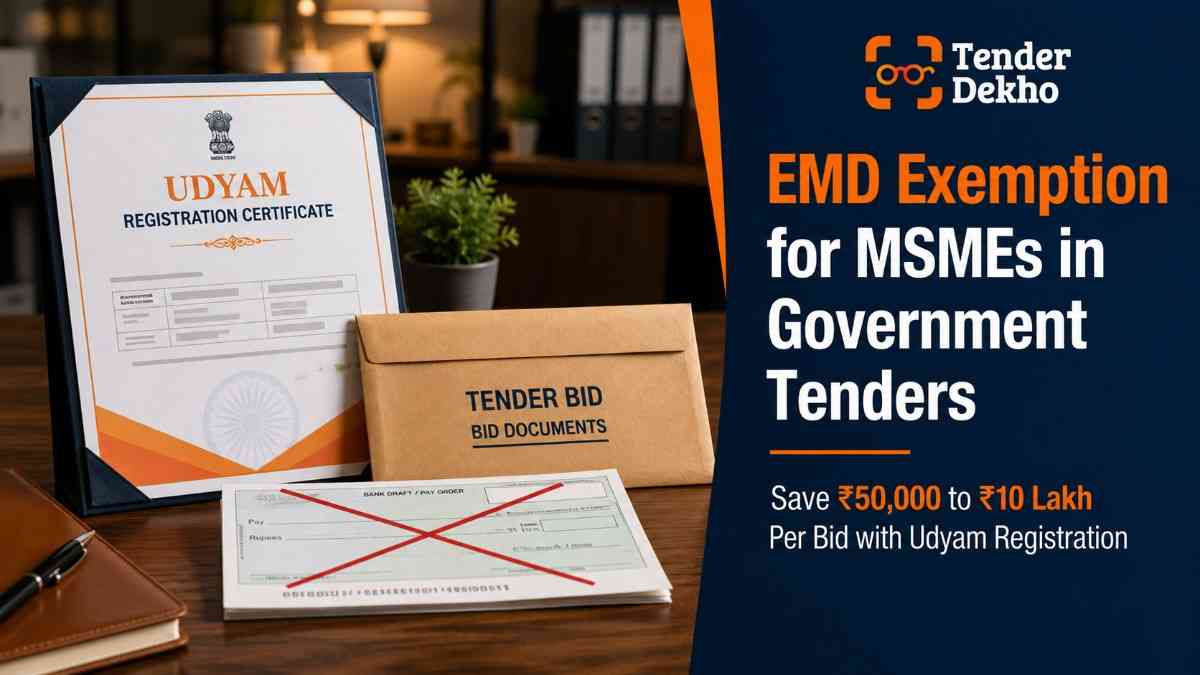
Earnest Money Deposit (EMD) is the refundable security deposit that most bidders must pay when submitting a government tender. EMD typically ranges from 1–5% of the contract value. On a ₹1 crore tender, that means locking up ₹1–5 lakh of working capital per bid — before you even know if you have won.
Registered MSMEs are fully exempt from paying EMD under Rule 170 of the General Financial Rules (GFR) 2017, as reinforced by the Public Procurement Policy under Section 11 of the MSMED Act, 2006. This exemption frees up liquidity and allows you to bid on multiple tenders simultaneously without tying up cash.
To claim this benefit:
- Hold a valid Udyam Registration Certificate
- Upload your Udyam certificate with your bid documents
- In place of EMD, many departments ask for a Bid Security Declaration (a signed undertaking) — read the tender carefully
- Ensure your Udyam category matches the tender's scope (service provider vs. manufacturer)
Important: Exemption is not automatic. You must actively claim it and submit your certificate. Without it, the department will treat your bid like any non-MSME submission.
Benefit 2: Tender Fee Waiver — Free Bid Documents
Along with EMD, registered MSMEs are also exempt from paying tender fees — the charges that departments collect for issuing bid documents and specifications. Under Rule 161(iv) of the General Financial Rules 2017, tender documents are available free of cost to eligible MSMEs.
This might seem small compared to EMD exemption, but tender fees can range from ₹500 to ₹25,000 depending on the contract value. If you are bidding actively across multiple tenders in a month, this saving adds up quickly.
Who gets this:
- Udyam-registered Micro and Small Enterprises
- NSIC (National Small Industries Corporation) registered businesses
- DPIIT-recognised startups (equivalent waiver)
Always check whether the specific tender has invoked these exemptions. The NIT (Notice Inviting Tender) document will indicate whether tender fee is applicable.
Benefit 3: 25% Procurement Reservation — A Guaranteed Share of Government Business
This is the most structurally significant benefit for MSMEs in government tenders. Under the Public Procurement Policy for MSEs Order, 2012 (amended in 2018), all Central Government Ministries, Departments, and Public Sector Undertakings (PSUs) must procure a minimum of 25% of their annual goods and services from registered MSMEs. This is not optional guidance — it is a binding legal mandate, as affirmed by the Supreme Court of India in February 2025.
According to GeM portal data (2025), more than 11.25 lakh MSME sellers on the Government e-Marketplace have secured orders worth over ₹7.44 lakh crore since the platform's launch, with MSME procurement significantly exceeding the mandated 25% target.
How the 25% is split:
| Category | Reserved Quota |
|---|---|
| General MSMEs | 18% |
| Women-owned MSMEs | 3% |
| SC/ST entrepreneur-owned MSMEs | 4% |
| Total | 25% |
Source: PPP-MSE Order 2012, amended 2018 (Ministry of MSME)
If you are a woman entrepreneur or belong to the SC/ST community, you have an additional sub-target working in your favour. You can browse government tender opportunities by sector on TenderDekho to identify which departments are active buyers in your product or service category.
Benefit 4: 15% Price Preference — Win Even When You Are Not the Lowest Bidder
In standard government tendering, the L1 (lowest bid) almost always wins. This disadvantages small businesses that cannot cut prices as aggressively as large suppliers. The 15% Price Preference rule changes that.
As per the PPP-MSE Order (amended 2018), if a non-MSME submits the L1 bid, any MSME whose bid falls within 15% above that L1 price can match the L1 rate and still be awarded at least 25% of the total tendered quantity.
Worked example:
| Bidder | Quoted Price (per unit) | Status |
|---|---|---|
| Large Company (L1) | ₹100 | Non-MSME — lowest bid |
| Your MSME bid | ₹112 | Within L1+15% band |
| Outcome | Match ₹100 and get 25% of order | ✅ Awarded |
Source: Public Procurement Policy for MSEs, Ministry of MSME
This mechanism is especially powerful in splittable tenders — procurements where the quantity can be divided among multiple suppliers. If multiple MSMEs fall within the L1+15% band, the 25% quantity is shared among up to five eligible MSME sellers, according to msme.gov.in.
Benefit 5: Relaxed Prior Experience and Turnover Requirements
Government tenders routinely ask for proof of prior contracts, minimum annual turnover, and years of experience. These criteria often block newer or smaller businesses from even submitting a bid. MSMEs get significant relief on these eligibility conditions.
Under GFR Rule 170 and the Public Procurement Policy, registered Micro and Small Enterprises are entitled to relaxation in prior turnover and experience requirements, as long as they meet the technical specifications of the tender.
What this means in practice:
- A startup-stage MSME with no prior government contract history can still qualify
- Minimum annual turnover barriers can be waived or reduced
- DPIIT-recognised startups get equivalent relaxations even without Udyam registration
This is the benefit that first-time bidders most commonly overlook. Many reject tenders without reading the fine print — and miss the MSME relaxation clause that would have made them eligible. Find active tenders with MSME-friendly eligibility criteria on TenderDekho and check each NIT carefully.
Benefit 6: 358 Items Reserved for Exclusive MSME Procurement
Beyond the 25% overall target, the Ministry of MSME has notified 358 specific product items that are reserved exclusively for procurement from Micro and Small Enterprises. Large companies cannot participate in these tenders at all, regardless of price.
These reserved items span a wide range of categories, including:
- Handloom and textile products
- Basic engineering goods
- Food processing items
- Certain chemical and pharmaceutical products
- Leather goods and accessories
- Printing and stationery items
If your product falls within these 358 items, you are competing only against other MSMEs — not against large corporations with far greater manufacturing capacity and pricing power. Check the official Ministry of MSME list at msme.gov.in to verify if your product category qualifies.
Benefit 7: GeM Priority Listing and MSME Badge
The Government e-Marketplace (GeM) is the primary digital procurement platform for central and state government buyers. As of 2025-26, GeM has crossed a cumulative Gross Merchandise Value (GMV) of ₹18.4 lakh crore, including over ₹5 lakh crore in FY 2025-26 alone, according to CEO GeM Mihir Kumar (April 2026).
For MSMEs, GeM offers several platform-level advantages beyond the policy benefits:
| GeM MSME Feature | What It Does |
|---|---|
| MSME Badge | Visually flags your profile to government buyers |
| Buyer-side MSME filters | Buyers can search and shortlist MSME sellers specifically |
| Reserved categories | Certain product categories listed only for MSME sellers |
| Startup Runway | Early-stage MSMEs can list without prior experience |
| Caution money exemption | Udyam-registered sellers save on GeM registration deposit |
| 30-day payment enforcement | GeM sends automated alerts if buyers delay payment |
Source: GeM Portal Policy, 2026; GeM CEO Statement, April 2026
To access all these advantages, your Udyam registration details must be accurately uploaded and linked to your GeM seller profile. A mismatch between your Udyam details and your GeM profile can result in your MSME benefits being blocked during bid submission.
For professional assistance with GeM seller registration and profile setup, explore GeM registration support services on TenderDekho.
Benefit 8: Delayed Payment Protection — Buyers Must Pay on Time
Cash flow is one of the biggest challenges for small businesses. Long payment cycles from large buyers can cripple your operations even when you have won a government contract and delivered successfully.
The MSMED Act, 2006 addresses this directly. Under Sections 15 and 16:
- Buyers must pay registered MSMEs within 45 days of accepting goods or services
- If no written agreement exists, the deadline drops to 15 days
- If payment is delayed beyond 45 days, the buyer must pay compound interest at three times the RBI's bank rate, calculated monthly
The Ministry of MSME launched the MSME Samadhaan portal (samadhaan.msme.gov.in) so that Micro and Small Enterprises can file delayed payment complaints online. The complaint goes to the relevant Micro and Small Enterprise Facilitation Council (MSEFC), which must resolve the dispute within 90 days.
Additionally, the Finance Act 2023 introduced a tax consequence for buyers who delay payment: from April 2024, any payment to an MSME supplier that is delayed beyond 45 days is disallowed as a tax deduction for the buyer — adding financial pressure on large companies and government entities to pay on time.
Benefit 9: Women and SC/ST Entrepreneur Sub-targets
If your MSME is owned by a woman entrepreneur or belongs to an SC/ST entrepreneur, you have access to additional reserved sub-targets within the 25% procurement quota.
- 3% of annual procurement is reserved for women-owned MSMEs — implemented through GeM's "Womaniya" initiative and other government procurement channels
- 4% of annual procurement is reserved for MSMEs owned by SC/ST entrepreneurs
These sub-targets are mandated for all Central Ministries, Departments, and PSUs. In practice, this means government buyers actively look for women-led and SC/ST-led MSME vendors to fulfil these specific sub-targets.
To claim these benefits:
- Register on the SC-ST Hub (scsthub.in) if you are an SC/ST entrepreneur — it directly connects you to procurement opportunities under the sub-target
- Mark your Udyam registration correctly to reflect ownership category
- On GeM, your seller profile should indicate women/SC/ST ownership so buyers can find you through category-specific filters
View government tender listings across all categories on TenderDekho and use ownership filters to find tenders that specifically invite women-led or SC/ST MSME participation.
Benefit 10: Collateral-Free Credit to Fund Your Bids and Contracts
Winning a government tender is only half the challenge. Executing it requires working capital — raw materials, labour, equipment, logistics. This is where many MSMEs struggle, especially after spending months bidding without income.
The Credit Guarantee Fund Trust for Micro and Small Enterprises (CGTMSE) scheme enables banks and financial institutions to provide collateral-free loans to MSMEs. Following the Union Budget 2025-26, the guarantee cover was raised, allowing collateral-free loans of up to ₹10 crore for eligible MSME borrowers, according to MSME registration benefit advisories (2025 data).
Other relevant credit schemes for MSMEs participating in government tenders:
- MUDRA Loans: Up to ₹10 lakh for micro enterprises under Shishu, Kishore, and Tarun categories
- TReDS Platform: Enables invoice discounting so you can unlock cash from a government buyer's invoice before actual payment is made
- MSME Sambandh: Connects MSMEs to procurement opportunities and facilitates access to working capital tied to government contracts
The combination of these credit facilities with procurement preferences makes government tendering a financially viable path even for MSMEs with limited capital.
Deep Dive: The Three Most Impactful Benefits
EMD Exemption: The Immediate Cash Saver
EMD exemption delivers direct and immediate financial benefit. On a ₹50 lakh contract, a 2% EMD would have required ₹1 lakh upfront per bid. If you are bidding on 10 tenders a month, that is ₹10 lakh tied up — capital that earns nothing while awaiting tender results. With Udyam registration, all of that capital stays in your business. The Ministry of MSME estimates that EMD exemption can save MSMEs anywhere from ₹50,000 to ₹10 lakh per tender, depending on contract value (2025 data).
The 25% Reservation: Your Legal Floor
The 25% procurement reservation is the structural foundation of MSME procurement support. It transforms government buying from an open competition — where the largest supplier almost always wins — into a two-tier system where a guaranteed share is set aside for smaller enterprises. The Supreme Court of India's February 2025 ruling affirming the mandatory nature of this policy means that government departments can no longer treat it as a target that is nice to meet. It is an obligation.
15% Price Preference: The Competitive Safety Net
The 15% price preference is the most misunderstood benefit. Many MSMEs assume that losing to a lower-priced competitor means losing the contract entirely. This benefit says otherwise. If your quote is within 15% of the L1 price, you get a chance to match that price and still receive 25% of the order. Over the course of multiple bids, this mechanism can be the difference between building a track record with government buyers and walking away empty-handed.
How to Act on These Benefits
| Step | Action | Where | Time Required |
|---|---|---|---|
| 1 | Register on Udyam portal | udyamregistration.gov.in | 10–20 minutes |
| 2 | Set up GeM seller account | gem.gov.in | 1–3 days |
| 3 | Link Udyam to GeM profile | GeM portal settings | Same day |
| 4 | Download Udyam certificate | Udyam portal | Immediate |
| 5 | Find relevant tenders | tenderdekho.com/tenders | Daily |
| 6 | Check NIT for MSME clauses | Tender document | Per tender |
| 7 | Upload Udyam certificate with every bid | Tender portal | Per bid |
| 8 | Track payment dates after delivery | Internal records + Samadhaan | Ongoing |
Note: Udyam registration is free of charge at udyamregistration.gov.in
FAQs
Is Udyam registration mandatory to get MSME benefits in government tenders?
Yes. Since the Udyam registration replaced the old Udyog Aadhaar system, all MSME benefits in government procurement — including EMD exemption, price preference, and tender fee waiver — require a valid Udyam registration certificate. NSIC-registered businesses and DPIIT-recognised startups are eligible for equivalent benefits, but Udyam registration is the most direct path for most MSMEs.
Do all government tenders offer MSME benefits?
Not automatically. The Public Procurement Policy applies to Central Government Ministries, Departments, and PSUs. State government tenders follow individual state procurement policies, which vary in how closely they mirror the central policy. GeM tenders typically implement all MSME benefits directly through the platform. For CPPP (Central Public Procurement Portal) tenders, check the NIT document for specific MSME clauses.
Can a medium enterprise claim EMD exemption?
EMD exemption under GFR Rule 170 applies primarily to Micro and Small Enterprises (MSEs). Medium Enterprises may not qualify for EMD exemption in all cases, though they benefit from the overall MSME procurement preference quota. Verify the specific tender document for details.
What is the 15% price preference and how does it work?
If the lowest bid (L1) for a government tender comes from a non-MSME supplier, any MSME bidder whose quote is within 15% above that L1 price can choose to match the L1 price. If you agree to match, you are awarded at least 25% of the total order quantity. Multiple qualifying MSMEs split this 25% among themselves, with up to five sellers eligible for a share.
How do I file a delayed payment complaint?
Visit the MSME Samadhaan portal at samadhaan.msme.gov.in. Log in with your Udyam registration. File a complaint against the buyer, specifying the invoice details, amount due, and days of delay beyond the 45-day limit. The case goes to the relevant state MSEFC for adjudication within 90 days.
Where can I find tenders that have MSME exemptions clearly listed?
TenderDekho aggregates government tenders from GeM, CPPP, and 50+ other portals, with daily updates. Search MSME-eligible government tenders on TenderDekho and filter by category, location, and value to find opportunities suited to your business size.
Conclusion: Your MSME Registration Is Already an Advantage

Government procurement in India is not a level playing field — it is deliberately tilted in favour of registered MSMEs. From EMD exemption that saves lakhs per bid, to the 25% mandatory reservation that guarantees a share of government business, to payment protection that forces buyers to clear dues within 45 days, the policy framework is designed to help small businesses compete and grow.
The businesses that succeed in government tendering are not always the largest or lowest-priced. They are the ones who understand the rules and claim every benefit they are entitled to.
30-Day Action Plan to Start Claiming Your Benefits:
| Week | Action |
|---|---|
| Week 1 | Complete Udyam registration at udyamregistration.gov.in (free, 20 minutes) |
| Week 1 | Set up or update your GeM seller account and link Udyam details |
| Week 2 | Identify 5–10 relevant tenders using TenderDekho alerts in your category |
| Week 2 | Read the NIT of each tender and confirm MSME clauses |
| Week 3 | Submit your first bid with Udyam certificate and (if applicable) Bid Security Declaration |
| Week 4 | Set up a payment tracking system to monitor 45-day payment windows post-delivery |
| Week 4 | Bookmark samadhaan.msme.gov.in for delayed payment complaints if needed |
Your Udyam registration is free, takes under 20 minutes, and unlocks all 10 benefits in this article. If you have not registered yet, that is the only step standing between you and a guaranteed share of India's government procurement market. Start your government tender search — find MSME tenders updated daily on TenderDekho and put your registration to work today.
For further reading on government tender strategy, procurement policy updates, and sector-specific opportunities, visit the TenderDekho blog.