
Solar Energy Tenders in India 2026: Complete Market Guide

India added a record 44 GW of solar capacity in FY 2025–26 alone — more than many countries have installed in total — and the government's procurement machine is running faster than ever. For EPC contractors, equipment suppliers, rooftop installers, and solar developers, this translates into one of the largest and most sustained government tender pipelines in the world. Government agencies issued nearly 6 GW of solar tenders in Q1 2026, almost double the capacity tendered in Q4 2025, according to Mercom India (2026 data). If you are looking to win solar energy tenders in India 2026, the opportunity is real — but so is the competition.
This guide covers the full market: scale, key buyers, types of tenders, eligibility rules, state-wise hotspots, and a practical action plan for new and experienced bidders. Browse active solar energy tenders on TenderDekho to see live procurement opportunities across India.
The Current Market Snapshot: India's Solar Procurement Scale in 2026
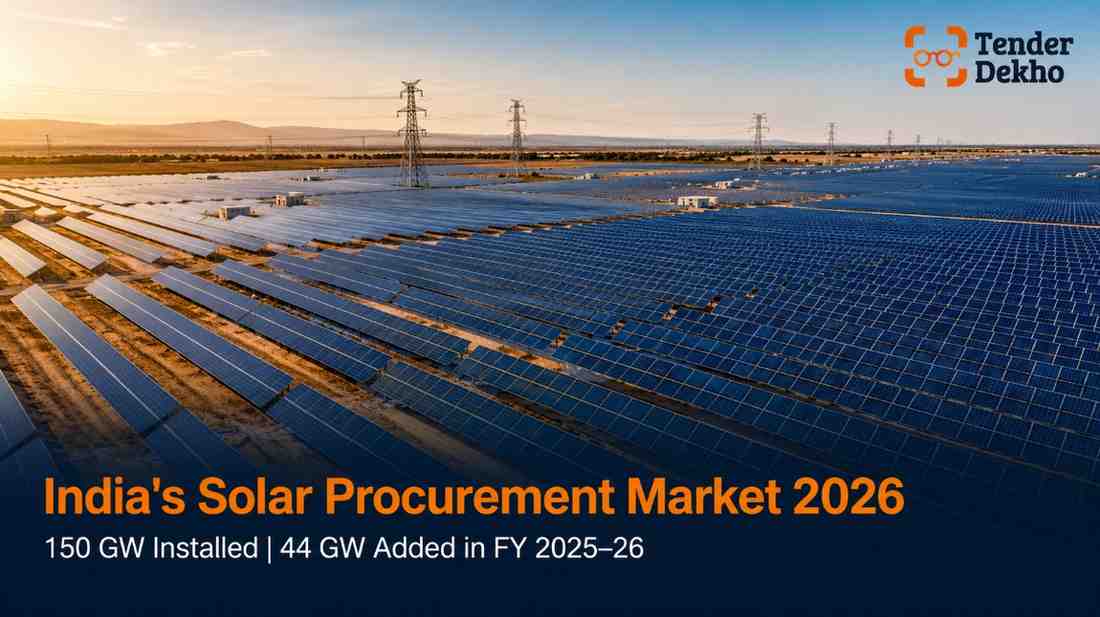
India's solar installed capacity crossed 150 GW as of March 2026, making it the world's third-largest solar market, according to the Ministry of New and Renewable Energy (MNRE, 2026). India's total non-fossil fuel power capacity reached 283.46 GW as of 31 March 2026, crossing 51.93% of the country's total electricity mix — five years ahead of India's Paris Agreement NDC target, per PIB (April 2026).
The numbers matter for tender buyers because the government must add approximately 250 GW more to reach its 500 GW non-fossil target by 2030. Solar is the dominant delivery vehicle, expected to contribute around 280 GW of that target according to IBEF (2026 data). That means procurement will not slow down — it will accelerate every year through 2030.
| Market Indicator | Figure | Source |
|---|---|---|
| Solar installed capacity (March 2026) | 150 GW | MNRE, PIB (April 2026) |
| Solar capacity added in FY 2025–26 | 44 GW (record) | JMK Research (April 2026) |
| Solar tenders issued in Q1 2026 | ~6 GW | Mercom India (2026 data) |
| MNRE Budget allocation 2026–27 | ₹44,614.67 crore | IBEF (2026 data) |
| PM Surya Ghar CFA disbursed (March 2026) | ₹17,967.53 crore | MNRE / SolarQuarter (2026 data) |
| India's 2030 solar target | ~280 GW | IBEF (2026 data) |
Source: PIB, IBEF, Mercom India, JMK Research (2026 data)
The MNRE budget allocation for 2026–27 stands at ₹44,614.67 crore — a 40.52% jump over the 2025–26 estimates, according to IBEF (2026 data). That increase directly funds more procurement, more auctions, and more tender issuances across the country.
Key Growth Drivers Behind India's Solar Tender Boom
Understanding why solar tenders are accelerating helps you position your business for the long term. These are the four forces driving procurement volume in 2026.
1. The 500 GW National Mission
India's commitment at COP26 — 500 GW of non-fossil fuel capacity by 2030 — is not just a policy statement. It is a legally binding NDC target backed by ministry budgets, PSU mandates, and state-level procurement plans. SECI (Solar Energy Corporation of India) and NTPC Renewable Energy Limited (NTPC REL) issue large-scale tenders directly from this mission. Every year without sufficient additions creates a larger catch-up requirement, which drives even more procurement in the following cycle.
2. PM Surya Ghar Rooftop Programme
The PM Surya Ghar Muft Bijli Yojana, launched in February 2024, targets one crore rooftop solar installations in residential households by FY 2026–27, with a total outlay of ₹75,021 crore. As of March 2026, 26.19 lakh installations have been completed and ₹17,967.53 crore disbursed as Central Financial Assistance (CFA), according to MNRE (2026 data). This scheme generates a continuous stream of small-to-mid-scale rooftop tenders and vendor empanelment opportunities, particularly suited to MSMEs.
3. Railway and Central Government Solarisation
Ministry of Railways continues its ambitious solarisation push. Southern Railway recently tendered three solar projects totalling 29 MW in Tamil Nadu, per Mercom India (2026 data). CPWD (Central Public Works Department) and government institutions regularly issue 50 kWp to 5 MWp rooftop tenders for schools, hospitals, offices, and railway stations. These tenders have lower turnover thresholds and are more accessible for new entrants.
4. ALMM and Domestic Manufacturing Push
Starting June 1, 2026, ALMM List-II compliance became mandatory for all government-backed solar projects. This means solar modules and cells used in government tenders must come from manufacturers listed on MNRE's Approved List of Models and Manufacturers. India's indigenous solar module manufacturing capacity under ALMM reached around 144 GW per annum as of 2025, with 81 GW added in calendar year 2025 alone — a 99% year-on-year increase, according to PIB (2025 data). Bidders must verify ALMM compliance before preparing any government tender submission.
| Growth Driver | Key Policy / Scheme | Tender Opportunity |
|---|---|---|
| 500 GW national mission | COP26 NDC commitment | SECI, NTPC REL utility-scale auctions |
| PM Surya Ghar | ₹75,021 crore outlay | Rooftop empanelment & small EPC tenders |
| Railway solarisation | Ministry of Railways plan | 5–500 MW station & railway land tenders |
| ALMM List-II mandate | MNRE circular, June 2026 | Module supply, EPC packages |
| PM KUSUM | Agricultural pump solar | State-level pump solarisation tenders |
Source: MNRE, PIB, Mercom India (2025–26 data)
Types of Solar Tenders Issued in India
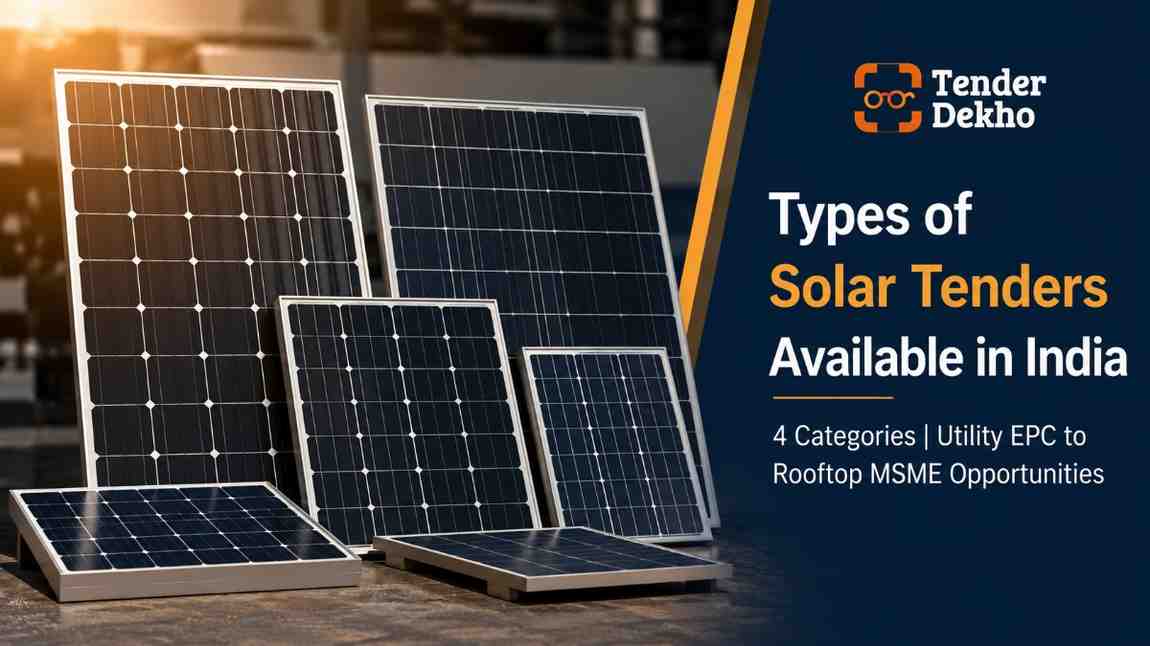
Solar government procurement is not one market — it is four distinct tender types with different buyers, sizes, and eligibility criteria. Knowing which type fits your capacity is the first decision you must make.
Utility-Scale Ground-Mounted EPC Tenders
These are the large tenders — 50 MW to 1,000 MW and above — issued by SECI, NTPC REL, SJVN, state DISCOMs, and NLC India. They involve engineering, procurement, and construction of ground-mounted solar PV power plants. Typical financial eligibility requires an average annual turnover of ₹1.5–2 crore per MW of bid capacity and a positive net worth, with demonstrated EPC experience of similar project size. The ALMM List-II compliance requirement applies to all modules and cells.
Recent examples include:
- NTPC REL invited bids for a 300 MW solar EPC project near Nokhra, Rajasthan (June 2026), per PV Magazine India
- SECI concluded a 2,000 MW solar + 1,000 MW/4,000 MWh energy storage auction at ₹2.86 per kWh (October 2025), per SolarQuarter
- SJVN Green Energy floated a 500 MW EPC tender in Rajasthan with EMD of ₹53 crore for full capacity bidders (August 2025)
Balance-of-System (BoS) and Module Supply Tenders
Many large project developers — particularly PSUs like NTPC REL — separate their procurement into BoS packages (civil, structural, electrical works) and module supply contracts. These are more accessible for specialist contractors. NTPC REL issued a 2,100 MW BoS tender for Andhra Pradesh projects in 2026 — one of the largest solar procurement packages issued by any CPSE this year, per TenderDekho blog (2026 data). NTPC REL also issued 1.2 GW module supply tenders for the Khavda Renewable Energy Park in Gujarat.
Rooftop Solar Tenders (Government Buildings)
RAIL, REIL, CPWD, state PWDs, educational institutions, hospitals, and defence establishments issue tenders for rooftop solar PV systems on government buildings. Capacity typically ranges from 50 kWp to 5 MWp. Eligibility criteria are significantly lower than utility-scale tenders. REIL (Rajasthan Electronics & Instruments Limited) recently floated a 17.5 MWp tender across eight regions covering government buildings in multiple states, per SolarQuarter (January 2026). MSME/NSIC-registered bidders frequently qualify for EMD exemption in these tenders.
Solar Pump and PM KUSUM Tenders
PM KUSUM (Pradhan Mantri Kisan Urja Suraksha evam Utthan Mahabhiyan) generates a large volume of state-level solar pump tenders for agricultural use. These are issued by state nodal agencies and DISCOMs and are well-suited to MSMEs with installation experience. They typically require MNRE empanelment and compliance with state-level technical specifications.
| Tender Type | Typical Size | Key Buyers | Entry Level |
|---|---|---|---|
| Utility-scale EPC | 50 MW – 1,000 MW+ | SECI, NTPC REL, SJVN, DISCOMs | Large EPC firms |
| BoS / Module Supply | 100 MW – 2,100 MW | NTPC REL, NGEL, PSUs | Specialist contractors |
| Rooftop (Govt buildings) | 50 kWp – 5 MWp | REIL, CPWD, Railways, schools | MSMEs, small EPC |
| Solar pumps (KUSUM) | 3 HP – 10 HP per pump | State nodal agencies, DISCOMs | MSME installers |
Source: MNRE, Mercom India, PIB (2025–26 data)
Who Benefits and How: MSMEs vs Large Players
Solar tenders span every business size. Your entry point depends on your turnover, past project experience, and current ALMM/MNRE compliance status.
For Large EPC Contractors and Developers
Utility-scale tenders from SECI and NTPC REL are your primary market. These require significant financial thresholds — ₹1.5–2 crore per MW in average annual turnover — and a track record of completed EPC projects of comparable size. The ALMM List-II mandate effective June 2026 means your module procurement chain must be fully verified before bid submission. Pre-bid meetings are generally mandatory; failure to attend disqualifies your bid in many tenders. Build relationships with ALMM-listed cell and module manufacturers early to avoid supply chain delays.
For MSMEs and Small Solar Installers
The rooftop and KUSUM segments are your natural entry points. The PM Surya Ghar scheme had 24,511 vendors registered on its national portal as of February 2026, with most belonging to the private sector and primarily in the MSME category, according to KNN India / MNRE (February 2026). This positions MSMEs as the backbone of India's rooftop solar rollout. Find rooftop solar tenders suited to MSME installers and filter by project size to identify the right fit.
Key MSME advantages in solar tenders:
- EMD exemption for MSME/NSIC-registered bidders in many rooftop and state-level tenders (verify per tender document)
- Lower turnover thresholds in CPWD, Railway, and state PWD rooftop tenders
- PM Surya Ghar empanelment creates a steady flow of installation work without competitive bidding in some cases
- MNRE empanelment for PM KUSUM unlocks state pump solarisation tenders nationwide
| Business Size | Best Tender Type | Key Eligibility Requirement | Entry Route |
|---|---|---|---|
| Large EPC firm | Utility-scale SECI / NTPC REL | ₹1.5–2 Cr/MW turnover, EPC track record | Direct bid |
| Mid-size contractor | BoS, 10–50 MW rooftop | ₹50–100 Cr turnover, MWp experience | Direct bid or JV |
| MSME installer | Rooftop (Govt), PM KUSUM | Udyam registration, ALMM compliance | Empanelment + tender |
| Equipment supplier | Module/inverter supply contracts | ALMM listing (modules), MNRE approval | Supply sub-contract |
Source: MNRE, KNN India, Energetica India (2025–26 data)
State-Wise Solar Tender Activity: Where Is the Action?
Solar tender volume is highly concentrated geographically. Knowing which states are most active helps you focus your registration, travel, and BD resources effectively.
Rajasthan and Gujarat — Utility-Scale Leaders
Rajasthan dominates India's utility-scale solar procurement. The Bhadla Solar Park (2.7 GW) and Pugal Solar Park continue to generate EPC and BoS tenders. In January 2026, Rajasthan launched a tender for the country's largest Solar + BESS project at Pugal, per Energy-Storage.News (2026 data). Explore Rajasthan solar and government tenders to track utility-scale auction activity.
Gujarat's Khavda Renewable Energy Park is on track to become the world's largest RE park. NTPC REL issued 1.2 GW module supply tenders for the Khavda project in 2026. Gujarat also leads residential rooftop solar under PM Surya Ghar with 1,491 MW of residential rooftop solar capacity installed — the highest of any state — according to JMK Research (2025 data).
Tamil Nadu and Andhra Pradesh — DISCOM-Led Procurement
Tamil Nadu led India's solar-plus-storage tendering scene in 2025, driven by TANGEDCO auctions and an active Southern Railway solarisation programme, per Energy-Storage.News (2026 data). Southern Railway alone tendered 29 MW across three Tamil Nadu projects. Andhra Pradesh is the focus of NTPC REL's 2,100 MW BoS tender — one of the largest solar procurement packages from any CPSE in 2026. View Tamil Nadu tender opportunities for active TANGEDCO and Railway listings.
Emerging States — Uttar Pradesh, Odisha, Maharashtra
Uttar Pradesh is emerging as a major solar procurement state under UPPCL (Uttar Pradesh Power Corporation Ltd) auctions and NTPC REL's northern RE park developments. Maharashtra features strong C&I (commercial & industrial) rooftop solar and state government building tenders. Odisha's captive solar procurement by state PSUs — such as the Jharsuguda thermal plant conversion to solar — signals a growing pipeline outside the traditional western belt.
| State | Dominant Tender Type | Key Buyer | Active Link |
|---|---|---|---|
| Rajasthan | Utility-scale EPC, BESS | NTPC REL, SJVN, state auctions | Rajasthan tenders |
| Gujarat | Module supply, rooftop, utility | NTPC REL, GUVNL | Gujarat tenders |
| Tamil Nadu | DISCOM auctions, Railway rooftop | TANGEDCO, Southern Railway | Tamil Nadu tenders |
| Andhra Pradesh | BoS packages, utility | NTPC REL, APEPDCL | Andhra Pradesh tenders |
| Uttar Pradesh | UPPCL auctions, KUSUM | UPPCL, state nodal agency | — |
| Maharashtra | Rooftop, C&I, KUSUM pumps | MSEDCL, CPWD | — |
Source: Mercom India, Energy-Storage.News, TenderDekho (2026 data)
How to Position Yourself for Solar Tenders in 2026
The market is large, but competition has intensified. These are the steps that separate consistently winning bidders from those who apply but rarely qualify.
Step 1: Get your registrations in order. At minimum, you need registration on CPPP (eprocure.gov.in), SECI's portal (seci.co.in), NTPC eProcure, and your relevant state e-procurement portal. For rooftop work, get MNRE empanelment and PM Surya Ghar national portal registration. For KUSUM, register with the state nodal agency.
Step 2: Ensure ALMM compliance. Since June 1, 2026, ALMM List-II compliance (covering solar cells, not just modules) is mandatory for all government tenders. Verify that your module supplier is on the current ALMM list before any bid submission. Download the latest ALMM list from mnre.gov.in before each bid.
Step 3: Build your MWp track record strategically. Start with Railway, CPWD, or state PWD rooftop tenders if you are new to solar. These smaller tenders (50 kWp–1 MWp) have lower thresholds and build the MWp experience certificates required for larger bids. A 3–5 MWp track record opens access to mid-scale SECI rooftop tenders.
Step 4: Prepare a standard document pack. Maintain ready-to-upload templates for experience certificates, ALMM compliance declarations, ISO certificates, and BOQ formats. Solar tenders frequently have a 10–15 day submission window; delays in document preparation cause missed opportunities.
Step 5: Monitor corrigendums actively. Solar tenders regularly receive corrigendums — amendments to eligibility criteria, capacity, module specifications, or deadlines — right after the pre-bid meeting or near the submission deadline. Missing a corrigendum can result in a rejected bid even with an otherwise qualifying submission.
For a live view of active procurement across all types and states, explore solar tenders updated daily on TenderDekho and set alerts to never miss a matching opportunity.
30-Day Action Plan for Solar Tender Bidders
| Week | Action | Portal / Resource |
|---|---|---|
| Week 1 | Register on CPPP, SECI portal, state e-proc portals | eprocure.gov.in, seci.co.in |
| Week 1 | Check & update ALMM List-II compliance | mnre.gov.in |
| Week 2 | Identify 3–5 target tenders matching your size | TenderDekho solar category |
| Week 2 | Attend pre-bid meetings for chosen tenders | Respective portals |
| Week 3 | Compile document pack (experience certs, BOQ, EMD) | Company records |
| Week 3 | Apply for Udyam / PM Surya Ghar empanelment if MSME | pmsuryaghar.gov.in |
| Week 4 | Submit bids; set corrigendum alerts for live tenders | CPPP / state portals |
| Week 4 | Review results; update eligibility for next cycle | — |
Frequently Asked Questions
What types of solar energy tenders are available in India in 2026?
India's government solar procurement covers four main types:
- Utility-scale ground-mounted EPC tenders (50 MW–1 GW+), issued by SECI, NTPC REL, and state DISCOMs
- Balance-of-System (BoS) and module supply contracts for large parks
- Rooftop solar tenders on government buildings (50 kWp–5 MWp), issued by REIL, CPWD, Railways, and state PWDs
- Solar pump tenders under PM KUSUM, issued by state nodal agencies
Can MSMEs participate in solar energy tenders in India?
Yes — and MSMEs are the dominant category in rooftop and KUSUM solar procurement. Under PM Surya Ghar, 24,511 vendors registered on the national portal are primarily from the MSME sector. Key advantages include EMD exemption for MSME/NSIC-registered firms in many state-level tenders, lower turnover thresholds in CPWD and Railway rooftop tenders, and PM Surya Ghar empanelment that provides a steady pipeline of installation work.
What is ALMM compliance and why does it matter for solar tenders?
ALMM stands for Approved List of Models and Manufacturers. MNRE maintains two lists: List-I covers solar modules, List-II covers solar cells. Since June 1, 2026, all government-backed solar tenders require modules to use cells from ALMM List-II-approved manufacturers — meaning domestically manufactured cells. Bidders must declare ALMM compliance in their technical submission. Using non-compliant modules disqualifies the bid.
Which states have the most active solar tender pipelines in 2026?
Rajasthan and Gujarat dominate utility-scale solar procurement, led by NTPC REL and SJVN projects at Bhadla, Pugal, and Khavda parks. Tamil Nadu and Andhra Pradesh are active for DISCOM auctions and BoS packages. Uttar Pradesh, Maharashtra, and Odisha are emerging markets with growing procurement under state PSUs and UPPCL.
What is the typical EMD amount for a solar tender in India?
EMD amounts vary significantly by scale: ₹66,000–₹2 lakh for small rooftop tenders (up to 100 kWp); ₹26.5–₹53 crore for 250–500 MW utility-scale EPC tenders such as the SJVN 500 MW Rajasthan project. MSME/NSIC-registered firms can claim EMD exemption in many state and CPWD tenders — verify eligibility in the specific tender document.
Where can I find all active solar energy tenders in one place?
Solar tenders are published across CPPP, SECI, NTPC eProcure, state DISCOM portals, GeM, and state e-procurement platforms. To track all of them without manually checking each portal, view all active solar tenders listed on TenderDekho, which aggregates opportunities across central and state procurement authorities.
Conclusion: The Solar Tender Window Is Open Now

With 150 GW installed, a 500 GW national target, and the largest renewable energy budget in MNRE's history, India's solar procurement market in 2026 is not just large — it is structurally committed to sustained growth. Every year through 2030, the government must add 30–40 GW of new capacity, and the bulk of it will be procured through competitive tenders.
For large EPC contractors, the utility-scale pipeline from SECI and NTPC REL is at peak volume. For MSMEs and small installers, PM Surya Ghar, Railway rooftop, and KUSUM schemes provide accessible entry points with real financial backing. The single biggest risk for any bidder is not competition — it is poor documentation, expired registrations, or missed ALMM compliance checks.
Get your registrations ready, ensure ALMM List-II compliance, and start with tenders that match your current capacity. To explore live procurement opportunities right now, browse solar energy tenders across India on TenderDekho and filter by state, size, or authority. For a broader view of government procurement across all sectors, explore all active tenders on TenderDekho. For further reading on solar and renewable energy procurement guides, visit the TenderDekho blog.